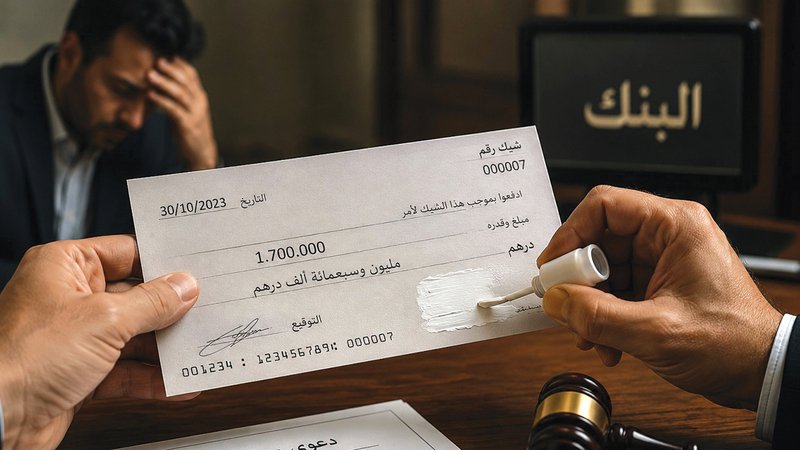
The Civil Court of First Instance in Dubai ruled to oblige a person of Arab nationality to return an amount of 1.7 million dirhams to another, after it was proven that he intentionally wrote a check for the amount to the creditor using fictitious liquid ink that “changes the data after a period,” in a trick that prevented it from being paid by the bank. The court also obliged him to pay compensation in the amount of 30 thousand dirhams for the material and moral damages suffered by the rightful owner, after he was convicted by the Penal Court and punished with one year in prison. And with a fine.
In detail, the incident began when the victim handed the accused an amount of 1.7 million dirhams, and in return he received a security check, which was supposed to be a tool for fulfilling financial obligations, but it turned into the focus of a judicial dispute that extended between the corridors of the criminal and civil courts for years, when the victim in the incident discovered that he had been deceived in an unconventional way.
The victim stated in his statements in the criminal case that he did not doubt for a moment about the nature of the check when he received it, as he carried all the necessary data to cash it when the due date arrived.
He pointed out that the surprise appeared when he went to the bank to cash the check on the specified date, only to be shocked that the bank refused to cash it due to tampering that occurred during its writing, using what is known as a “fake liquid” that causes a change in the data of the check, which made it lose its validity as a fulfillment instrument.
The plaintiff did not treat this incident as a mere financial dispute, but rather resorted to the competent authorities and filed a criminal complaint in which he accused the check writer of intentionally using a fraudulent means to prevent its value from being paid.
During the investigations and criminal trial, the incident was subject to examination and scrutiny, and the criminal court reached a decisive conclusion that the accused deliberately wrote the check using the fictitious variable correction fluid, with the aim of preventing its disbursement when it was presented to the bank.
The first instance criminal court punished the accused with imprisonment for one year, but he was not satisfied with the initial ruling and appealed it before the Court of Appeal, which rejected the appeal and ruled to uphold the ruling, which became final after not appealing it before the Court of Cassation.
After obtaining a final ruling by the criminal courts, the victim resorted to the civil court to regain his rights after a long period of prosecution, demanding that the defendant be obligated to pay the value of the check, 1.7 million dirhams, in addition to 200 thousand dirhams in compensation for the material and moral damages he suffered as a result of the incident.
After examining the case papers, the civil court stated in its merits that the final criminal rulings are authoritative before the civil judiciary with regard to the occurrence of the crime, its legal description and attribution to its perpetrator, and that it is not permissible to re-discuss what the criminal judiciary has finally decided.
She pointed out that the criminal ruling conclusively proved that the defendant intentionally issued a check using a fictitious, variable liquid in order to prevent it from being cashed, which is the same act that the plaintiff relied on to claim his financial rights.
She added that what is confirmed from the papers is that the plaintiff was deprived of a huge amount that remained pending for years due to this behavior, and was forced to take a long path of legal procedures to recover his rights, starting with the criminal report, investigations, and trials, all the way to filing a civil lawsuit. The court found that the defendant enriched himself at the expense of others without legitimate justification, and that his debt was still occupied with the full value of the check amounting to one million and 700 thousand dirhams, which necessitated obliging him to return the full amount with legal interest at the rate of 5% annually, starting from the check’s maturity date until full payment.
The court also stopped at the damage caused to the plaintiff as a result of the delay in obtaining his money, and the financial and psychological burdens he endured during the litigation journey, stressing that his having to move between the criminal and civil courts and pursue his rights for years represents material and moral damage that requires reparation and compensation.
It ended up awarding him a total compensation of 30 thousand dirhams, in addition to legal interest, fees, expenses, and attorney’s fees.
• The surprise arose when the victim went to the bank to cash the check on the specified date, but the bank refused to cash it due to tampering that occurred while writing it.