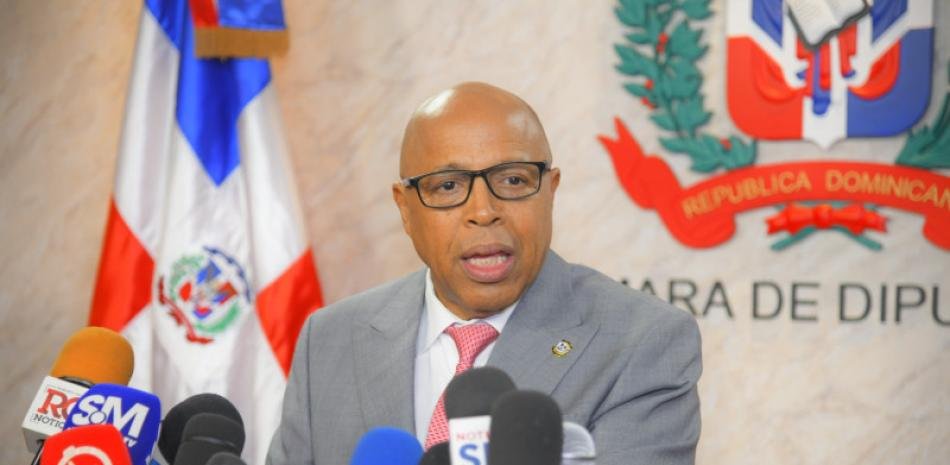
The president of the Chamber of Deputies, Alfredo Pacheco, highlighted how political maturity has allowed progress in reforms that directly impact citizen life.
Pacheco described the Chamber of Deputies as a “quite complex” space, where 190 legislators and around 10 political forces converge, which requires a constant capacity for articulation and listening.
The president of the Lower House highlighted that the Dominican Republic has moved towards a model of Social and Democratic State of Law. It is not easy to be the president of a body where all political forces come together.
The legislator spoke in these terms, when participating in the panel on Structural Reforms and Legislative Power, which was moderated by the executive vice president of the Institutionality and Justice Foundation (FINJUS), Servio Tulio Castaño Guzmán, within the framework of the Judiciary 2026 conference.
He stated that to build consensus you must have the maturity to understand that the national interest comes first when producing a reform.
When asked about how he has managed to articulate the most complex reforms of recent years, Pacheco identified three fundamental pillars, such as the strengthening of the Commissions, openness to society and expert advice.
He highlighted the technical work within the permanent commissions since in his opinion it has been the driving force of the projects, pointing out that the promotion of public hearings and consultations allow citizens and organized sectors to influence the laws.
Pacheco recognized the work of prominent judges and jurists who, in their capacity as experts, have guided legislators to understand the technical depth of the reforms.
A curious aspect highlighted by Pacheco is the territorial vision, explaining that, sometimes, regional interests (such as those of legislators from the South or East) manage to unify deputies from different parties above party lines to benefit their communities.
For the legislator, the country’s rise in terms of modernization of justice is undeniable. “I congratulate the National Congress because we have achieved reforms that not only improve the Judiciary, but also benefit all actors and sectors of Dominican society,” he emphasized.
He highlighted the close relationship of technical assistance and collaboration that the National Congress has maintained with the Judiciary in recent years, which has allowed a qualitative leap in the modernization of the Dominican justice system.
Pacheco said that fundamental laws such as Cassation (2-23) have been decisive in reducing judicial delays, an advance that he described as a “high leap” in the efficiency of the system.
A package of reforms for citizen agility
During his speech, he listed several key pieces approved in 2024 that, in his words, society has not yet finished “assessing” their proper dimension, such as the Law on Real Estate Rentals and Evictions: Defined as a “model law” and agile, which had the direct support of the Supreme Court of Justice for its preparation.
Likewise, Law 167-21 on Simplification of Procedures, focused on reducing the bureaucracy that has historically affected the administration of justice, the Contentious-Administrative Jurisdiction law, which introduces figures such as the State Attorney General to represent public interests before justice.
Pacheco placed special emphasis on the Organic Law of Supervision and Control of Congress, which seeks to normalize invitations and interpellations to public officials.
“This law will allow invitations to officials to no longer be seen as a ‘sin’ or a confrontation, but as a periodic legislative service where State actors are accountable for their management before the first power of the State,” he explained.
Defense of Congress: “It is impossible to approve without reading”
In the face of constant criticism from sectors of society who accuse legislators of approving laws “without reading them,” Pacheco was categorical in his defense of the parliamentary process.
“Citizens are sometimes unfair to Congress,” he said. He explained that, although debates in plenary last a few hours, the real work is done in the permanent committees, where the laws are “broken down” article by article.