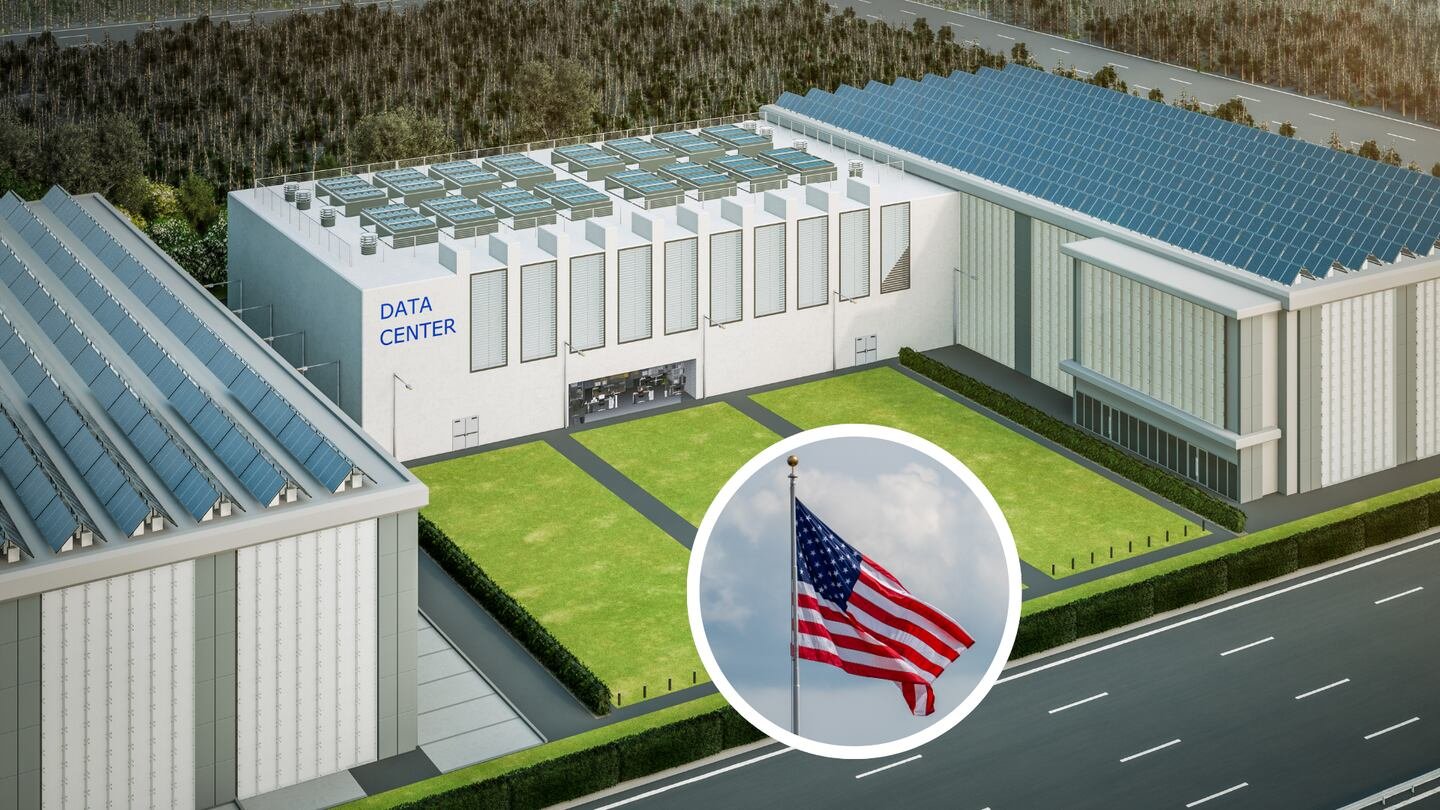
The United States concentrates 5,427 artificial intelligence data centersthe largest amount in the world. This is revealed by AI Index Report 2026 from Stanford University.
The study also points out that the country leads the development of advanced models, but depends on Taiwan to manufacture the chips that sustain this industry.
By 2025, the number of data centers in the United States will exceed for more than ten times to countries such as Germany (with 529), the United Kingdom (with 523) and China (with 449).
In the development of artificial intelligence systems, leadership is also maintained. That same year, the country produced 50 notable models, above China’s 30 and South Korea’s 5.
Furthermore, the systems developed in the United States are those that demand the greatest computational intensity on a global level, which also translates into the highest energy consumption in the world in this sector.
American leadership depends on a supply chain concentrated in Taiwan
The report warns that American leadership presents a supply chain vulnerability. Global computing capacity has grown 3.3 times a year since 2022, but flows primarily through a single companyTaiwan Semiconductor Manufacturing Company (TSMC), which makes almost all of the leading AI chips.
American companies They design these processors, but they do not produce them. Firms like Nvidia and AMD send their most advanced designs to TSMC, which has the technology necessary to manufacture them at the nanometer scale. This positions the Taiwanese company as a single point of global dependency.
This phenomenon also includes other stages of the process. Assembly and testing involves Taiwanese companies such as ASE Group, along with American companies. Additionally, key components such as high-bandwidth memory rely on South Korean manufacturers such as SK Hynix and Samsung.
The report indicates that a joint expansion of TSMC in the United States will begin operating in 2025, as part of an effort to diversify production and reduce the geographic fragility of the supply chain.
Nevertheless, This measure does not eliminate the monopoly. Technology, operations and knowledge continue to be concentrated in the Taiwanese company.
The barriers to entry in semiconductor manufacturing make it difficult for new competitors to appear. The development of nanoscale chips requires decades of accumulated experience, highly specialized equipment and large capital investments.
South Korea appears as the main competitor in the manufacture of advanced chips, through Samsung Foundry. However, the current ecosystem maintains TSMC as the dominant player, with a share that encompasses the majority of AI chips.
The United States leads in infrastructure, China dominates in research
While the United States dominates in infrastructure and commercial development, China takes first place in academic research and theoretical production in artificial intelligence.
The patents are official records of applied innovation that grant rights over specific technological developments. In the context of artificial intelligence, they allow us to measure how ideas and models are transformed into practical solutions that can be implemented in systems, products or services.
In 2024, China accounted for 17.8% of global AI publications and accounted for 20.6% of citations. Its presence in the group of the 100 most cited articles grew from 33 in 2021 to 41 in 2024.
In applied innovation, the country concentrated 74.2% of artificial intelligence patents worldwidein front of the 12.1% from the United States. However, US patents have a greater impact, accounting for 51.91% of subsequent citations, compared to 29.81% for China.
The report also indicates that US patents spread faster. Only 19% do not receive subsequent appointments, while in the case of China the proportion reaches 44%.
In software development, Chinese activity is distributed on national platforms such as Gitee and GitCode. Furthermore, more than 25% of publications on artificial intelligence come from government institutions, while in In the United States, research is more concentrated in the private sector.