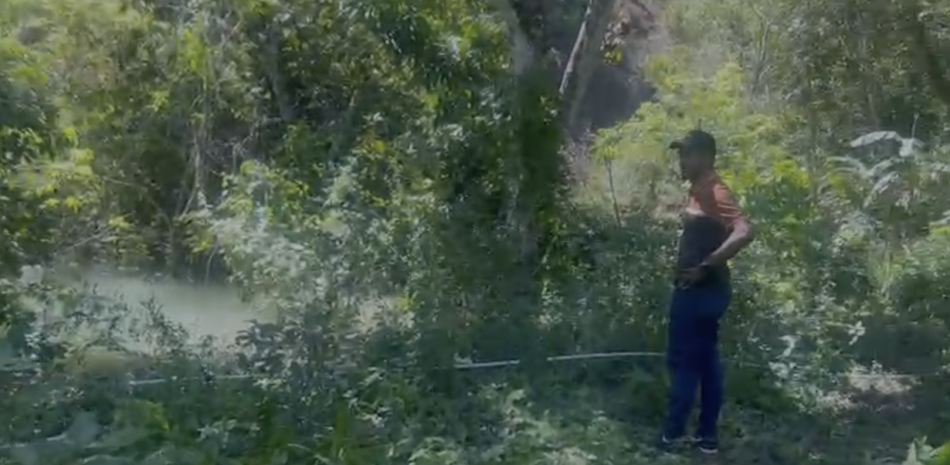
At approximately 11 pm last Thursday, the roar of a landslide on the Quinigua River woke up the community of Palo Quemado, located in a mountainous area in the north of Santiago.
The landslide keeps a large stretch of the tributary channel dammed, raising concern among community members, who fear that, if the water drops abruptly, it could flood dozens of homes located down the hill and on the banks of the river, in the town of Gurabo.
“When it collapsed it felt like an earthquake, but we already knew, because days ago it was about to collapse due to the rains,” say the residents of the place.
The landslide knocked down several trees in its path, and dammed the river in such a way that many of the other trees that remained standing were covered in water up to the top.
Likewise, he lost the path that led to the mountain after crossing the river, where residents of the area have agricultural plantations and animals.
Miguel Andrés Mencía, known as Miguelito, had to move some goats that he had in his corral on the banks of the river, because he was drowning.
Yesterday, the accumulation of water had decreased considerably, however, the water marks on the trunks of the trees and the ropes that the community members hung showed the height to which the water reached.
The community members expressed that the authorities had reported that they would send heavy equipment to move the debris. However, the residents themselves understood that it was not convenient, since, due to the depth of the dam, and the instability of the terrain due to the threat of continued rain, this would represent endangering the life of whoever handles the device.
“If they put that machine there, that land can continue to spill because it will continue to rain, and that can cause a tragedy. Furthermore, it is super deep, you enter the river standing still and swim down and you don’t reach the bottom,” said Miguelito.
Concern continues to expand in this area, especially for the people who live downstream and on the banks of the tributary, in communities of Gurabo, where the Quinigua River passes, which, by the way, has historically caused disasters and flooding in previous rainy seasons.
This area of the Palo Quemado community, which gives access to the river, is located at kilometer 13 of the Gurabo highway that connects with the Cumbre, on the right, a narrow road that begins with less than a meter of cement and then of dirt and stones, approximately a kilometer and a half downwards.
This small sector is made up of about five or six families, among which there are at least four small children. The houses are scattered between the hill and the banks of a rock, which goes down to the river.
This river represents the only source of water for these families, who depend on it to wash, clean, and even bathe, if necessary. The family of Mrs. Rosa Catalina Carela, known as Yeya, who have been residing in this area for more than 28 years, connect a water pump from the river, with tubes and ropes to the upper part where the house is located, whose patio ends right at the rock that leads to the precipice of the tributary.
The services of the Santiago Aqueduct and Sewer Corporation (CORAASAN) or the National Institute of Hydraulic Resources (INDRHI) have never arrived there. Nor can the trucks that sell water access this area of Palo Quemado, due to the poor condition of the road.