Add the Press on Google as your preferred news source.
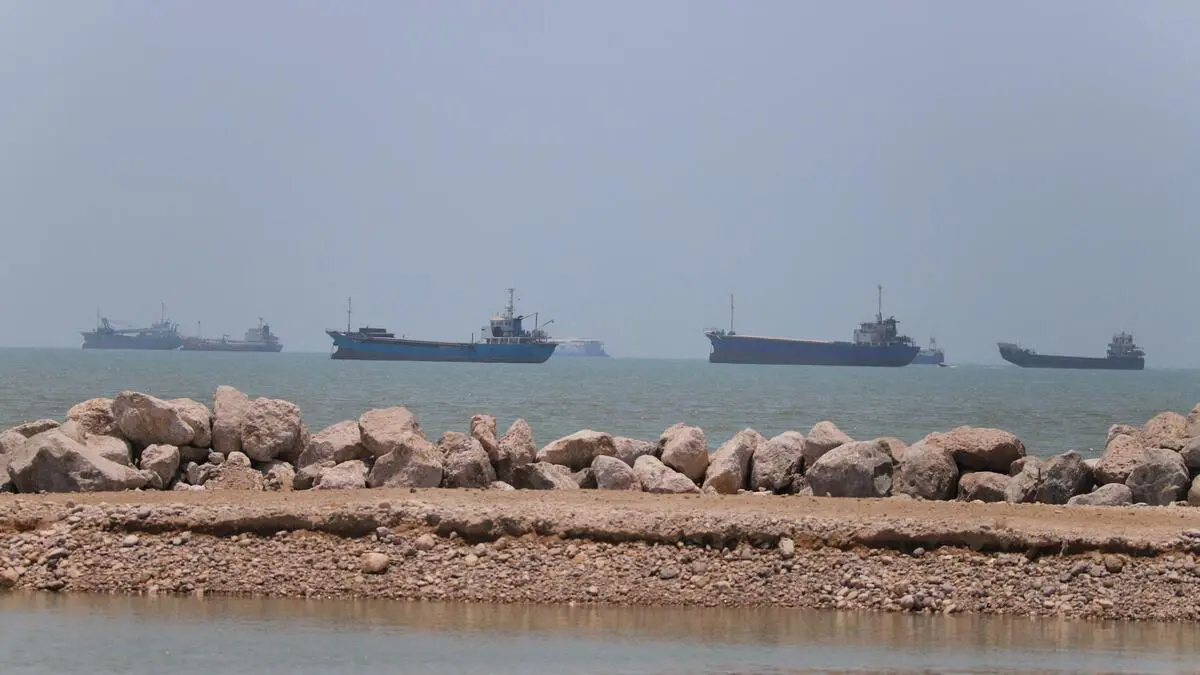
According to ship tracking services, several cargo ships have already passed through the Strait of Hormuz on Thursday following the signing of the framework agreement to end the Iran war. By early evening, eight freighters had left the Gulf through the strait, said the data company Kpler. Among other things, three Saudi Arabian oil tankers passed through the strait, each transporting two million barrels of oil from Saudi Arabia, as Kpler announced.
At eight, the number of transits was roughly the same as the average daily traffic volume for the past week. This was still well below the 120 passages per day that were recorded before the outbreak of the war, as reported by the magazine “Lloyd’s List”, which reports on shipping and maritime trade.
According to position information on the MarineTraffic website, the freighters included the French-flagged ship “Mraikh” carrying liquefied natural gas (LNG). The freighter belongs to the French subsidiary of the Norwegian company Knutsen OAS Shipping and, according to Kpler, loaded 76,535 tons in Qatar. These should therefore be transported to Pakistan. According to Kpler, only 15 LNG transport ships have left the Persian Gulf with a cargo since the war began on February 28th. All had LNG from Qatar or the Emirates on board.
After announcing an agreement between the US and Iran to end the fighting, US Vice President JD Vance announced the official start of the next phase of negotiations. The 60-day period provided for in the agreement “officially began today,” Vance told reporters at the White House on Thursday.
During this period, particularly contentious and previously unresolved issues that were initially left open will be negotiated. These include key questions about Iran’s nuclear program and how to deal with stocks of highly enriched uranium. The 60-day period can be extended if both sides agree.
The mediating state Pakistan announced on Thursday that the agreement would come into force with “immediate effect”. Tehran will “immediately reopen” the Strait of Hormuz and the US will immediately lift the naval blockade of Iranian ports, the Pakistani prime minister announced Shehbaz Sharif known on X.
Shortly after the start of the war, Iran largely brought traffic in the Strait of Hormuz, which is important for global trade in oil, gas and fertilizer, to a standstill through threats and attacks on ships. The United States later imposed a naval blockade of Iranian ports to cut off Tehran’s oil revenues. Global energy prices shot up with the start of the war.
According to the US statement, the framework agreement now states that the US Treasury Department will grant exemptions for the export of Iranian crude oil immediately after it is signed. The sanctions against Iran should only be completely lifted once a final agreement has been reached. The US promises to release Iranian assets frozen abroad. The question of implementation is also part of the ongoing negotiations.
Trump signed the framework agreement in Versailles, France, where he was met by France’s head of state Emmanuel Macron at the end of the G7-Summit was received in the castle. A video distributed by the White House on X showed Trump signing a paper there. According to the White House, this is the framework agreement. There is applause from those present, Macron shook Trump’s hand. “Great job,” praised the French head of state.
Meanwhile, the Iranian news agency IRNA published photos showing how President Pezeshkian holds a paper signed by him and Trump into the camera. On Thursday morning, Pakistani Prime Minister Sharif also signed the agreement as a mediator, as he shared in a video on X. According to state media, the Iranian Foreign Ministry spokesman said there would be no signing ceremony in Switzerland. It was originally expected that the signing would take place there on Friday.
Instead, representatives of both countries are scheduled to meet on Friday in the Bürgenstock resort above Lucerne to discuss outstanding issues. In addition to representatives from Washington and Tehran, envoys from the mediating states Pakistan and Qatar as well as other countries involved are also expected at the meeting on the implementation of the agreement, the Swiss Foreign Ministry said. According to the ministry, details about the schedule or the course of the discussions were not initially available.
A final agreement between the US and Iran is expected to be reached within 60 days. The period can be extended if both sides agree. However, it is by no means certain whether there will ultimately be a solution to the dispute over the controversial Iranian nuclear program.
Pakistan’s Prime Minister Sharif had initially written on X that a ceremony to honor “this milestone” was planned in Switzerland on Friday. This post was no longer available a short time later. In a new post by Sharif, there was no longer any mention of such a ceremony.
After weeks of negotiations, the USA and Iran agreed on the framework agreement on Sunday – on Trump’s 80th birthday. In the 14-point agreement, both sides also agreed to an “immediate and permanent end to the war on all fronts, including in Lebanon,” according to a senior US government official.
But questions remain: Will Israel and the pro-Iranian Hezbollah militia in Lebanon comply? What happens if the fighting between both parties continues? In any case, a withdrawal of Israeli troops from Lebanon, which Iran has also demanded, is not in the text of the agreement.
A possible Iranian toll for shipping traffic in the Strait of Hormuz is also explosive. There will be no charge for the duration of the 60-day in-depth negotiations. According to the framework agreement, Iran should first negotiate what happens next with Oman. The US has repeatedly described a toll in the Strait of Hormuz as unacceptable.
There are still central questions regarding the controversial Iranian nuclear program that will be clarified as part of the in-depth negotiations. According to a US official, the framework agreement already stipulates as a minimum measure that the highly enriched uranium will be on site and under the supervision of the International Atomic Energy Agency (IAEA) should be diluted.
The IAEA still sees a great need for clarification, for example regarding the specific facilities that should be inspected by the UN agency’s experts. “There is still a bit of work to do,” said IAEA Director General Rafael Grossi in a press conference in Switzerland, where further talks could begin on Friday following the signing of the framework agreement. Now the time has come to formulate concrete further steps with representatives of the United States and Iran. He did not want to comment on details before these technical negotiations began.
China, however, welcomed the agreement. The signing of the first phase memorandum is “of positive significance for easing the situation and consolidating the ceasefire,” said a Foreign Ministry spokesman in Beijing. China hopes that all parties involved uphold the spirit of the agreement and fulfill their commitments. Problems cannot be solved with armed force.
White House Chief of Staff Susie Wiles acknowledged on Platform X that the “next 60 days will present challenges.” Trump threatened Iran again on Wednesday. “If they don’t behave, we will go straight back to throwing bombs right on their heads,” he said on the sidelines of the G7 summit on Lake Geneva. He had already made similar threats in recent weeks.
A senior former US State Department official described the framework agreement as a “strategic fiasco of epic proportions”. The agreement with Iran means “a break with almost fifty years of bipartisan US policy towards Iran,” Joel Rubin told the Israeli TV station i24news. Rubin served under former Democratic President Barack Obama.
Rubin warned of a scenario in which “hundreds of billions of dollars could now be handed over to Tehran without any restrictions.” Israeli Prime Minister Benjamin Netanyahu had in the past urged Trump to take a tougher line towards Tehran. In 2018, he encouraged the highly controversial decision to withdraw from the international nuclear deal with Iran. Looking back, Israeli security experts also classify this step as a strategic mistake. (APA/dpa)