Graz was and is a city of study: of around 60,000 officially registered people who are hungry for education, around a quarter are studying at the TU Grazthe Technical University, which was founded in 1811 as a museum and teaching institution Joanneum has developed. Today, the different faculties of the TUG, with their educational range ranging from technology, natural sciences and construction, are spread across three different “locations” in the southwest of the city.
The main building is the “Alte Technik”, built between 1885 and 1888, a mighty Wilhelminian-style building with two inner courtyards that extends between Rechbauerstrasse and Mandellstrasse. The library tower, built in 1970 by Karl Raimund Lorenz’s team, is a striking cornerstone; the “expansion building” by Günther Domenig, which was placed in the park in 1983, is a little hidden. Over time, “Old Technology” has infiltrated the majority of the surrounding former residential buildings, adapted them and converted them into institutes, laboratories or offices.
As early as 1921 it was clear that knowledge transfer required a new field: with a little spatial respect, the New Technology Campus was founded on the corner of Brockmanngasse and Kopernikusgasse. Here you will find, among other things, the horseshoe-shaped, expressive building of the Biochemistry/Biotechnology by Michael Szyszkowitz and Karla Szyszkowitz-Kowalski, which was completed in 1990 and is representative of the late Graz School. Behind it, like an antithesis, is the “Alte Chemie”, an elegant, functional post-war modern building with a grid of slim exposed concrete columns.
At the end of 1970, due to the need for large experimental facilities for engineering and natural sciences, another area was opened up outside the city, the Inffeld Grounds in St. Peter. Today the largest of the three campus locations is located here, which is expected to contain around 185,000 m² of net floor space by 2030. Factory and test halls were the beginning, and what was significant for the joy of technology at the time was the high-voltage building built in 1972, hanging on a steel frame, which has since been renamed the “Nikola Tesla Laboratory” in honor of the former student. The strictly functionalist building of the Mechanical Engineering Institute dates back to the late 1970s and was modernized and densified in terms of urban planning by Ernst Giselbrecht between the beginning of 2016 and the end of 2019 while it was still in operation: the office towers, which had previously had different heights, were increased using lightweight wooden construction, and the cladding with a ventilated aluminum facade ensures a uniform image. In contrast to the study center, which was built in an asymmetrical shape, the building for computer science and biomedical technology from the Riegler-Riewe office is reduced and clear; eight cuboid module blocks made of exposed concrete with horizontal window slots stand in two rows, connected by intermediate wings with large glass surfaces.
As at other university locations, the Inffeldgasse campus clearly shows that the “ensemble effect” often cited by monument and townscape conservationists does not have to be based on the same form and material or consistent construction dates: consistent functionality can create the accompanying harmony. It also becomes clear that an ensemble can develop together: the initially purely technical, almost industrial character has been joined by ecological and social thinking, the outdoor space has gained a lot of green space, cycle and walking paths, a cafeteria and kindergarten have been added, and according to the 2024 master plan Federal real estate company BIG Sports areas are also planned.

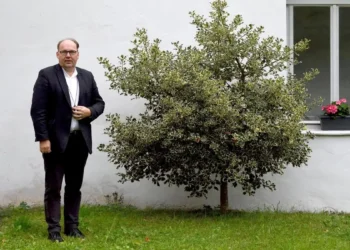
The inner courtyard curves around the approximately 100-year-old silver linden tree. pierer.net
The last “new addition”, the Cybersecurity Campus Graz, fits perfectly into the picture. The building, which will be completed in 2026 and planned by the EEP Architects team (Gerhard Eder, Christian Egger, Bernd Priesching), fits in, but is not inferior. The first challenge was the urban integration: Located on the northern edge of the campus, it not only has to accommodate the space, but also forms an entrance as well as a transition to the adjoining residential buildings and the business school. The building volume was divided into three height-staggered, conical structures, which are connected by a bridge on the first floor. Raising the ground floor by half a floor not only creates the necessary clearance height for emergency vehicles, but also two very inviting, pleasantly shaded passageways to the campus and school.
By dispensing with the obligatory fence, the sealed area between the school entrance and the new building, which was previously (mis)used as a parking lot, became a diverse, microclimatically effective green courtyard with narrow sidewalks and various seating areas. The centerpiece is the approximately 100-year-old silver linden tree, around which the bridge structure on the first floor gently swings. From the lounges arranged here and the roof terraces above, which serve as a “communication line”, you can look into the treetops.
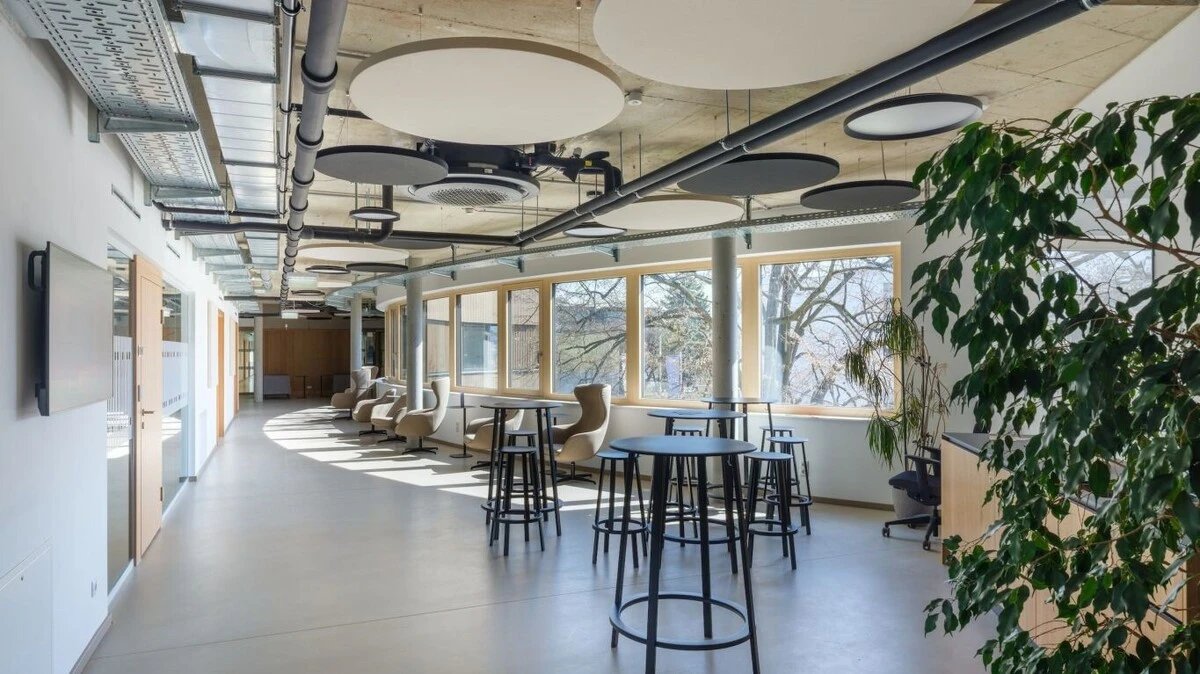
The idea that a competence center for digital security in cooperation with companies and start-ups in the IT industry has to resemble a technological fortress is quickly refuted: the elevated, generously glazed ground floor in a bright, warm color scheme conveys openness, visibility and transparency in the area of the entrances and passages that lead to foyers, seminar rooms and lounge areas. Around the massive core zone with a staircase, there are no corridors on the upper floors in front of the cell-like office and laboratory structure, but rather friendly lounge areas; Playfully circular acoustic panels and lamps float between the open cable routing on the in-situ concrete ceiling.
Geothermal energy and a PV system on the green roof ensure energy efficiency, while minimizing heat-storing materials and using sustainable materials are good for both the micro and macro climate. Collecting and storing all surface water on your own property relieves the burden on the sewer system and cools the air via green space. Ecology will also play a major role in the next campus project: the fact that the renovation of an existing building from the 1970s is based on a research project on circular construction fits into the overall picture of this university.