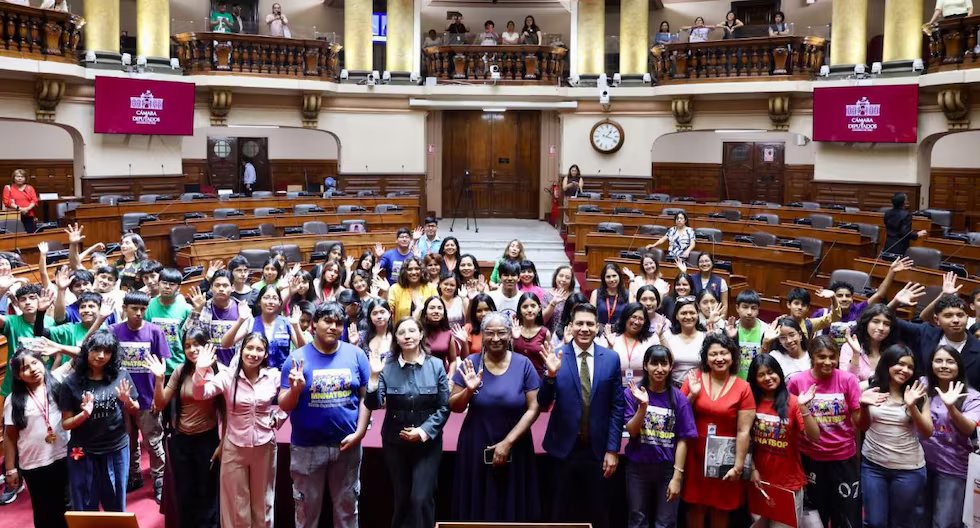

Girls, boys and adolescents from nine regions of Peru presented the National Agenda for Children and Adolescents before representatives of the Legislative Branch, in a space for dialogue that sought to strengthen their participation in public decisions and promote the commitment of the authorities to guarantee their rights.
During the meeting, representatives of organizations of girls, boys and adolescents from Arequipa, Huánuco, Loreto, Cajamarca, Apurímac, Ayacucho, Ica, Huancavelica and Lima shared their main concerns and proposals with deputies, senators, as well as with representatives of the legislative commissions linked to their priorities.
The meeting was chaired by the president of the Chamber of Deputies, Óscar de Jesús Reto Otero (Good Government Party). Senator Susana Matute Charún (Good Government Party) also participated; Deputy Hilda Judit Fernández de la Torre (Good Government Party); and deputies Diethell Columbus Murata (Fuerza Popular) and Marco Antonio Pacheco Quispe (Fuerza Popular).
“It is thought that laws and politics are the business of adults, but that is not the case. You, girls, boys and adolescents, are at the ideal age to transform the world. Use that strength and that energy to change things and also to supervise the authorities,” said Óscar de Jesús Reto Otero, president of the Chamber of Deputies.
Deputy Diethell Columbus highlighted the importance of recognizing the voices of girls, boys and adolescents, promoting interculturality and creating spaces to listen to their proposals. “Their words about the need not to be made invisible, to promote real interculturality and to protect the environment remind us of the importance of listening to their proposals,” he said.
For her part, representative Hilda Judit Fernández de la Torre highlighted the importance of sexual education and expanding spaces for participation in the country. “Sexual education must return to schools, because it is essential for the care of girls, boys and adolescents. Above all, we need to create more spaces like this, not only in Lima, but also in other regions of the country,” he said.
Senator Susana Matute highlighted the value of the evidence-based analysis that supports the proposals of the National Agenda. “It is very valuable that they have analyzed reality based on data and that they have formulated their solution proposals on that basis. These proposals must be assumed responsibly by the authorities, because it is up to us to address them and look for solutions,” he stated.
Meanwhile, deputy Marco Antonio Pacheco stressed the need to give continuity to these spaces for participation. “It is essential to institutionalize dialogue tables that allow girls, boys and adolescents to have communication channels with their authorities,” he said.
The National Agenda, built and validated through a participatory process with organizations from different regions, includes proposals in four priority axes: education, comprehensive health, protection against violence and discrimination, and environment and climate change.
Education: inclusive and violence-free schools
The girls, boys and adolescents proposed guaranteeing an inclusive, safe and violence-free education. Their proposals included strengthening comprehensive sexual education and establishing mechanisms to prevent and address school, sexual and digital violence, as well as discrimination in educational institutions.
“We are very concerned that our educational institutions have poor infrastructure and do not have adequate conditions to protect us against emergencies. We have observed that only 2.1% of public educational facilities met these conditions, and that worries us a lot,” said Keyla, spokesperson for the Education axis and representative of the co-managed Microfinance Program for working children and adolescents.
Comprehensive health: timely care without discrimination
In terms of health, they proposed eliminating the barriers that make it difficult for girls, boys and adolescents to access services, especially in emergency situations. They also pointed out the need to train health personnel to provide respectful and non-judgmental care, as well as clear and reliable information on physical, mental, and sexual and reproductive health.
“One of our main concerns is the barriers we face in accessing health services. When we go to a post, they often ask us for our ID or to be accompanied by our parents, and even in emergency situations we can find difficulties in receiving care,” said Fátima, spokesperson for the Health axis and representative of the National Movement of Organized Workers Children and Adolescents of Peru (MNNATSOP).
Protection: prevent and respond to violence
The agenda proposes strengthening prevention, care and response mechanisms in situations of violence in the different environments in which girls, boys and adolescents develop. Likewise, it proposes to combat discrimination and guarantee that those who go through these situations can access protection services and receive adequate care.
“Girls, boys and adolescents live with the constant fear of being victims of violence. This does not only occur in the streets, but also in our homes, schools, communities and digital spaces. Racism and discrimination are added to this,” said Noemi, spokesperson for protection and for the collective Yo Also Hay Something to Say (YTTAQD).
Environment and climate change: participate in the decisions that affect your future
Faced with environmental and climate challenges, girls, boys and adolescents proposed promoting measures to protect their communities and reduce the risks of emergencies and disasters. They also highlighted the importance of having permanent mechanisms that allow them to participate in public decisions on environmental protection and climate change.
“We are already experiencing the impacts of climate change on our education, health and recreation, and these will be stronger in the coming years. Girls and boys born in 2020 will face up to seven times more heat waves and at least twice as many intense rains and floods throughout their lives, compared to their grandparents,” said Santiago, spokesperson for the Climate Change axis and representative of the Organizations of Amazonian Girls, Boys and Adolescents (ONNAAS).
The initiative is part of the Program to Strengthen Support for Civil Society for the Rights of Children 2026-2028, in which 14 organizations committed to the promotion and defense of the rights of children and adolescents participate, with the support of Save the Children and the Government of Sweden.