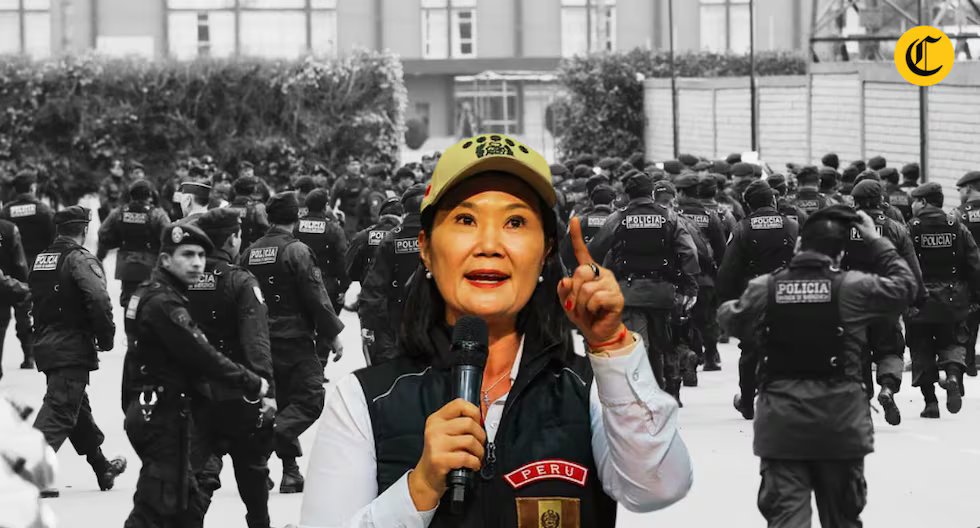
In the first 100 days of her administration, the president Keiko Fujimori authorized the Ministry of the Interior (Mininter) to develop a plan to reform the National Police, an institution that suffers from corruption and lack of equipment. This proposal is almost ready and more details would be provided in the coming weeks.
Sources close to the Government Palace indicated that the police reform promoted by the Ministry has eight axes and does not include the departure of senior officers. But there are concrete measures to be implemented in the medium and long term. For example, the retirement of police officers involved in crimes, especially those linked to criminal networks, regardless of their rank.
Also the reduction of Police training schools, which in 2027 would go from 18 to only 10.
The same sources announced that it is very likely that the central government will receive criticism and pressure from regional governments that wish to maintain these schools in their jurisdictions. However, they stressed that these educational centers do not have the financial resources or the necessary filters to prevent criminal networks from infiltrating the PNP.
In Tumbes, they reported, a police training school had already been closed, because it could not be sustained and did not have the conditions for the installation of students. In addition, large sums of money were requested from the parents of those who entered for the purchase of mattresses, cabins and wardrobes and for food, when this should be covered by the State.

In mid-September, Lieutenant General Fredy López Mendoza assumed the general command of the PNP, after the retirement of Óscar Arriola. (Photo: Peruvian Presidency)
/ Cristian Olea
Other sources linked to the Ministry reported that the sector has also proposed establishing greater requirements for entry to the training centers of the National Police. One of them is that applicants with family members or an environment related to the underworld are subject to a review by intelligence agencies.
This is in order to determine whether or not they can be infiltrated by criminal networks.
Another measure that the police reform contemplates is changes to the regulations of the National Police and the Promotion Law of the aforementioned institution. In the first case, it seeks to establish that police officers separated for acts of corruption or criminal acts who are replaced by court order do not return to their original or operational units.
“Those police officers who are identified as members of extortion gangs or criminal organizations cease to be police officers and we are going to transfer them to the prosecutor’s office. We are going to treat them as criminals. They are not going to go to military police jurisdiction, because this is not a crime of function,” they stated.
Regarding the changes to the PNP Promotion Law, the ruling party seeks to prioritize experience in the field over administrative or academic requirements.

(Photo: Peruvian Presidency)
/ Cristian Olea
The other axes of the police reform that the government is preparing are the improvement of the infrastructure of the police stations, the purchase of patrol cars, and acquiring technology for the investigation departments, especially those that seek to capture extortionists, hitmen, kidnappers and illegal miners.
And, in addition, they plan to build headquarters for the PNP and give them better equipment. “We have to aspire to have a crime laboratory in each region, starting with the northern coast, plagued by organized crime,” they added.
One of the axes of the reform – according to sources close to the Ministry – will be the organization of specialties. This, they added, does not mean the return of the defunct Peruvian Investigative Police (PIP).
“The units must be strengthened. The National Police has become stronger, and there is already a new generation. We have to strengthen what we already have,” they mentioned.
Sources close to the Executive estimated that this reform would take place in approximately one year.
“It has been said that we are afraid of carrying out a reform and that is not the case, a reform does not involve lowering almost all the generals,” they concluded.
Former Minister of the Interior Carlos Basombrío said that he agrees with this proposal that the government is preparing.
“I hope it has results, that comes from the Ministry of the Interior and the General Commander of the Police (Fredy López Mendoza). Let them do it, because there will be enormous resistance from the regions, no one wants to lose, in quotes, the training in their region. Why? Because they want to ‘make sure’ they have police officers,” he told El Comercio.

(Photo: Hugo Pérez/ El Comercio Archive)
Basombrío considered that the government, in this context, will have to fulfill its main campaign promise: “to bring order.” “I hope it is like that,” he said.
Criminologist Nicolás Zeballos, former vice minister of Public Security of the Ministry, said that he does not see bad ideas that the government has, especially because several of them have been discussed for some time. For example, he said that in the transition government of Francisco Sagasti (2020-2021) an attempt was made to reduce the number of police training schools to 12, but that in the administration of Pedro Castillo (2021-2022) “a lot” were opened.
“The idea was to have few schools, but of high quality, that is a route. And that must come accompanied by an educational reform. The Police curriculum was homologated with university education. They take many theoretical courses, that must be simplified. Police training must be between 12 and 18 months. That they have the basic skills and then they can do specialization,” he explained.
In communication with El Comercio, Zeballos considered that police officers should specialize mainly in four fields: intelligence, public order, special operations and criminal investigation. “And, at the same time, there must be a change in doctrine, police work must be oriented to the logic of a public service,” he added.
The expert also said that it may take the government a year to begin the police reform process and that it may conclude in five or more years.
“This government can leave us on the right track and lay the foundations for the reform of the National Police,” he concluded.
The former Chief of the Ministerial Cabinet and former Minister of the Interior Óscar Valdés Dancuart said that previously an attempt was made to reduce training schools for the National Police, but there was opposition from the regions. He added that we should aim for centers in macro-regions, as is the case with the Army, to have better instructors and logistics.
“Many of these schools not only ask for money from parents, but also put applicants under warm water,” he questioned, referring to the infiltrators of criminal networks in the aforementioned institution.
Valdés Dancuart believed that it was a mistake by the first APRA government to unify the police, when the country “had a Civil Guard that was impeccable and that was in charge of citizen security.” “The Investigative Police had the task of dealing with major crimes, such as organized crime, they did their job. If you ask me if I would return to the codes, yes. They are different formations,” he remarked.
In dialogue with El Comercio, the former prime minister criticized that within the Police there are “so many specialized units.” “They no longer know what acronyms to give it, each one has its administrative part and its budget,” he added.
The former head of the Interior indicated that the reform of the National Police must also prioritize the fight against corruption within the same institution. “The majority of the officers are commanders and majors, who have not managed to be promoted, they have already fulfilled their role, they have reached their limit. They should be invited to retire for renewal, their salary will be paid, but they will no longer bribe, that must be done,” he said.
In September, when he appeared before the Defense and Internal Order Commission of the Chamber of Deputies, the Minister of the Interior, César Astudillo, announced that the “changes will come in December.” “It is part of a small reform that involves having the right people in the right place,” he said.
Furthermore, Astudillo said that the police reform will follow the guidelines set forth in the Mariano Santos plan, a document that contains the new profile of non-commissioned officers and police officers, from the curricular framework to the humanistic training and the equipment that is needed.