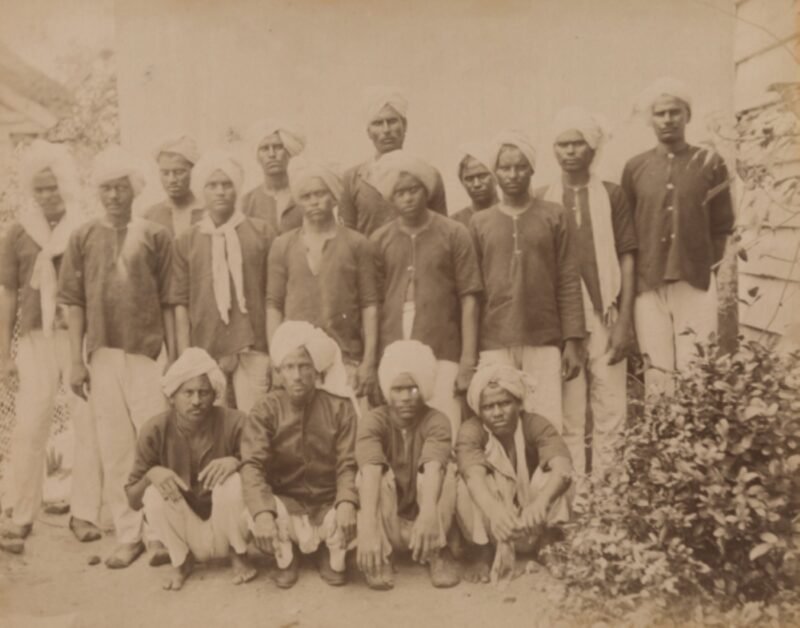
THE HAGUE — After all the attention to the history of slavery, it is now time to highlight and commemorate what followed in Suriname: indentured labor. That is the advice of the Dutch National Coordinator against Discrimination and Racism. “The history of contract labor of Chinese, Hindustani and Javanese Surinamese belongs to the colonial past and deserves a full place in it,” says Rabin Baldewsingh, who is national coordinator.
Between 1853 and 1874, approximately 2,500 Chinese came to Suriname, between 1873 and 1916 a total of 34,304 British Indians were transferred, and between 1890 and 1939, 32,956 Javanese from the then Dutch East Indies. Almost all of them worked as indentured servants and had to replace the African slaves. However, their position and the treatment they received were anything but positive.
“Poverty was great, the slavery mentality had not yet disappeared”
Professor Rosemarijn Hoefte
However, this is now receiving increasing attention. In the advice ‘Contract labor and historical equivalence’ presented last week, one of the recommendations is: ‘Set up a National Knowledge Institute for Contract Labor and develop a sustainable national knowledge and heritage infrastructure.’ “It must become a national knowledge and expertise point for science, education, heritage institutions, governments, social organizations and the general public,” says Baldewsingh, who is a former councilor of The Hague and is himself descended from Hindustani contract workers in Suriname.
Major colonial migration movement
Professor Rosemarijn Hoefte outlines how contract labor followed almost seamlessly after the slowly abolished slavery. Tens of thousands of Asians were transferred to Suriname to work for meager wages on the plantations and in the sugar factories. “Poverty was great, the slavery mentality had not yet disappeared.” Hoefte also indicated that Surinamese contract labor was part of a ‘large colonial migration movement’.
Although the contract workers would in principle return after five years, most remained in Suriname. In this way, together with other groups, including the descendants of the enslaved, they formed the diverse Surinamese society. And this was later followed by the flow of migration to the Netherlands, which would make The Hague one of the largest ‘Hindostan’ cities in Europe.
Barbera Wolfensberger, Director General of Kingdom Relations of the Dutch Ministry of the Interior, accepted the advice and underlined the importance of anchoring contract labor in the collective memory. This may lead to a ‘broadening of the commemoration of the past of slavery’. The first steps could be setting up a national ‘oral history’ programme, appointing a quartermaster, digitizing vulnerable collections and reserving resources for the ‘start-up phase’.
Historical equivalence
Almost everything surrounding slavery is sensitive, says Baldewsingh. He emphasizes that it is not a matter of measuring indentured labor against the immense suffering of slavery. “These are different systems within the framework of Dutch colonialism. Recognition of one history never has to be at the expense of the other. But historical equivalence is necessary. The contract workers do not yet have a sustainable and recognizable place within the collective memory.” The Dutch cabinet will later issue an official response to the advice.