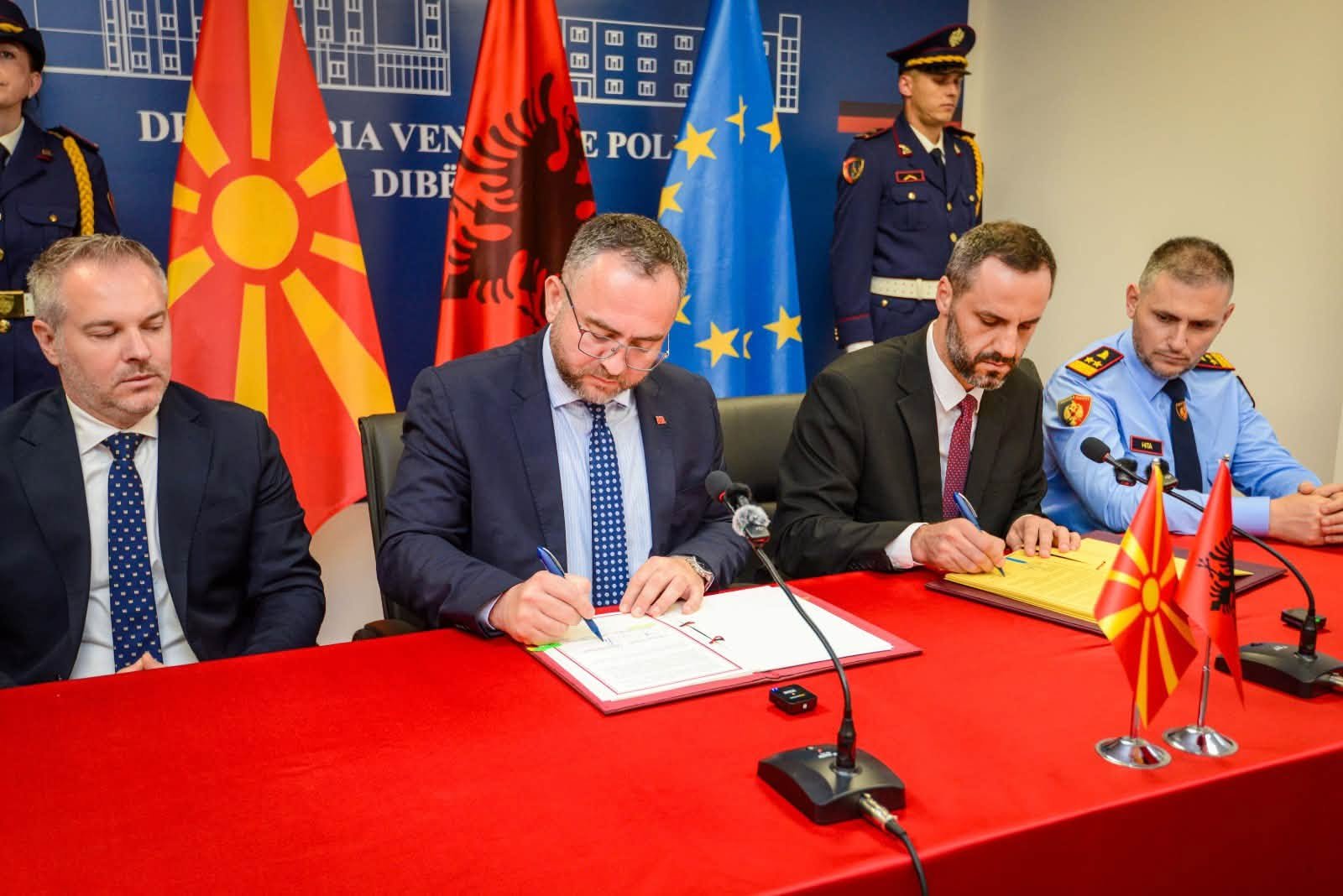
The Macedonian Minister of the Interior Pance Toshkovski and the Minister of the Interior of the Republic of Albania Besfort Ljamalari in Peshkopeja, Albania signed an Agreement on the establishment of joint border crossings and implementation of joint border controls between the two countries.
– This agreement establishes a modern and functional framework for more efficient management of the common border, with the aim of facilitating the movement of people and goods, improving security and reducing the waiting time at border crossings – the Ministry of the Interior informs.
The agreement foresees formalized institutional cooperation, phased implementation through protocols adapted to each location, as well as strengthened mechanisms for coordination and exchange of information between competent services.
In his address, Minister Toškovski emphasized that the agreement represents a significant step towards more efficient, safer and more predictable management of the border, with direct benefits for citizens, the economy and institutions.
He emphasized that joint border procedures not only facilitate the flow, but also strengthen the ability of both states to deal with cross-border crime, human trafficking and other security risks, through coordinated action and information exchange.
In particular, it was emphasized that the implementation will take place gradually and in a controlled manner, in order for each joint border crossing to be fully operational and legally prepared before implementation.
Minister Toškovski thanked the expert teams, legal advisors, police officers and all institutions from both countries that participated in the preparation of the agreement, stressing that their work is key to the achieved result.
The signing of the agreement at the Blato border crossing, according to the Ministry of the Interior, represents an important milestone in the bilateral cooperation between Macedonia and Albania and a confirmation of the joint commitment to modern, efficient and safe border management.
This completes the process of establishing this system with the three neighboring countries of the Republic of Macedonia that are not part of the Schengen zone, bearing in mind that it already works successfully with Serbia and Kosovo.