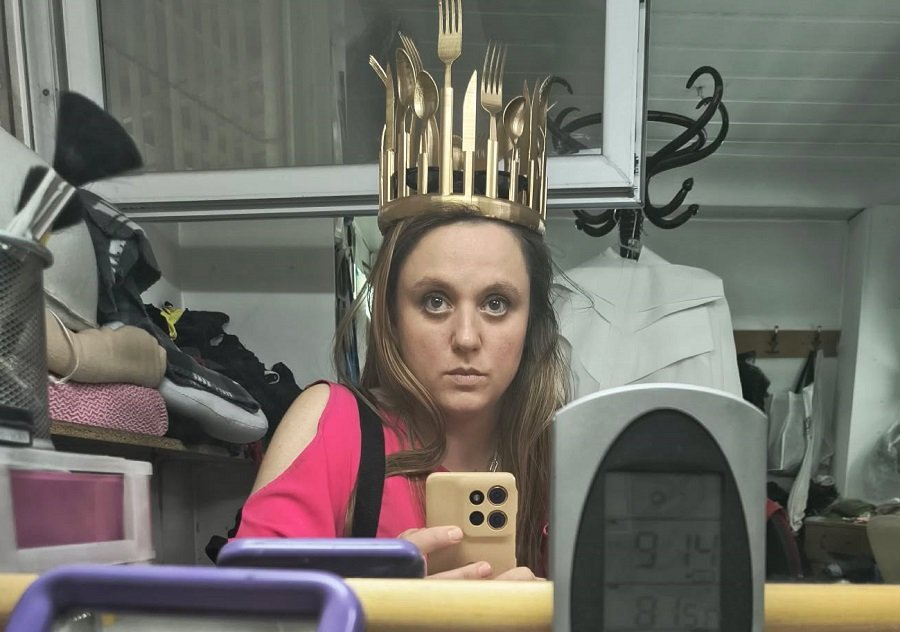
Theater director Hana Milenkovska very honestly and deeply reveals the process she went through together with the entire author team during the creation of the play “The Path of Baba Yaga” in the Theater for Children and Youth in Skopje.
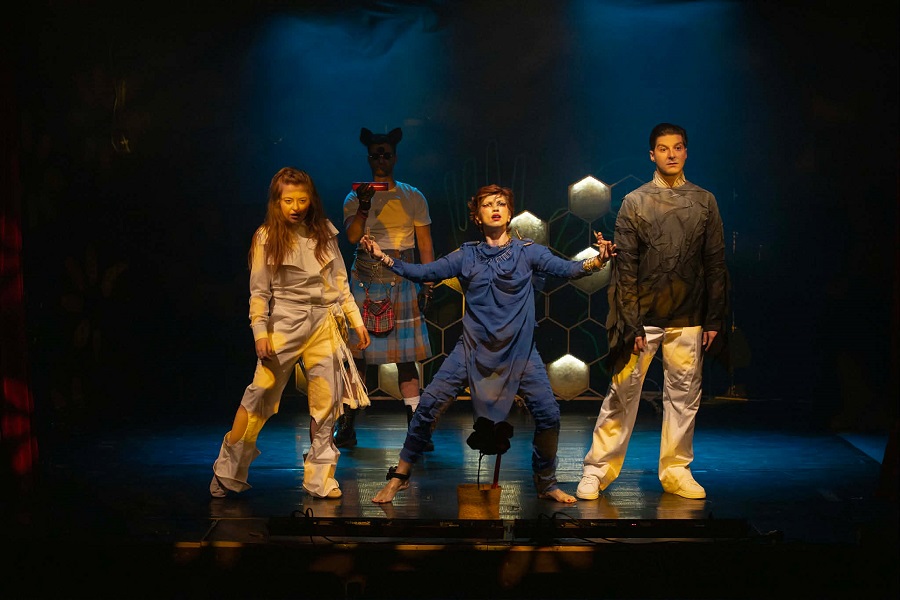
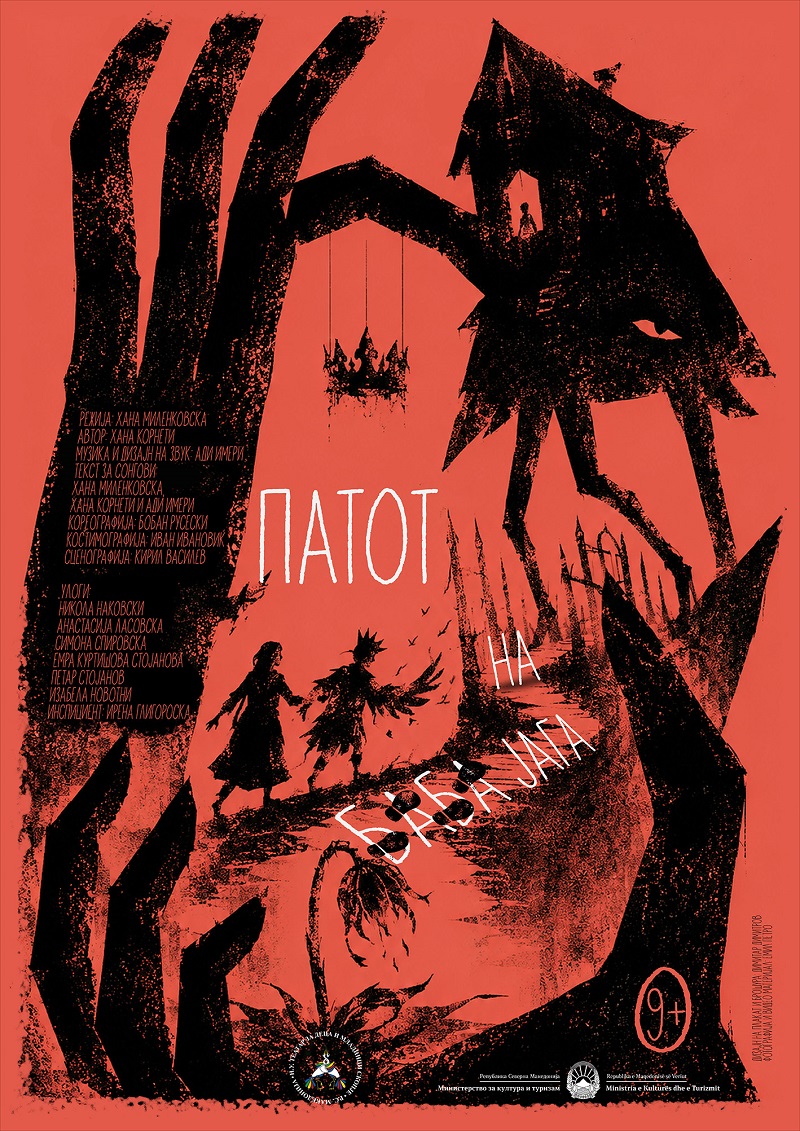
On June 24, the Theater for Children and Youth premiered the play “The Path of Baba Yaga”. The play is directed by Hana Milenkovska, according to the author’s text by Hana Cornetti and with music by Adi Imeri. Milenkovska, Kornetti and Imeri also write the lyrics for the songs in the play together.
Nikola Nakovski, Anastasia Lasovska, Simona Spirovska, Emra Kurtishova Stojanova, Petar Stojanov and Isabela Novotni play in the play, with choreography by Boban Ruseski, costume design by Ivan Ivanovic and scenography by Kiril Vasilev.
The director Milenkovska points out the moment of the premiere of a Macedonian dramatic text for children and the opportunity to create the theatrical story with the author Hana Korneti on the stage itself. Kornetti has had the idea and the original version of the text since 2018, and now a situation has arisen to stage it as her first dramatic text on stage directed by Hana Milenkovska.
The premiere of the text “Baba Yaga’s Path” by Hanna Cornetti, directed by you, took place in the Theater for Children and Youth. What kind of process did you and the whole crew go through while making the play?
– On a human and artistic level, working on the play was an impressive and intense experience. Unfortunately, that process was followed by a certain production weakness from which we managed to emerge and achieve the maximum in every aspect. The limitations didn’t ruin the magic, luckily I had a resilient and resilient cast that dreamed and built with us until the end. We were able to play and do what we do best. We followed the final result without having to justify ourselves because of the circumstances in which we create, we were faithful to the goal and with faith in what we did.
There is a tendency among people in our profession to idealize the process after a work is done, which I used to shy away from, but now I understand, because the process is our food, which we then turn into energy on stage. I think that we have all grown up a little and that in the development of a show for children it is good for that to happen. In this process, each of us had our own small victory and I think that affects the kind of work we created.
How did the two Hanis, the author and the director, find themselves on the same frequency, considering that the idea and the text itself appeared in 2018?
– In 2020, the other Hana, the author Hana Cornetti, recognized something in my practice and approached me first for collaboration, which I think was a great decision. I liked the text and decided that I will do it one day. Since then we have cultivated a wonderful friendly and professional relationship, which has led to a very easy and efficient collaboration.
When I told her that I wanted to go in the direction of some kind of hybrid genre that wanted to be a musical, she bravely agreed, which only confirmed to me that we had chosen each other at the right moment, but we had started working later than planned for a reason.
Hannah, in my opinion, is a rising star in literature in the region, but despite her talents, there was no excess vanity in the process of finishing and adapting the work that we went through together before rehearsals began. He understood me and believed me until the end, which is very important for my courage to stay alive until the last trial.
What significance does the fact that the author of the text is present in the process of creating the play have for the director and the cast?
– In our case, it was a very good support to have Hana with us, especially at the beginning of the process, because we could do a live reading of her text in front of her and follow her reactions. Although it is her first dramatic text, she had an absolute ear to determine when something is good and when it squeaks, to agree when the word stops the action and not to stick to the first solutions, but to “grow” them with us. It meant a lot to everyone involved in the process, because we felt safer taking steps without compromise.
To what extent is folk art amenable to new and modern reading in order to be understood and accepted by young generations?
– The approach to folk creativity in this performance was in the direction of inspiration, not interpretation. In the scenic expression itself, there are elements of magical rites, alchemical symbols, as well as a soundscape, which are a collection of several civilizations. The world is a big place and having access to information as a generation of artists opens up new ways for us to observe the notion of folk art.
In this case, I see the modernization of folk art as a series of signs that remind us of the collective unconscious, and at the same time have a function in strengthening the search, which is the main motivation in the play. But yes, it is manageable, when it is not burdened with associated concepts.
What message does the play you staged at the Theater for Children and Youth send, and who did you actually intend it for?
– This time we dealt with the importance of the search for one’s own identity and choice. In all my works, I deal with the issue of free will, so that concept somehow runs through here as well. I believe that it is more important what discussions we open than what message we convey, because the time we live in is dense and full of messages and intentions towards children and young people, and there is too little dialogue. So, probably the message is to enter into a dialogue with the child who will become human without telling him how to feel about himself and the world.
The show is intended for everyone who cares about asking who they are and what they want to be, and what would be ideal is to reach children from 10 to 14 years old, the audience we had in mind when we created the expression.
Music and choreography play an important role in the play. How did the collaboration with guitarist Adi Imeri and choreographer Boban Ruseski take place?
– We have been working with Adi and Boban for several years now. Adi Imeri, in addition to being a virtuoso in his field, is also a serious artist and educator in every sense. Through working with him, everyone realizes their potential in the process, and that is really valuable in collective art. It is a man who understands my artistic whims as a director and respects them, while maintaining high aesthetic standards throughout the process. Working on songs with him is always one of my favorite aspects of the work process. Without him this work would not be what it is.
Boban is an outstanding young choreographer, who unobtrusively engages in collaboration with the actor according to the capabilities and limitations of each member. He does so with great respect for the collective expression and is a beautiful presence in the dark as the rehearsal progresses. They’re both people with great taste, and I think that’s why I choose to work with them multiple times, among other things.
What feeling does the profession of a theater director bring and the opportunity to tell stories on stage, and at the same time to collaborate with actors, musicians, set designers, costume designers?
– I am very happy with my choice of profession, although I sometimes doubt that it is a choice, I just feel as if it had to be that way. I was privileged to grow up with theater and I don’t know if I can separate a conscious memory of myself without theater in it.
Every working day I have at least 20 seconds where everything is perfect. And for that moment, I get up every morning to do the same thing again. Theater is a team contact sport, being able to give and take every day is a wonderful thing. The job is to assemble all the elements, all the individual abilities, all the relationships, and even the disagreements into a healthy tissue, which should regenerate itself further through the performances. I’ve had luck or instinct so far, so I perceive my collaborations as significant, most of the time.
More recently, I discovered a new level of co-creation with another author, this time a fine artist and costume designer, Ivan Ivanovic, who proved to me that I should not be afraid of the costume if I have someone to make it as close as possible to perfection. This collaboration restored my faith in my own taste and criteria for visual identity.
In the larger picture, how can theater influence the feelings, emotions, behavior, and also the education and culture of the audience?
– Art has a function, even when it is made without an idea of the function. Expanding and unfolding great ideas, as well as everyday human battles, is the function of theater today. Theatre, especially children’s theatre, is key to communicating concepts like emotional literacy, which is a subject that is not in any school, and I think that’s where we need to start when we talk about education and culture more broadly. The attitude towards the public, towards the system, towards the other person, starts from the attitude towards oneself.
Through stories like this one, we debate topics such as compassion, personal choice, attitude towards the environment while “walking” through all musical genres and all this in a witty Macedonian language in the colors of the time in which we live. I really wanted, through the complexity of this work, to unlock new ways of cooperation between generations and, perhaps, for it to be a show that children and parents will follow with the same enthusiasm.
He tempered his experience on the independent scene. What kind of home did he find in the Theater for Children and Youth in Skopje?
– I have found a home with very solid foundations, because I can freely say that we have an outstanding acting ensemble and a very hardworking and efficient technical team. However, that home lacks basic elements and technical and human resources that would make it a home worthy of artistic creation.
We are a strong team of artists who pretends to have a home, and we carry it inside us, we push a lot of “muscles” so the difference in comfort that the institution offers versus the independent scene in this case is not that big. That difference is balanced to the greatest extent by our wonderful inspectors, the technical team, who have little at their disposal, and make us feel as if we are in a better position than the real one. What I do know is that this position takes a heavy toll on an artist’s physical, mental and creative health, and that we use up reserves of strength from tomorrow to create today in these conditions.
(The interview was published in “Cultural Press” number 337, in the printed edition of the newspaper “Sloboden Pechat” on 27-28.6.2026)