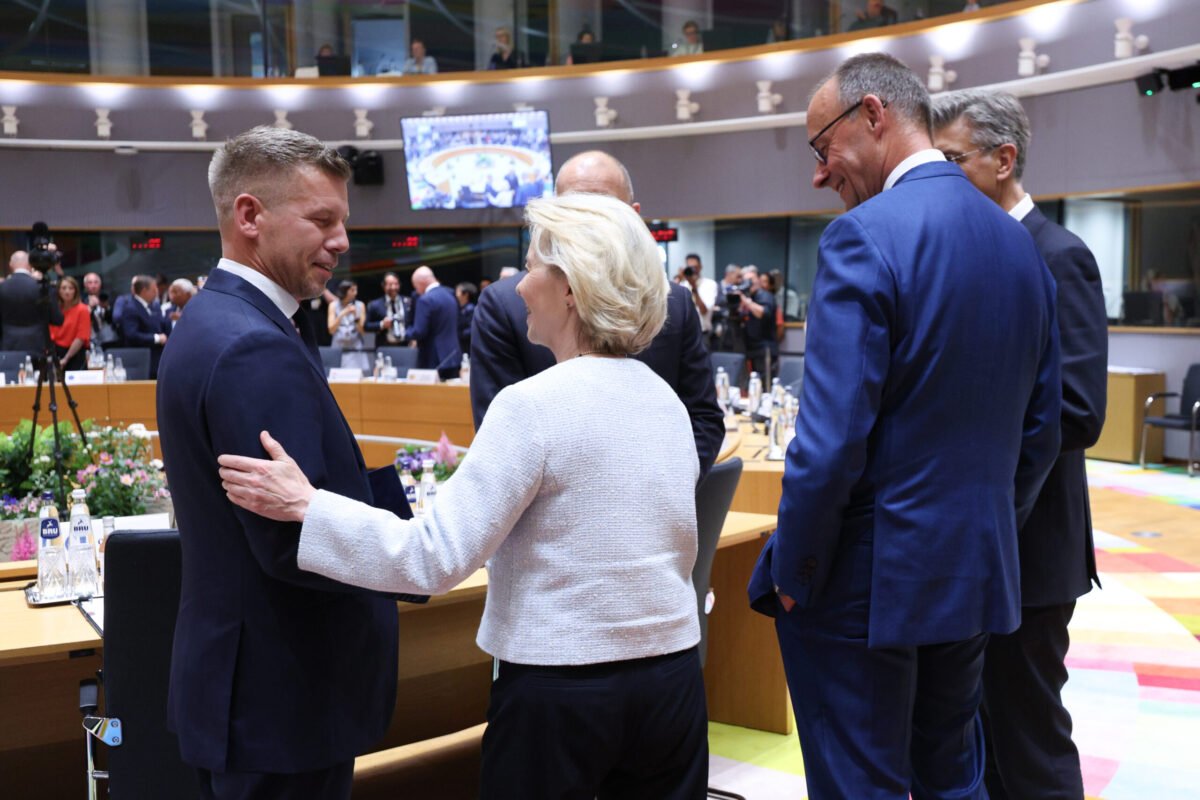

L-R: Prime Minister Péter Magyar and Ursula von der Leyen, President of the European Commission
The FIDESZ delegation in the European Parliament has submitted a written petition to the European Commission regarding Hungary’s economic austerity measures, FIDESZ MEP Csaba Dömötör announced Wednesday.
The politician explained that they expect the Commission to state whether the decisions made by the Hungarian government in recent weeks were set as conditions during negotiations on EU funding. As the MEP said, the written inquiry is also justified because
Prime Minister Péter Magyar has not provided any substantive information about what was actually agreed upon.
He added that Valdis Dombrovskis, EU Commissioner for Economic Affairs and Productivity, had made it clear that the Commission’s earlier recommendations had been incorporated into the new government’s official plans.
Accordingly, the TISZA Party’s parliamentary majority had decided to lift price controls on fuels and “presumably also” to intervene in the gas and electricity subsidy system, the FIDESZ MEP said. He recalled that during the minister’s hearing, it was stated that instead of the current general subsidy system, the government intended to introduce a much more narrowly defined, socially oriented energy subsidy system.
The politician pointed out that the interest rate cap on construction loans will also expire in September. In his view, this could increase the monthly repayment installments for affected families by as much as several tens of thousands of forints and affect nearly a quarter of a million Hungarian families. The current government is also abolishing the loan program offered to small businesses with a preferential interest rate of three percent.
He added that
in line with the Commission’s recommendations, it also appears that interest rates on Hungarian government bonds for private investors could be significantly reduced beyond the general interest rate cut.
According to the politician, the question of whether the tax exemption for long-term investment accounts will remain in place is also becoming increasingly urgent.
He noted that
the Commission had also strongly urged Hungary to halt its energy imports from the East, including imports of nuclear fuel from the East, which could disrupt the operation of the Paks Nuclear Power Plant.
Csaba Dömötör made it clear that, in line with its statements, the new government is prepared to fulfill this obligation as well, but has not provided any information on who would have to bear the additional costs resulting from the associated price increases. In his opinion, these burdens would fall on Hungarian families.
The FIDESZ MEP concluded by stating that the Commission’s demands and the related government decisions affect the lives of several million Hungarians; therefore, detailed information is expected regarding exactly what is contained in the agreement between the European Commission and the Hungarian government and what austerity measures can be expected in Hungary as a result.

Via MTI, Featured image: European Union