Beyond the numerical objectives, the Jossour 2030 strategy marks the opening of a new cycle for an institution which intends to strengthen its role as a bridge between the financing needs of the economy and the players capable of meeting them. Presenting this vision, the general director of Tamwilcom, Said Jabrinirecalled the progress made by the institution over the last fifteen years. Since 2010, the number of guaranteed credits increased from 949 to 61,800 operations in 2025, a multiplication by 65. Over the same period, the volume of guaranteed credits increased from 1.2 billion to 25 billion dirhams. The growth was also reflected in the financial performance of the establishment. Net banking income increased from 77 million dirhams to 892 million dirhams, while net income reached 445 million dirhams in 2025.
When the guarantee becomes an economic lever
For Tamwilcom, the question is no longer just that of business financing, but that of its impact on the entire economy. An evaluation study shows that each 1 dirham injected by the State in the form of an allocation intended to guarantee credit generates 2.5 dirhams of added value in the economy over a five-year cycle. This training capacity constitutes one of the foundations of the new strategy. “We aim to be bridges between entrepreneurs and financing, between project leaders and support structures, between startups and investment funds, but also between territories and development,” explained Said Jabrini. It is from this vision that the name “Jossour” was born, plural of the word bridge in Arabic, which symbolizes the desire to connect different economic ecosystems in order to accelerate growth.
Three axes to support the rise of the private sector
The strategy is based on three major pillars. The first consists of strengthen the historic guarantee profession. Without calling into question its economic model, Tamwilcom intends to broaden its scope of intervention to areas deemed strategic, in particular exports as well as subcontracting ecosystems and value chains.
The second pillar aims to further territorialize guarantee and co-financing mechanisms. Until now, the devices were deployed relatively uniformly across the entire territory. The objective is now to adapt solutions to the economic specificities of each region, taking into account dominant sectors such as industry, tourism, fishing and even service activities.
This orientation is concretized by the signing of an agreement with theAssociation of Regions of Morocco.
The third pillar consists of put Tamwilcom’s financial expertise at the service of public policies. The institution wishes to become a privileged partner of ministries and public bodies to support programs requiring specific financing mechanisms.
The Jossour 2030 strategy also places an important place on the valorization of data. Drawing on the information accumulated over the years on business financing, Tamwilcom intends to develop a data-based approach in order to better measure the economic and social impact of its interventions. The institution thus plans the regular publication of studies and indicators intended to inform public decision-makers, financial players and economic operators.
An ambition for change of scale
Tamwilcom aims to support 435,000 beneficiaries by 2030, including 330,000 micro, small and very small businesses.
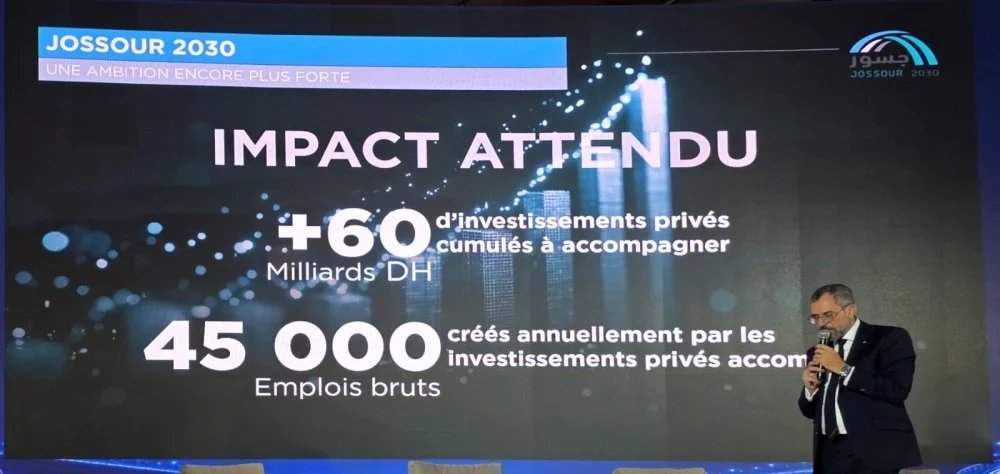
In partnership with financial sector players, the institution plans to mobilize more than 300 billion dirhams in financing (excluding EEP) over the period. This dynamic should make it possible to support more than 60 billion dirhams of cumulative private investments and contribute to the creation of around 45,000 jobs each year. “We want to achieve in five years what we accomplished in ten years,” summarized Saïd Jabrani.
In order to quickly translate this strategy into concrete actions, Tamwilcom has announced several measures which will come into force on June 4. The first concerns theexpansion of the scope of companies that can benefit from its guarantee mechanisms. The ceiling on eligible turnover increases from 200 million to 500 million dirhams, thus further opening the system to mid-sized companies and large SMEs.
The second measure targets very small businesses. THE coverage rate of credits granted to VSEs will be increased to 75%, in order to facilitate their access to bank financing.
Finally, the institution will strengthen its co-financing mechanisms in favor of three priority categories: women entrepreneurs, Moroccans around the world investing in Morocco and projects linked to the energy transition.
These beneficiaries already have preferential financing conditions, with rates of 2% for female entrepreneurship and 2.5% for Moroccans around the world as well as for projects linked to the energy transition.
Present at the launch of the strategy, the Minister of Economy and Finance, Nadia Fettahplaced this initiative within the framework of the Kingdom’s economic ambitions. According to her, Morocco’s economic transformation necessarily requires a stronger, more innovative and better financed private sector. “There cannot be economic emergence without a strong, innovative and competitive private sector, and there cannot be a strong private sector without fluid, inclusive and efficient access to finance,” she said. The minister recalled that SMEs represent nearly 99% of the national economic fabric and constitute the main engine of job creation.
The challenge of growing businesses
Same diagnosis on the side of the CGEM. Its president, Mehdi Taziconsidered that the challenge was no longer only to encourage the creation of businesses, but above all to enable them to reach new levels of growth. Today, only 0.5% of micro and small businesses manage to change category to reach the next level.
Furthermore, while SMEs represent almost the entire productive fabric, they only capture around 40% of the credits granted to private companies, compared to more than 50% in OECD countries, 65% in Japan and nearly 80% in South Korea.
The financing gap for formal SMEs is estimated at nearly 200 billion dirhams. In this context, the Jossour 2030 strategy appears to be one of the main instruments intended to reduce this deficit and support growth.
Main points of the “Jossour 2030” plan
– “Jossour” means “bridges”, reflecting the Institution’s desire to strengthen the bridges between the financing needs of economic actors, the solutions it offers and the development priorities of the Kingdom.
– “Jossour 2030” is based on an approach based on the expansion of the offer, the consolidation of intervention capacities, operational excellence and the search for a sustainable economic impact.
– “Jossour 2030” is based on a central orientation, namely supporting more beneficiaries, mobilizing more funding and strengthening the impact of the institution’s interventions on investment, employment and value creation in the territories.
– “Jossour 2030” provides for the mobilization of 300 billion dirhams of financing, for a volume of commitments of 170 billion dirhams.
To support this trajectory, Tamwilcom has announced several major developments to its guarantee and financing systems:
1. Strengthening support for Very Small Enterprises (VSE): Tamwilcom is strengthening its support for VSEs by increasing the level of guarantee coverage to 75%, in order to further facilitate their access to bank financing.
2. Extension of support to mid-sized companies: Tamwilcom is expanding for the first time its interventions for the benefit of mid-sized companies (ETI) with a turnover of between 200 and 500 million dirhams. This development will make it possible to support a new generation of leading companies in their growth, modernization, investment and international development projects.
3. Implementation of a co-financing offer at a preferential rate: Tamwilcom adopts a new generation of co-financing products at very advantageous interest rates, intended for projects carried out by Moroccans around the world, women entrepreneurs, as well as projects contributing to the green transition.