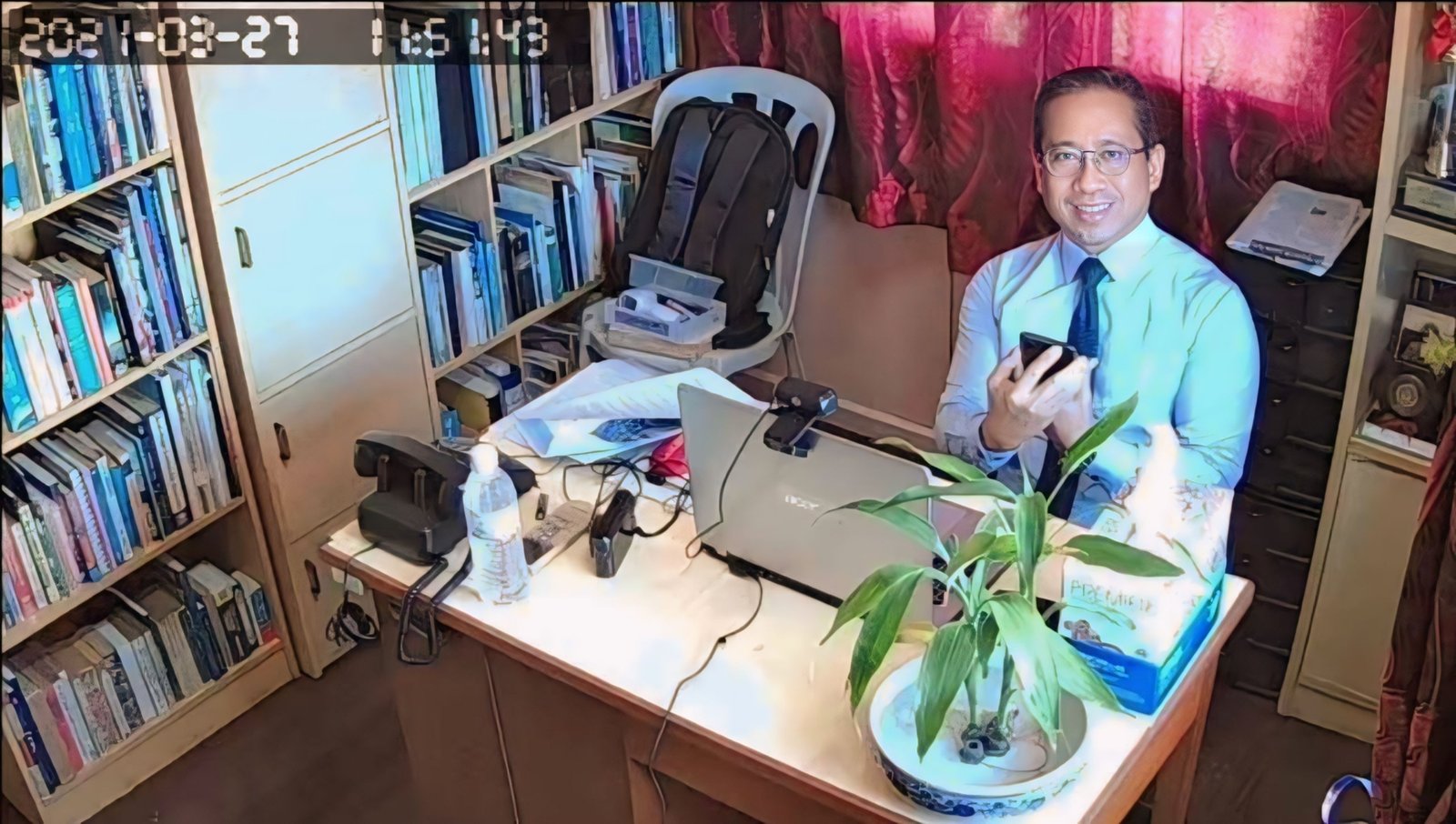

The columnist working from home during the height of the Covid-19 pandemic, as captured by his home CCTV camera.
THE Malaysian government’s decision to introduce a Work From Home (WFH) policy on 15 April 2026 marks an important shift in public sector management. The move came amid rising global fuel prices linked to conflict in the Middle East, which placed increasing pressure on Malaysia’s subsidy system and national expenditure. As transportation costs surged, the government sought practical ways to reduce commuting, cut unnecessary travel and manage public spending more efficiently. Allowing civil servants and selected government-linked employees to work remotely emerged as both an economic and administrative response.
WFH, however, is nothing new to Malaysians as it was widely practised during the Covid-19 pandemic when movement restrictions required organisations to operate remotely. That earlier experience revealed both strengths and weaknesses of remote work across sectors, including challenges in communication, supervision and digital readiness. While the policy appears logical at the national level, its effects in Sabah are more complex owing to differences in geography, infrastructure, income distribution and local economic conditions compared to major urban centres such as Kuala Lumpur or Johor Bahru.
At its core, the WFH initiative represents a response to economic pressure. Governments typically respond to such challenges by improving efficiency and reducing operational costs. Malaysia’s approach reflects this pattern. Each day that thousands of workers remain off the roads leads to lower petrol consumption, reduced congestion and decreased reliance on fuel subsidies. Over time, such reductions contribute to easing the government’s financial burden while encouraging more responsible energy usage among the population.
For employees, the financial impact is immediate and highly visible. A worker commuting daily from Tuaran to Kota Kinabalu may save a substantial amount each month on petrol, parking fees and vehicle maintenance. Even in districts such as Beaufort, Papar or Kudat, commuting costs remain significant owing to long travel distances and limited transport alternatives. For some workers, especially those in lower or middle income brackets, fuel expenses form a considerable portion of monthly expenditure. When fuel prices rise alongside the cost of essential goods such as food and utilities, the savings generated through WFH can help ease financial strain and improve household stability.
Another key advantage of WFH lies in improved work-life balance. In Sabah, commuting often involves long journeys across districts with limited public transport options. Roads connecting towns may pass through hilly terrain or rural areas, making daily travel both time-consuming and tiring. Urban congestion in Kota Kinabalu continues to worsen as vehicle numbers increase, further extending travel time during peak hours. Workers who spend hours on the road each day often return home fatigued, reducing time for family interaction, rest and personal development.
Under remote work arrangements, commuting time becomes available for more meaningful activities. A parent in Keningau may manage school routines more calmly, while an employee in Ranau may dedicate more time to caring for elderly parents or tending to household responsibilities. Some individuals may use the extra time to pursue further education, engage in small-scale entrepreneurship or improve personal health through exercise. Reduced travel lowers stress levels, improves mental well-being and contributes to a more balanced and fulfilling lifestyle.
This flexibility carries particular significance in Sabah, where family structures often include multiple generations living together. Adults frequently share responsibilities for children and elderly relatives, creating a strong sense of interdependence within households. Remote work allows employees to manage these commitments more effectively while maintaining professional responsibilities. A civil servant in Sandakan who assists an ageing parent with medical needs, for instance, may find remote work far more manageable than a fixed office schedule. In this context, WFH reflects a practical adaptation to social realities and cultural values that emphasise family support and community cohesion.
From an environmental standpoint, the policy offers meaningful benefits. Fewer vehicles on the road lead to lower carbon emissions, reduced air pollution and less congestion. This environmental advantage is especially relevant in Sabah, known for its rich natural environment, including rainforests, coral reefs and diverse wildlife. Reduced traffic improves air quality in urban areas and lessens wear and tear on road infrastructure. It further contributes to preserving the natural appeal of tourism destinations such as Kundasang, Sepilok and Kinabalu Park, which rely on clean and sustainable surroundings.
WFH contributes significantly to digital transformation within the public sector. Remote operations require greater reliance on online communication tools, electronic documentation, virtual meetings and digital approval systems. This digital transformation shift encourages government departments to modernise processes that previously depended heavily on manual paperwork and physical presence. In Sabah, where certain administrative systems have developed more slowly than in Peninsular Malaysia, this transition can serve as an important catalyst for reform. More efficient digital systems enhance internal productivity while improving accessibility and convenience for the public. Citizens in rural areas, for example, may benefit from faster online services without needing to travel long distances to government offices.
Another advantage involves the decentralisation of employment opportunities. In the past, many skilled individuals relocated to larger cities in search of stable employment and career advancement. Remote work enables professionals to remain in their hometowns while continuing to contribute to national institutions. A graduate from Tenom may work for a ministry without relocating while a resident of Kota Marudu may contribute to a federal agency while staying close to family. This decentralisation trend reduces internal migration, supports local economies and distributes opportunities more evenly across Sabah. It may even encourage reverse migration, where individuals return to their hometowns after years in urban centres, bringing skills and experience that benefit local communities.
Despite these advantages, several challenges limit the effectiveness of WFH in Sabah. The most pressing issue involves uneven digital infrastructure. Reliable internet access remains essential, yet many rural and semi-rural areas experience slow speeds, unstable connections and limited coverage. Workers in districts such as Pitas, Nabawan or Tongod often struggle to participate in virtual meetings or access online systems efficiently. Frequent disruptions reduce productivity, delay tasks and create frustration for both employees and supervisors. In such conditions, remote work becomes less efficient than conventional office-based arrangements.
Household limitations further complicate remote work. Some homes lack proper equipment such as laptops, printers or dedicated workspaces. Devices are often shared among family members, especially when children require them for school. Smaller living spaces may lack quiet environments for concentration. An employee in a busy household in Semporna may face constant distractions during meetings or work tasks. Productivity challenges in such situations arise from environmental constraints rather than individual capability or commitment, highlighting the need for supportive policies and adequate resources.
The impact of WFH on local businesses presents another significant concern. Office workers contribute substantially to daily economic activity through spending on food, transportation and retail goods. When employees remain at home, this routine consumption declines. In Kota Kinabalu, eateries that depend on office crowds experience reduced patronage. Small food operators near government offices in Tawau or Sandakan may face declining income while roadside vendors lose regular customers. For small businesses operating on narrow margins, even slight reductions in demand can threaten sustainability. Over time, reduced economic activity in urban centres may affect employment opportunities and overall economic vitality.
Productivity and accountability represent additional concerns. Remote work requires discipline, trust and clearly defined performance systems. Some tasks are easily measured through output while others require real-time collaboration and access to physical documents. Communication gaps may occur when interactions rely heavily on digital platforms. While some employees perform well in independent environments, others face challenges in maintaining focus and managing time effectively. If service delivery slows, public confidence in government institutions may weaken, particularly in sectors that rely on timely responses and efficient administration.
WFH arrangements create disparities across professions as well. Teachers, healthcare workers, enforcement officers and frontline staff continue to perform duties on-site, ensuring that essential services remain uninterrupted. This occupational imbalance results in differing experiences among employees. Office-based workers benefit from flexibility and reduced commuting costs while frontline workers maintain regular travel routines and associated expenses. Such differences may influence morale if they remain unaddressed, especially when employees perceive unequal treatment within the same organisation.
Another challenge involves blurred boundaries between work and personal life. When home becomes the workplace, employees may find it difficult to disconnect from professional responsibilities. Messages may extend into the evening, and expectations for constant availability may increase. Instead of improving balance, remote work may lead to fatigue and reduced motivation over time. This work-life boundary pressure intensifies when organisations fail to establish clear guidelines on working hours, communication practices and rest periods.
Given these mixed outcomes, a balanced approach offers the most practical solution. A hybrid work model, combining remote and office-based arrangements, provides flexibility while maintaining operational efficiency. Employees continue to reduce commuting costs, businesses retain customer flow and teams preserve essential face-to-face interaction where necessary. For instance, civil servants in Kota Kinabalu may work remotely on selected days while attending the office for meetings, coordination and service delivery on other days.
At the same time, long-term investment in infrastructure remains essential. Improvements in broadband connectivity, stable electricity supply, cybersecurity systems and digital training programmes will determine the sustainability of WFH implementation. Sabah’s rural districts require stronger connectivity while employees across all regions benefit from reliable tools and systems. Support for small businesses is equally important. Financial assistance, digital platforms and delivery-based services can help local enterprises adapt to shifting consumer behaviour.
Ultimately, the WFH initiative introduced in April 2026 extends beyond a short-term response to rising fuel costs. It reflects a broader shift in the way Malaysians approach work, productivity and lifestyle in an evolving global environment. In Sabah, the policy offers clear benefits, including cost savings, flexibility, environmental gains and digital progress. At the same time, it highlights structural challenges such as infrastructure gaps, regional inequality and dependence on physical economic activity.
The success of WFH depends on thoughtful and adaptive implementation. When supported by hybrid strategies, infrastructure development and inclusive policies, it can become a valuable tool for modernisation. For Sabah, the priority lies in maximising its advantages while addressing its limitations, ensuring that progress remains balanced, inclusive and sustainable for all segments of society.
Dr Richard A. Gontusan is a Human Resource Skills Training and Investment Consultant. He writes on academic, economic, political and social issues. His views expressed in this article are not necessarily the views of The Borneo Post.