Loading Text-to-Speech…
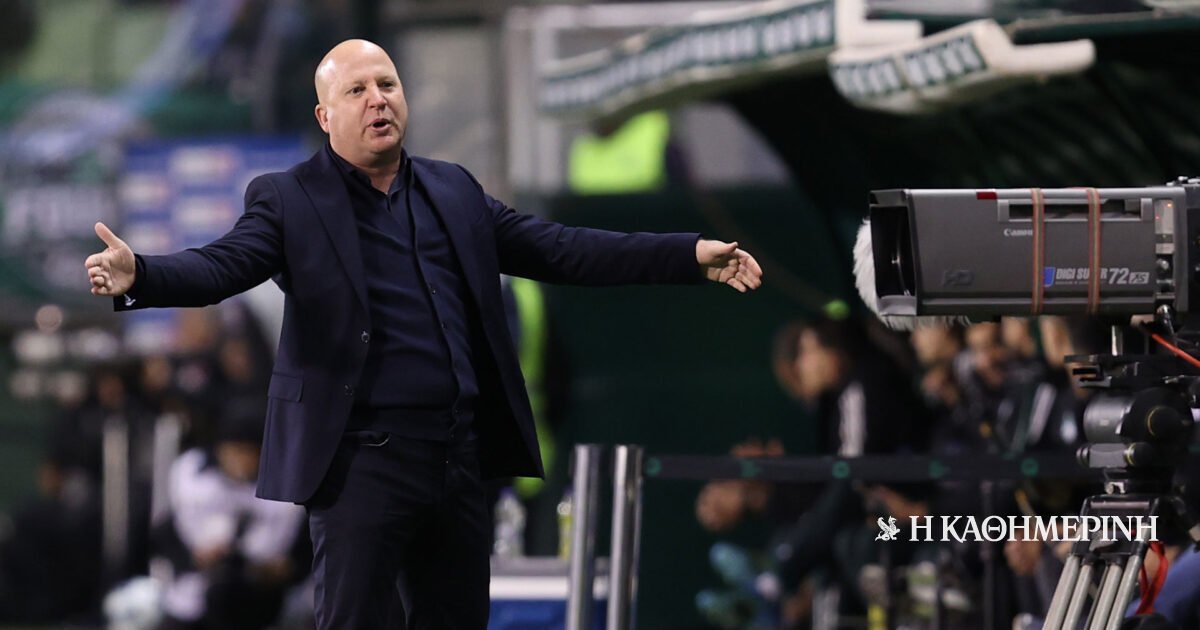
The end of the derby with Panathinaikos found Marko Nikolic monologuing, in two installments, in front of television cameras. Initially she acknowledged that her AEK the pressure created by the realization that, after the defeat of Olympiakos by PAOK in Toumba, a victory over Panathinaikos would “lock” the winning of the title in the Superleague fell “heavy” on her. Then he remembered that “every time we prepare for a festival and arrogantly approach a match we don’t live up to expectations”.
At UEFA Pro level, the highest coaching diploma in football, what Marko Nikolic described is not treated as a simple “psychological block”, but as a classic case of deviation from basic performance management principles.
Coaches at this level are taught first and foremost to separate the outcome from the process: a team that enters the field thinking about what winning will mean (a title, “locking up” a championship, etc.) is distracted from how it should play. This shift in focus and concentration – from the execution of the plan to the outcome of the performance – directly affects the quality of decisions, speed of thought and ultimately performance itself.
At the same time, the concept of “pressure” described by Nikolic is explained through the basic yield and excitation curve: there is an ideal level of tension that leads to peak performance, but when this is exceeded, i.e. when stress exceeds a threshold, performance declines. In “title-deciding” games, teams often cross this stress threshold and enter a state of hyperarousal, where the fear of error replaces clear thinking.
Added to this is another pitfall identified in UEFA Pro as ‘the closing effect’: when a team feels that they are one step away from success, they subconsciously change their behaviour. She loses her discipline, diversifies the risk she takes and often falls into a state of premature confidence. There is also the concept of arrogance mentioned by the AEK coach: at the highest level, the slightest shift from a competitive mindset to a sense of superiority can be costly.
But the most crucial point, according to the philosophy of UEFA Pro, concerns the responsibility of the coach. If a team goes into a match with their mind on the title and not on the execution of the plan, this is considered a management failure. The coach’s role is to “break” the narrative of the result, bring attention back to specific competitive actions and keep the team in a controlled emotional state.
Simply put, what happened to AEK on the Avenue against Panathinaikos with 10 players was not a regular problem. Because the plan yielded and “brought” AEK opportunities of greater value (xGoals: 2.19) than the value of the opportunities it “allowed” to Panathinaikos (xGoals: 1.21). It was a problem of concentration and moment management: the team played the title game before the “match game” was over. And so Barnabas Varga, a keen executioner, did not put the ball in the net while being given four chances in which he accounted for at least one goal (xGoals: 1.09), when his average execution performance over the last three years shows that such chances result in at least one goal.
In UEFA Pro terms, AEK’s reaction at this point in the season is not necessarily cause for concern in the form of an ‘alert’; but it is an absolutely recognizable group phenomenon in transition. Because one must always consider the starting point: a team that the coach took over last July with low confidence, carrying the psychological weight of six straight losses in the previous year’s playoffs. The fact that within one season this same team has reached the point of playing for a title “lock” in the 3rd game of the playoffs is already a profound change in the level of their self-perception.
What is observed in such cases is the transition from “survival mode” – where the priority is not to lose – to “expectation mode”, where the team begins to feel that it must win. In this phase, the pressure no longer comes from the fear of failure, but from the realization of the opportunity. And it is this shift that often creates the phenomena described by Marko Nikolic: increased tension, loss of clear thinking, and moments of arrogance or premature emotional relaxation.
At the level of analysis, this is not interpreted as a classic “relaxation”, but as an indication of a team that has not yet fully developed a winning mentality under conditions of high expectation. This is what is described in coaching jargon as an “immature winning mentality”: the team has the quality and function to get close to the goal, but has not yet learned to manage the moment when the goal becomes tangible.
What matters to the coach is not whether it happened once, but whether it is a recurring pattern. If the team exhibits the same behavior in similar game states – that is, when they are favourites, when they are ahead or when they are close to achieving a goal – then the issue turns from a normal stage of development into a problem that requires intervention. But if it is an isolated event, it is part of the so-called “growth pain” of a team that is relearning to function at a championship level. In the case of AEK there are “ups and downs”. She found a way to manage her emotions from the win over Olympiakos to the game with PAOK, but she couldn’t from the win over PAOK to the game with Panathinaikos.
In any case, the responsibility shifts to the coach and how he will manage this phase. The correction is not tactical, but mainly mental and procedural. The coach must bring the team back from outcome thinking (“what it means if we win”) to process thinking (“how we play to win”). This is achieved through clear, game-specific focus points before and during the match, which keep the footballers focused on executing the plan. At the same time, systematic work is required in training with high-pressure scenarios (game simulations), so that the players become familiar with the management of critical moments, as well as constant communicative discharge from the narrative of the title.
Simply put, the team does not need to learn to play better, but to learn to think correctly when playing to win. And this is the last, but crucial step to go from claiming to conquering. AEK is right there. And she has a few 24 hours left to pass from the stadium she was in at Leoforos to the next one, that is, the one she must be in next Sunday in New Philadelphia, when she welcomes Panathinaikos.