Loading Text-to-Speech…
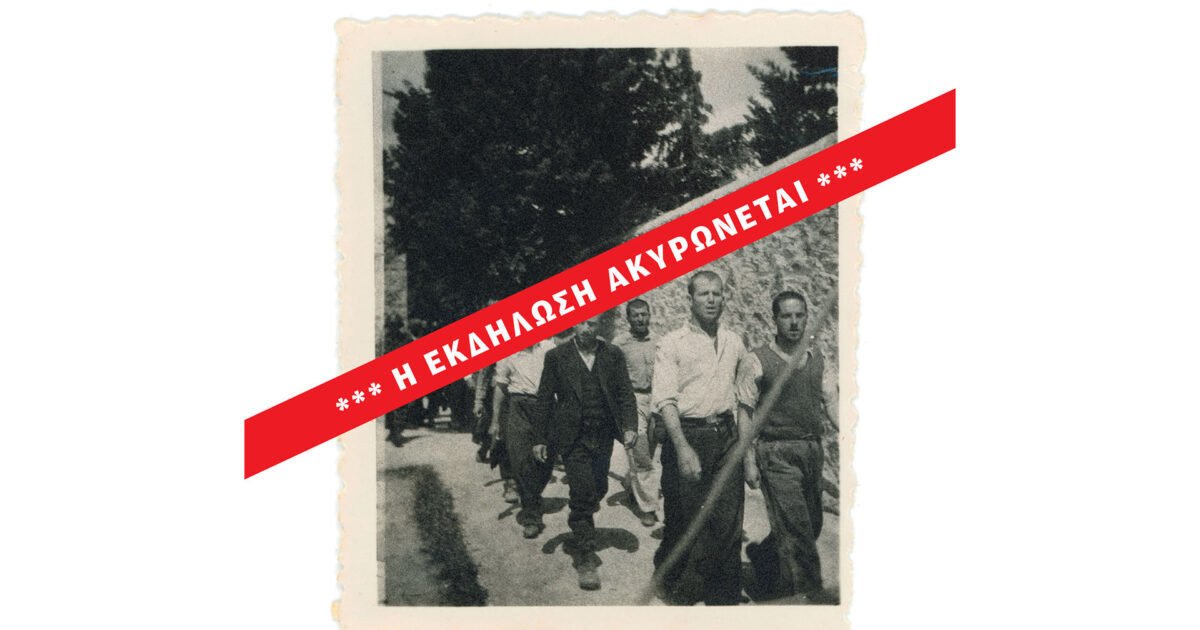
Last Thursday I was scheduled to moderate an event on “U Caesariani and the photos of the 200: from the photos of the shooters to a national monument”, which the German foundation undertook to organize Friedrich Ebert (FES) with speakers two historians, the Jason Chandrino and him Valentine Snyder. “How does the finding of the photographs contribute to a new approach to the German occupation in Greece?” And what do the images mean for Greek-German relations and the effort to form a common culture of memory?”, were some of the questions that the speakers were expected to answer, fueling a discussion with the audience.

After the critical reports, which could be described as threatening, the organizers decided to cancel the event. The interesting thing is that exactly the day before, an open debate was held with the same topic and the same speakers under the auspices of the Archives of Modern Social History, without similar reactions. Is there a monopoly on historical memory after all? Are there organizations that are entitled and others that are not entitled to organize such discussions?
H Regina Schubertdirector of FES in Athens, is categorical: “We made a proposal for dialogue. It is legitimate for someone not to accept it. It is legitimate, and even desirable, for someone to accept it and to openly and freely express a critical opinion. However, under no circumstances is it acceptable to prevent others from engaging in dialogue or to prevent others from accepting a proposal for dialogue. This goes against every democratic principle and practice.”
I took it as a threat – “When someone says ‘it’s our duty to prevent this event from happening’, I take it as a threat. I also believe that probably nothing would happen, but even if there is only a small possibility, we cannot risk it”, says Regine Schubert, director of the Foundation in Athens.
Is the invocation of security reasons exaggerated or pretentious? “I have not been in this country very long, but when someone says that ‘it is our duty to prevent this event from happening’, I take it as a threat. With this wording, nothing is ruled out. As the manager of the event I had to make decisions when we cannot guarantee the safety of the participants. I also believe that probably nothing would happen, but even if there is only a small possibility, we can’t risk it,” he says to “K”.
Because it was aborted
“Are you satisfied that the debate has been aborted?”, I ask the editor of the disputed publication in Documento Thanasis Petrakosformer SYRIZA member of parliament. “If they canceled the event because they realized that what they went to do is sacrilege, I would be happy. However, if they canceled the event because they were afraid that there would be reactions and incidents, then I am not happy at all, because they are judging other people by themselves. This shows that they have not realized and probably do not want to realize, to be precise, that what they have gone to do is unacceptable. And especially on her stay May Dayof the anniversary of the execution of the 200″.
When I ask him if he intended to come to the event, he laughs: “What are you asking me now?”. “However, I would give you the opportunity to express your opinions”, I assure him. He insists: “There must be practical recognition by the German state of the disasters it caused to the Greeks, the Greek people and the Greek territory. The non-recognition of these shows that there is no scope for discussion.”
They speak from safety – “The Germans do not have the luxury of…reflecting on their crimes from safety, to the extent, in fact, that in the case of Greece they refuse to fulfill their material debt”, says journalist Giorgos Harvalias, who is however opposed to any form of censorship.
Criticisms came not only from the Left, but also from the conservative newspaper “Demokratia”. “Those who react consider how history is purposefully attempted to soften the impressions of the German occupation through baseless comparisons and stereotypes (“the Germans didn’t kill, the Tagmatasfalites killed”, “the mass executions were military reprisals”, etc.). This idiosyncratic revisionism is unfortunately also “subsidized” by official German institutions. In this sense, the argument is based that the Germans do not have the luxury to… reflect on their crimes from safety, to the extent, in fact, that in the case of Greece they refuse to fulfill their material debt (reparations)”, the journalist and author of the book “Yavol” (published by Pedio, 2023) tells “K” George Harvaliaswho opposes, however, any form of censorship.

“In the hanged man’s house they don’t talk about rope. I don’t know if this Greek proverb has an equivalent in German. However, whether in one language or the other, the German ambassador and the German cultural institutions should know it, before organizing, and then canceling after protests, events for the photos of the executed people of 1944 in Kaisariani”, says the historian Antonis Liakos on Facebook, who speaks of “a second execution, with conciliatory fire that teeths the memory of its righteous anger”.
Apology and compensation
Although he disagrees with his colleague, the historian Hagen Fleischer he is not surprised by the reactions. They were expected and feared because whenever official German bodies are involved, the trigger is given to the well-known complainers to repeat the same expressions: “second execution, sacrilege”. During the visit of the German president Richard von Weitzacherwhen it was announced that he would visit the Shooting Range in 1987 they said they would come out of the graves, he recalls.
But also in 2014, when the Joachim Gauck he became the first president who managed to utter the hard-to-pronounce word “sorry” to the Leaguers, they still said: “Apology is good, but let the Germans bring a single franc.” “And not just one franc, 300 billion euros,” clarifies Fleischer. “Perhaps if it was the Green Foundation that had organized the event there would not have been any backlash, as the party had supported the request for the home loan.”