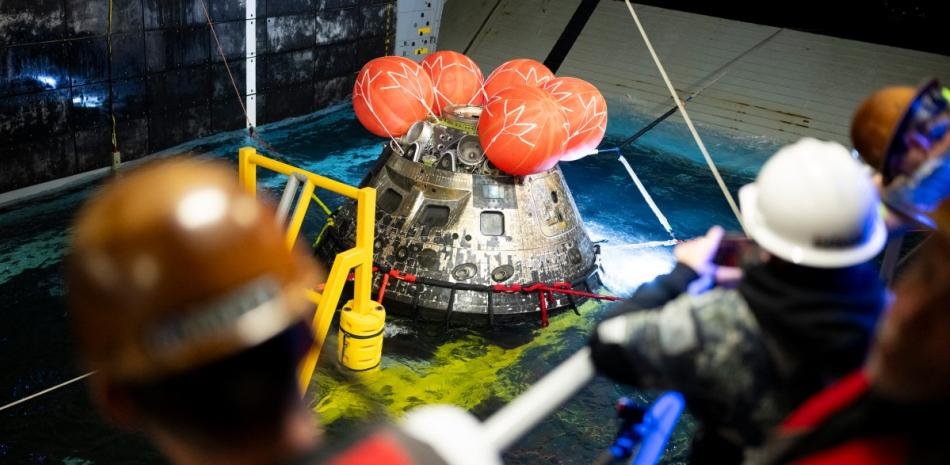
After the success of the historic Artemis II mission completed on Friday, NASA bets on millionaires Jeff Bezos and Elon Musk for the next step: taking astronauts to the Moon.
He Apollo program which sent the first and only humans to the surface of the Moon between 1969 and 1972, was designed so that only two astronauts would land on the moon and stay on the satellite for a few days at most.
More than 50 years later, the ambitions and experience of USA They have grown, and NASA hopes to send four people on a multi-week mission and eventually build a base on the satellite.
For this phase of its mission, the space agency hopes to use the modules designed by SpaceX of Musk and Bezos’ Blue Origin to take their astronauts to the Moon.
Officials say the goal is to achieve a manned moon landing in 2028.
“We need the entire industry to work with us, and they have to rise to the challenge and really get the production lines going that are going to be required to meet that goal,” Lori Glaze, NASA’s acting administrator, said at a news conference.
The Apollo program only used one rocketthe Saturn V, to carry the lunar module and the astronaut capsule. For Artemis, NASA has opted for two different systems. The first will launch the Orion spacecraft with the Earth crew, and the other will be for the lunar landing module.
“Camping trips”
The decision is made due to the technical limitations of the Apollo program, Kent Chojnacki, a senior official at the Apollo program, told AFP. POT in charge of the development of the lunar landing module.
“It was not at all suitable for long-term exploration or long stays,” he explained.
Although spectacular, the Apollo missions were like “camping trips,” said Jack Kiraly, director of government relations at the Planetary Society, which promotes space exploration.
The systems NASA is studying now are “huge compared to Apollo,” Chojnacki said.
The new lunar modules developed by Blue Origin and SpaceX They are two to seven times larger than those used in the 20th century.
The space agency is also now turning to outside partners, such as the European companies that built Orion’s propulsion module.
This new approach opens up the possibility of having more equipment and resources, but it also significantly complicates operations.
To send these giant ships to the Moonprivate space exploration companies will need to master in-flight refueling, a complex maneuver that has not yet been fully tested.
After the lunar module is launched, other rockets will have to carry the fuel necessary for the trip to the Moon, about 400,000 kilometers from Earth.
“Lose the Moon”
Because of the risky commitment and numerous delays, particularly from SpaceX having to get the module ready first, pressure has increased in recent months.
“We are about to lose the Moon again,” three former NASA officials warned in an article in SpaceNews in September.
China has also made progress in its goal of sending humans to the Moon by 2030.
Against this backdrop, NASA raised the possibility last year of reopening the contract awarded to SpaceX and using Blue Origin’s lunar module first.
Both firms announced the readjustment of their strategies to prioritize the lunar project, and maintain their lucrative contracts with NASA.
But doubts persist, above all, regarding the viability of resupply in space.
“We have a plan,” Chojnacki said, adding that NASA has a backup strategy in case of failure.
The agency plans to test a meeting in orbit in 2027 between the spacecraft and one or two lunar landing modules.
Companies will also need to test in-flight refueling and send an unmanned lunar landing module to the Moon to demonstrate its safety.
Then will follow the long-awaited manned trip to the Moon. All within a period of two years.