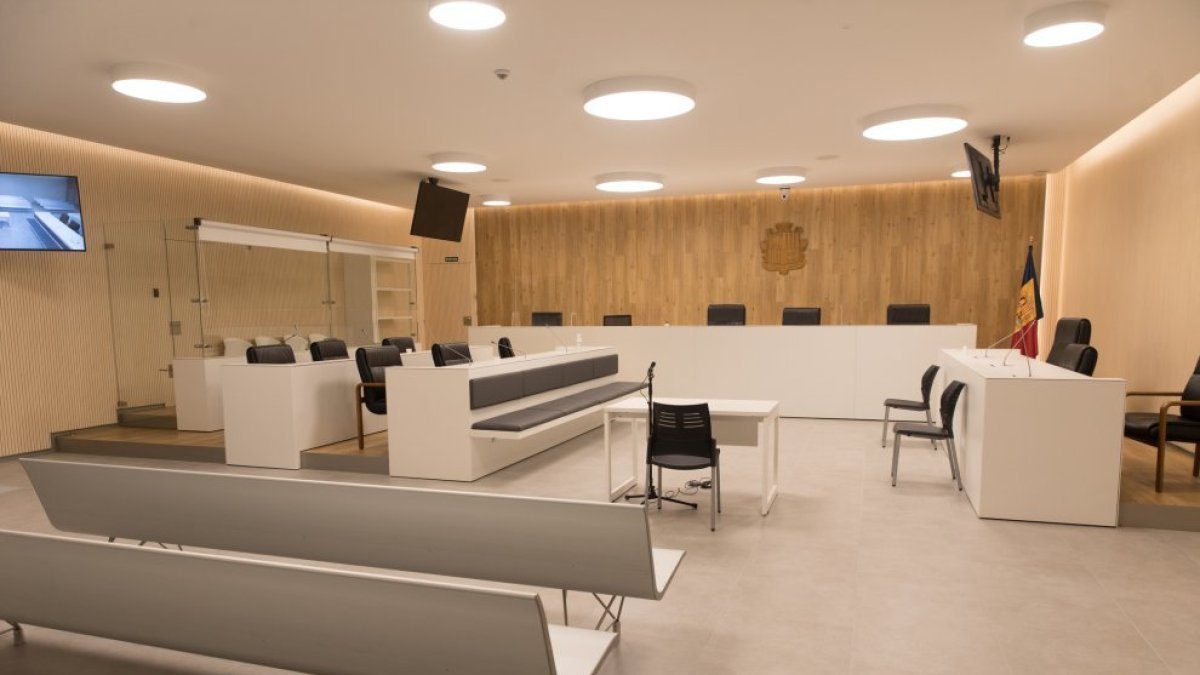

A woman sat in the dock yesterday Court of Courts accused of a major crime of slander with advertising in a case that involved years of complaints, appeals and confrontations with the entire office shift of lawyers – approximately 40 lawyers – and with different actors in the judicial system of the principalitysuch as battles or magistrates. The hearing began with an unusual preliminary question: her lawyer raised the question of whether he could continue to assume the defense because the accused had also denounced him and refused to speak to him. The court, the prosecutor and the private prosecution ruled out any incompatibility and the trial was ordered to continue. The accused intervened in French, confronted the court at several times and refused to answer the questions of the Fiscal Ministry and the accusation.
The prosecutor’s office and the prosecution are asking for three months and a 5,000 euro fine
The origin of everything is located in 2018, following a complaint filed by the woman for one alleged sexual assault against a firefighter. That case ended up being dismissed, but the conflict had only just begun. Subsequently, the defendant sent a police officer a photograph of a firefighter masturbating during duty hours. The officer transferred the image to management and es opened an internal file. From there, as the complainant explained yesterday, publications began to appear – two on social networks and three opinion articles in a national media outlet – which, in his opinion, linked him with false accusations of cocaine use and violence against his ex-partner.
The trial focused on whether those texts were written by the accused, whether they allowed the reporting officer to be identified and whether the statements constituted a false accusation of a crime. The complainant assured that he was easily recognized in the body and in his environment and that “between 200 and 300 people” had made comments to him following the publications. He reported that he had suffered anxiety and “sleepless nights”, despite admitting that he had not suffered financial losses or provided medical or psychiatric reports.
A proven crime
The Prosecutor’s Office considered the crime of slander with advertising proven. He defended that the initials, the position, the context and the relationship with the previous events made it possible to know perfectly who was being talked about in the articles and they maintained that the The woman’s accusations had not been substantiated. He also noted that the articles had been made public and that the defendant had previously admitted to writing them. For this reason he asked for three months of conditional imprisonment, the payment of the costs and that the sentence be published in the media involved or in the BOPA. The private prosecution also claimed 5,000 euros for moral damages. His thesis was that the publications had caused clear personal harm and had forced the officer to give explanations to those around him. “This is not freedom of opinion, it is accusing a person of a crime he has not committed”, he maintained.
The defense, on the other hand, asked for the woman’s acquittal. He argued that the texts were opinion articles protected by freedom of expressionwhich did not directly identify the complainant and that the IT expert evidence did not allow all the digital publications to be attributed with certainty to the defendant. An officer who intervened as an expert admitted that could not be conclusively determined nor the device or IP address from which some posts were made. The hearing also revealed how much the case had grown over the years. The defendant had filed complaints against ex officio lawyers, professionals who had represented her and members of the judiciary.
A journalist responsible for the medium that published the articles stated that the texts had passed editorial filters and that precisely attempts had been made to prevent the man from being identifiable. The medium’s defense denied any civil liability and maintained that it could not be held responsible for the fact that third parties deduced who it was about. The cause remained view for judgment after a day marked both by the legal debate on the limits between freedom of expression and slander and by the procedural trajectory of an accused who, over the years, had ended up maintaining open fronts with many of the actors who had intervened in her proceedings.
The keys to the case
- CRIME OF CALAMITIES. The Prosecutor’s Office is asking for three months of conditional imprisonment and the prosecution 5,000 euros for moral damages.
- DISPUTED IDENTITY. The indictment says the fire officer was recognizable; the defense denies it.
- YEARS OF CONFLICTS. The reported woman has maintained several open fronts with lawyers and members of the judiciary for years for other reasons.