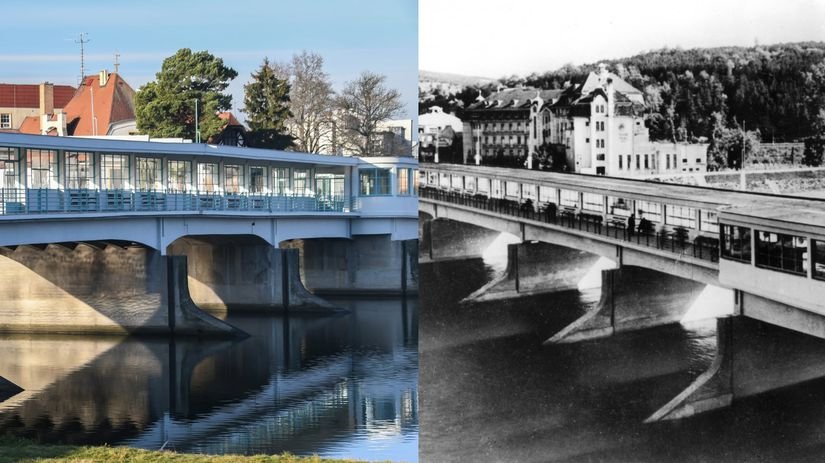
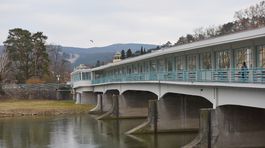
Colonnaded bridge Piešťany, known to many locals as the Glass Bridge, connects Spa Island with healing springs and the city center. It has served pedestrians and cyclists since 1933, when it was built. It underwent restoration six years ago, but due to limited resources, it was not sufficient. However, since October last year, the national cultural monument has been closed – this measure came suddenly after experts carried out an inspection below the surface.
“Based on discussions with the diver, who is also a structural engineer, and after looking at the video recordings from the dive, it was decided to temporarily close the bridge,” said the structural engineer and structural engineer of the University of Žilina, Patrik Kotuľa, who, together with Marián Drus, is the designer of the restoration project. During the inspection, they found serious damage to two pillars. A few days later, the town hall also banned sailing under the bridge. So far, the people of Piešťany are bypassing it by taking an alternative route through the adjacent Krajinský most. Subsequently, last autumn, the representatives of Piešťany announced a public procurement, while they began to deal with the rehabilitation of the bridge’s pillars as the first step.
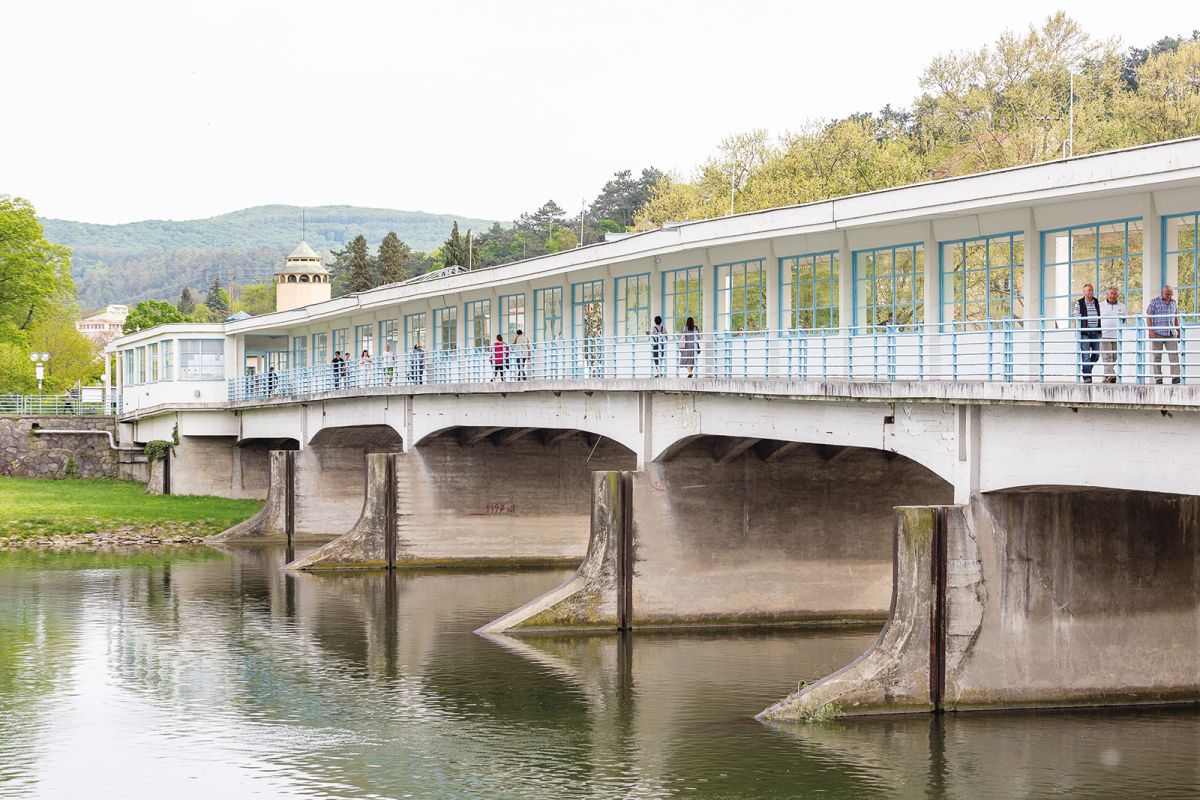 Photo: Miro Chyba / TASR
colonnaded bridge source tasr Miro Doubt Photo of the Colonnade Bridge in Piešťany.
Heavy damage was confirmed by sonar
In January of this year, the project underwent an in-depth survey of the condition of the bridge and the focus of the underwater structure as well as sonar research. The images specified where the pillars were located below the surface and made it possible to plan precise repairs without additional intervention. The manufacturer even had to modify the sonar used in Piešťany to capture the sides of the columns, not just the view from above.
So it was created 3D model of the bridge with centimeter accuracy, but the scans finally confirmed significant damage. According to experts, there is no danger of collapse, but the bridge should not carry more than its weight. The movement of people along it was therefore unrealistic. “The supporting structure of the bridge consisted of five pillars based on pylons in one row. During the war, the bridge was damaged – the third and fourth pillars were repaired, but the first and second pillars, which are the subject of rehabilitation, remained original,” explained the region in the documents for the competition.
The technical requirements for the works were also mentioned in the tender for the contractor, as they require a team of divers. The municipality accepted offers for the reconstruction of Belluš’s work until the last week of May, but has not yet chosen any of them. The work could start this summer, as long as none of the participants withdraws from the public procurement process. The contractor has eight months from taking over the construction site to complete the reconstruction.
They priced the project at a total of 2.97 million euros, and the city will have to take out a loan for most of the work. However, the amount needed for restoration is so high that the management has to draw it gradually and still does not know exactly where it will get all the money from. Partly also from the Comprehensive restoration of national cultural monuments program with the priority of protection and restoration for the year 2026, if the procedure with the selection of the contractor is accelerated.
Two months ago, the Piešťan administration managed to obtain at least 275,000 euros for the first phase of the reconstruction as part of the Renovate your house program of the Department of Culture. This concerns the stabilization of piles and the underwater concreting of the first and second pillars.
“Construction work will take place directly in the bed of the Váh River, and part of it will include securing piles and concreting underwater to prevent further washing away of the subsoil by the river current,” said Piešťany spokeswoman Alexandra Střelcová. “Underwater concreting is particularly difficult because the concrete must not melt and lose its properties during placement. It requires a special recipe, a controlled procedure,” added bridge designer Ján Laco, who also worked on the repair of historic bridges abroad.
The bedrock of Váhu is the reason why the reconstruction is difficult. A large part of the bottom consists of unstable liquid sands, which also contributed to the damage to the pillars. They have been washing them for almost a hundred years. This was confirmed by civil engineer Vladimír Benko, expert guarantor of the bridge repair.
“The pillars of the bridge were originally founded on the bottom of the river and supported by reinforced concrete piles. As a result of the erosion of the river bed and increased water flows, the foundations were washed away, while the original piles were exposed and damaged to a large extent. For this reason, the designers proposed their reinforcement,” said Benko, adding that they have been monitoring the deformations of the concrete pillars for a long time.
The Belluš bridge is almost a century old, but in addition to being a historical building, it is also an important architectural work of interwar architecture. Special sonar images were created to save it, while it was already unique at the time of its construction.
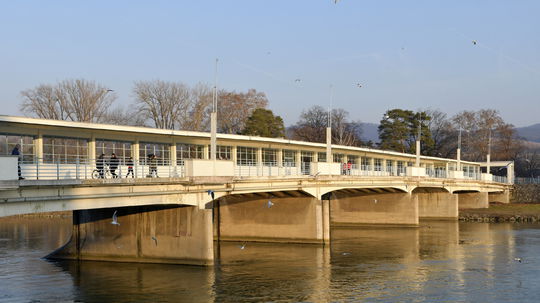
Preserve character or save the bridge?
As part of the repairs, the columns will be concreted under water. “It is specific in that it is necessary to prevent the washing out of the cement milk and the separation of the mixture when in contact with water. At the same time, it is necessary to ensure proper sealing, continuous supply of fresh concrete and control of its solidification in a wet environment,” Benko explained in detail, adding that it will be essential that fresh concrete does not touch water. According to Lac, it is important not to change the bridge, but at the same time to repair it sensitively so that it meets the safety requirements of today. In the case of a classic road or pedestrian bridge, the supporting structure, loading and subsequent operation are mainly dealt with.
“Here, the protection of the architectural rhythm, roofing, details and the overall expression of the bridge is added. It is therefore technically difficult to design interventions in such a way that they help the structure, but do not destroy its character. It is also an engineering structure. The designer must therefore respect the original character, and at the same time propose a technical solution,” he explained.
The place where the workers will repair the pillars of the bridge must be separated from the flow of water, so that the river does not wash away the material and damage the new structure – for example, with dams. First, they must create a dry or protected space around the pillar. “Rehabilitation of pillars and foundations is an operation on a very sensitive part of the bridge. The pillars transfer the load of the entire structure through the foundations to the subsoil, and if they are washed away or damaged, it is not enough to repair only the surface,” added Laco.
The project documentation, which the winning company must adhere to, was drawn up by engineers from the University of Žilina. The implementer may propose a different procedure, but it must be approved by the expert committee. Until then, the repairs should look like they will first install the formwork around the existing pillar, this will basically serve as a form for the concrete.
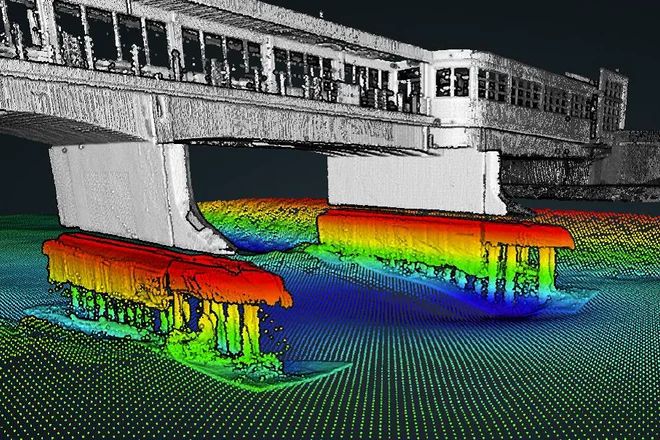 Photo: City of Piešťany
Photo of the pillars of the Colonnade bridge – bathymetry source city of Piestany Sonar image of the pillars of the Colonnade Bridge in Piešťany.
It will be anchored to the bottom of the river using piles – long columns drilled into the bedrock. The space inside the “form” is filled with special waterproof concrete. After hardening, a new massive concrete block will be created around and under the original foundation, which will better support the pillar and protect it from further washing away.
According to Lac, the balance between preserving the form of the bridge and its repairs is a dialogue between preservationists and builders. “Safety must be non-negotiable. Monuments protect authenticity, appearance, materials and details. Statics deal with load-bearing capacity, stability, cracks, deformations and durability. Most often, these views meet when asking what can still be preserved, what can be rehabilitated and what needs to be replaced or strengthened,” the designer recalled.

Unique architecture
Although it is a construction of technical infrastructure, it is also the longest covered bridge in Slovakia. Its architecture is even unique in the European context. It was created according to the design of the architect Emil Belluš, the author of important buildings such as the Danube station for the Propeller ship, or the building of the General Prosecutor’s Office in the capital.
The bridge was built for almost three years, it was opened in 1933, making it one of the top works of functionalist architecture in the country. This is also evidenced by his appearance with fine geometric lines, reminiscent of the era of Hercule Poirot. Its uniqueness lies in the fact that it is a promenade bridge with an ornate roof, which was originally also used for traffic, but also in the fact that it includes spaces for shops between the spans of the bridge.
“Benko’s stained-glass windows and especially Kühmayer’s sculpture of a bard breaker above the fountain on the city’s forebridge are also popular. The bridge was supposed to be connected to embankment pergola columns, that’s why it is called colonnaded,” said experts from SAS. Although the connection was not realized, the built bridge was both technically and visually exceptional for its time.
The structure of the bridge was calculated by the Swiss engineer A. Schwarz and built by the Pittel & Brausewetter company – which has, for example, the Bratislava polyclinic on Bezručová Street in its portfolio. The mentioned damage during II. World War also complicated the life of the bridge. In 1945, its central part was blown up. The renovation, which returned it to its original functionalist form, was completed only in 1956.