10‘minutes reading
Four decades ago, Alejandro Ojeda Carbajala 52-year-old man, returned to his work excitedly. He embraced the camera that he used, especially on weekends, while a car took him back to the Mexican newspaper’s editorial office. The Herald. He was sure of his luck, but he had to wait for the roll to be developed to check it.
I had spent the afternoon pressing the shutter on the Aztec Stadium from Mexico City, like another 50 or 100 photojournalists from different media around the world. The quarterfinals of the Soccer World Cup were being played, and the Argentine National Team faced England, one of the greatest powers in that sport.

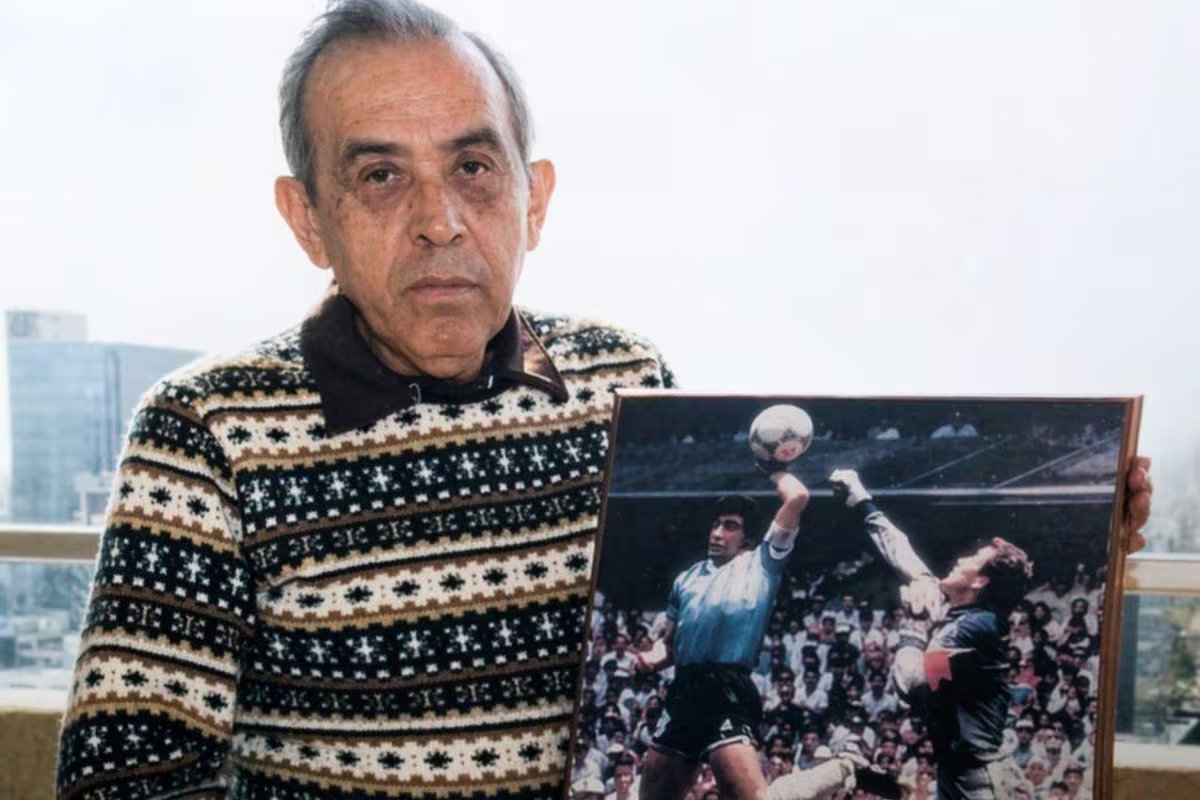
It was June 22, 1986. 45 minutes of the first half had passed and neither team had scored. It was already six minutes into the second when Diego Armando Maradonathe Ten, entered the rival area and tried to head the ball. He competed against the England goalkeeper, Peter Shilton20 centimeters taller than him. The striker’s left arm was raised, he was looking for the clean and jerk. He won the play and the ball crossed the line, went straight into the goal and scored the first winning goal that would put the National Team in the semifinal.
The VAR did not exist, and the scoreboard went ahead for Argentina, despite the fact that the British players complained about an invalid play: they said that Maradona had pushed the ball with his fist. Without listening to the reproaches, the referee ratified the goal. But the next day, the front page of that newspaper, The Heraldwould show the truth: Ojeda Carbajal checked his luck, and on the roll there was, indeed, the clear image of the hand of the Ten. The hand of God.
“I didn’t want to take photos of dead people.”
Alexander was a common man. I practiced photography more as a hobby than as a job.. In fact, although he had already covered the World Cups in Mexico 1970, Germany 1974 and Argentina 1978, his profession – with which he earned a living and filled the refrigerator – had nothing to do with cameras and film.

He loved animals, especially dogs. In fact, I worked in a dog grooming salon since I was young.. His son, Juan Carlos, was the one who told it in dialogue with different media: “He had a dog bathing and cleaning business, that was his job. But one day he began to take the pleasure of taking photos, developing them and then hanging them,” he recalled in an interview with The Commerce.
Yes, his father was fond of photography, but he had never studied. A great autodidact. Fate crossed him with the director of The HeraldGabriel Alarcón, who by pure chance took his pets to the Ojeda Carbajal store. One day, in a typical “hairdresser” talk where they talked about their lives, Alejandro told him that he liked to take photos of his children and that, for this reason, he had set up a dark room to reveal them in his own house.

Alarcón then had an idea: he asked him if he wanted to collaborate with the media that was preparing, at that time, to cover the 1968 Olympic Games. “He chose to cover Sports because it was what he liked the most. And I didn’t want to take pictures of dead people or anything like that.“Juan Carlos added. The pact was made, thus starting a link that, without suspecting it, was going to take him to the cover of the newspaper and to the mouths of many.
“I have it! I have it!”
Almost 20 years after that chance meeting, that proposal, his new profession, which he practiced in parallel to dog grooming, took him to the World Cup that was also held in his country. And on that particular June 22, he had the chance to photograph one of the most memorable matches of the competition. “Because of the experience my dad had, he usually chose where he stood. For Argentina vs. England, chose to follow the Argentine attack“, explained his son.

“In each Mexico 86 match they did not allow more than two photographers per country and per media outlet on the field. There could have been two others in the stands. I covered that match, but since they were raffled off for the positions and bibs, and it was not Spain that was playing, I was on the other side of the field. I couldn’t catch Maradona’s goal“recalls photographer Pepe Caballero, who covered the match for Brand.
After the game, clicksthe photojournalists ran: “When we all quickly went to develop, in some booths set up for that, no one had the photo, but a South American colleague, with a 200 lens in his hand, shouted in Spanish: I have it, I have it! Maybe it was that Mexican,” Caballero explained.

That “I have it” was more an expression of desire than of certainty. The proof took a while to appear. Everyone wanted to be that someone to achieve it. Until now, the doubt persisted: had it been a head or had it been a hand? The hand that Maradona himself awarded to God, and that in his book My world, my truth He predicted like this: “If it was because of the Argentines, we had to go out with a machine gun each and kill Shilton, Stevens, Butcher, Fenwick, Sansom, Steven, Hodge, Reid, Hoddle, Beardsley, Lineker. But we got away from that mess. They were just our rivals. What I did want was to throw hats and pipes at them, dance at them, score a goal with my hand. and score them another one, the second, which was the greatest goal in history.”
Francisco Javier González, editor of The Herald At the same time, he told El País about the tension they experienced in the offices in the meantime. He said: “When I returned from Azteca, the person in charge of photography, Aureliano López—now deceased—was asking about Alejandro’s material. Everyone wanted to know if I had the image of the hand. But the scrolls did not appear. Some colleagues even believe that the slides appeared in the trash. That someone, by mistake, in the heat of work, had thrown them away.”

To this, Adolfo Peñaloza, also a photographer for that medium, added: “Someone told me that he had seen Ojeda in a cantina near the newspaper. The games were played at noon in Mexico and the journalists who went to the stadium, when they returned, wanted to have lunch. I went to the bar and Ojeda was playing dominoes and having a beer. I told him ‘They’re looking for your photos!‘. ‘But I already delivered the rolls,’ he told me. ‘No, they’re not there,’ I insisted. In the end, she had left them in a bag. We returned to the journal and they began the development. Aureliano, my boss, who was strong-willed, was furious. He said ‘Will you have a hand?’ We had two photographers at the game and the first of them had not captured it. Ojeda calmed him down: ‘Of course, my friend, I have it.’” Again, the voice of hope.
“The entire photo on the front page”
The development ended up confirming that intuition. Diego’s hand made contact with the ball. “We put it on the front page, the entire photo on the front page,” Alarcón said when he saw it. Later, in an interview in the same newspaper, which quotes The CommerceAlejandro explained what that moment was like: “I was interested in following the play until the ball entered the goal. When Maradona touches the ball, I shoot twice.” And he added: “The only thing I know is that the 114,000 spectators who were at the Azteca, millions of viewers and I, appreciated a hand, I don’t know if it was that of God, while the referee did not notice it and accepted a victory that should have been a draw.”

Decades later, not only did the photo show what was suspected, but Maradona himself made it clear in the same book: “But (the ball) fell to me like a little balloon, like a little balloon fell to me. Aaahhh, what a gift, dad… ‘This is mine,’ I said. ‘I don’t know if I’m going to beat (Shilton), but I’m going for it.’ If he charges me, he charges me‘. I jumped like a frog, and that was what Shilton didn’t expect. He thought, I think, that I was going to crash him. But I jumped like a frog, look at the photos (…). If you look at the photos, the difference between Shilton and my hand and the ball is big. Shilton doesn’t even appear and, if you look at his feet, I’m already taking off, I’m still up, I’m still going up, and he hasn’t even taken off yet. (…) The ball had come out very strong. I hit him with my fist “But it came out as if it had been a left-footed blow rather than a head-butted one.”
And he added: “I don’t regret the goal with the hand at all. I don’t regret it! With the respect that fans, players, and leaders deserve from me, I don’t regret it in the slightest. Because I grew up with this, because In Fiorito I constantly scored goals with my hand. And I did the same thing in front of more than 100,000 people who didn’t see me… Because everyone was shouting the goal.”

A few years ago, Juan Carlos spoke about his father and photography with TV Azteca: “He told it with teary eyes, that It was wonderful to have captured that sublime moment of footballwhich was controversial, in a match where Maradona scored one of the most beautiful goals in the world, so it was very nice that he had that great satisfaction.”
“My father was very dedicated. He said that what he liked most was being sent to football. Whenever he took a good photo, he knew it, he had that gift, that feeling,” he recalled.
The image of a Mexican photographer
Years later, the photo that earned Alejandro the National Journalism Award of Mexico in 1987, became the protagonist of a global debate.
Initially, the British media tried to buy the rights to the image. Juan Carlos detailed to The Country: “The next day, the BBC in London contacted my dad to buy the slide. They offered him 10,000 dollarsbut he said no. I was 23 years old and I asked him ‘Sell it, dad’, but he told me that he was not honest, that the photo was from the newspaper. There was no copyright then, or we didn’t know it. Later, whether the newspaper made a profit or not, I don’t know, but it was always a source of pride for the family.”

Now, depending on where the photo appears, the credit is assigned either to Ojeda or to an English photographer, Robert Thomas. Several journalists tried to contact him to clarify the situation, but the reporter does not accept interviews.
“That photo is in many places, in the Azteca Stadium, in several football museums. It would be interesting if at some point they put it there that that photo was taken by Alejandro Ojeda Carbajal, who, at that time, worked for the Heraldo de México. It would be nice to know that a Mexican photographer took it”said his son.