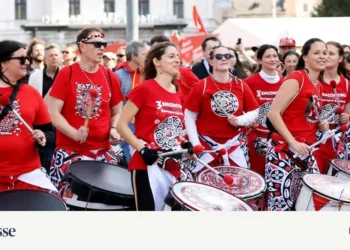
A delegation from the Chinese Society of Automotive Engineers (SAE) in Vienna provided an insight into how industrial policy also can look.
Where we stand
Looking at the three largest global motor vehicle markets for cars and light commercial vehicles (only with these the picture is meaningful) shows growth, but no breakthrough of the battery-electric car (BEV). In Europe, the third largest market, the relevant BEV share grew very moderately from 15.78 to 16.64 percent of sales from the full year of 2025 to the first quarter of 2026. Combustion engines fell by four percent to 48.2 percent, while hybrids of all kinds – i.e. vehicles with electric and combustion engines – increased by around the same amount. Their steady growth in recent years suggests that this type of drive will soon become market leader.
China, BEV’s paradise? There can be no question of that: the BEV share – again for cars and light commercial vehicles – actually fell in the period mentioned, from 28 to 24.4 percent, which is mainly due to the expiration of government funding programs. Hybrids of all kinds also fell slightly to just under a fifth of sales. Solo burners make up over 56 percent. This is certainly not a permanent scenario, just like in the USA, where electric cars are currently kept small according to the government’s wishes: they only account for 5.85 percent of sales – and over two thirds of the BEV top ten alone Tesla –; With over 78 percent of US sales, combustion engines leave just a little room for hybrids of all kinds (15.8 percent). BEVs play almost no role in South America, Africa and Japan.
When it comes to political strategies, Europe is firmly committed to a “tank to wheel” approach and thus to BEVs as the sole vehicle for CO2-Reduction. China prefers “well-to-wheel”, the entire consideration of manufacturing, supply chains and operations, and thus BEVs and hybrids of all kinds, in order to reduce CO2-Effectively push back the share of the transport sector. In the USA, the motto “Drill, baby, drill” is celebrating a renaissance.
Combustion engine future
The de facto ban on combustion engines that still exists in the EU has undoubtedly had a strong effect: the relevant technological development has almost completely migrated from Europe to China. In the uninformed, even blind trust that the battery-electric car would win the race, that the lack of an exhaust meant zero emissions and that the combustion engine was a hopelessly obsolete model EU Commission a key technology was revealed.
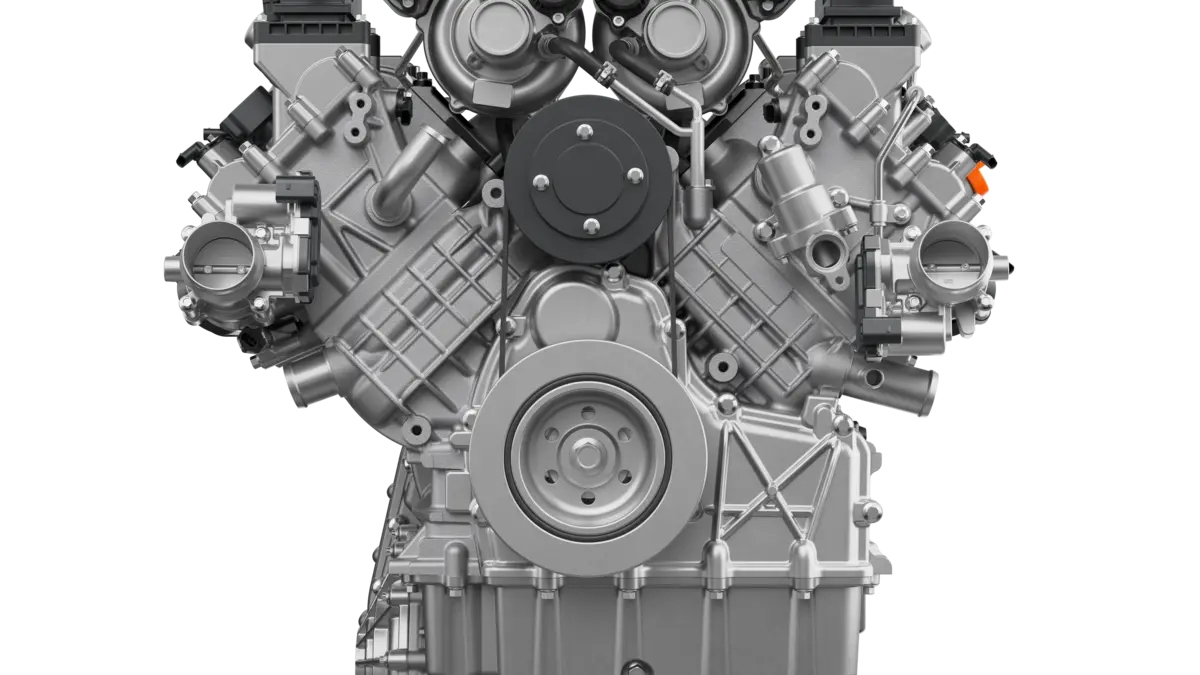
Research and development on pistons, cylinders, injection, controls and transmissions is more intensive than ever before – of course with the combustion engine in its new role Dedicated hybrid engine (DHE), not just modified, but designed from the ground up to work together in a hybrid drive train. Such a 1.5-liter four-cylinder, as presented by Aurobay at the symposium, achieves a maximum efficiency of 48 percent and above. In series production, 46.5 percent are already on the road.
The same dedication applies to high-voltage batteries, electric motors, transmissions and control electronics – not just adapted and optimized, but specifically developed for the requirements of hybrid systems. Wherever the BEV is not the first choice, for whatever reason, hybrid systems allow maximum efficiency through high combustion efficiency, relatively small batteries and therefore lightweight construction – and in the future also CO2-neutral operation through the use of synthetic and fossil-free fuels such as hydrogen, methanol and other e-fuels. Remarkable: The originally tiny but rapidly growing group of range extender hybrids (REEV) already reached over 1.2 million vehicles in China last year.
China has a plan
Intake, compression, work and exhaust – the four strokes of the gasoline engine can also be used metaphorically for the development of the Chinese automobile industry. After the learning and imitation phase supported by the West, China has now found its own formulas according to which the reduction of greenhouse gas emissions in the transport sector is accompanied by an increase in economic power. They are summarized in the Mao Bible of Chinese engineers and strategists, the latest edition of which was presented as a European premiere at the Vienna Motor Symposium: the Roadmap 3.0. The two thick volumes are now also available in German translation and contain the country’s “collective knowledge”, compiled from science, research and development in alignment with the government’s goals.
Xu Xiangyang, professor at Beihang University, explained the key points in Vienna that essentially revolve around the various technologies of “New Energy Vehicles” (NEV). Their share of cars should be 70 percent by 2030, 80 percent by 2035 and 85 percent by 2040. The proportion of purely electric cars in NEVs – including plug-in hybrids and those with range extenders – is to be gradually increased to 80 percent by 2040. This is where the importance of the internal combustion engine comes from, because, says Xu, by then a third of all cars will still have one in various degrees of electrification. In 2025, NEV sales in China were 48 percent.

Visiting Vienna: Xu Xiangyang from Beihang University spoke at the engine symposium Roadmap 3.0 for China’s auto industry. Joseph Krpelan
The roadmap, which is developed every five years, contains detailed optimization goals for combustion engines, electric motors, transmissions, controls and AI-supported software, without necessarily specifying specific technologies. The roadmap also contains sales targets that one would like to achieve with “sustainable growth”: that would be 38 million by 2030, 40 million by 2035 and 41 million by 2040. Xu points to the great market potential in the country, where there are currently 260 cars per 1,000 inhabitants (in the West this number is twice or three times as high). Nevertheless, one can easily calculate that the desired growth will be based on strong exports – no longer as low-cost suppliers, but with goods that are superior in terms of technology and price.
Hydrogen is coming
But initially less in Europe, where the corresponding political course is not being set, but in Asia – in China, Japan and South Korea. China sees hydrogen as a strategic key technology as a climate-neutral energy source and vehicle drive. According to Roadmap 3.0, over four million vehicles with fuel cells are expected to be on the road in China by 2040 – a ten percent share of the projected total volume.
The renowned hydrogen expert Helmut Eichlseder from the TU Graz In the context of the engine symposium, reports on field tests in China, in which the 50-ton trucks that are common in the country are on the road in parallel with both fuel cells and hydrogen in direct combustion. This makes it much easier to compare the advantages and disadvantages of both systems than simply putting them to the test, as is the case in Europe. The differences in consumption achieved, reports Eichlseder, are in the low single-digit percentage range. Direct combustion would foreseeably be more suitable for heavy-duty transport, also because manufacturers can rely on existing production lines. Even fuel cell pioneers such as Toyota and Hyundai now attach great importance to direct combustion.
Eichlseder, co-author of an industry bestseller on the subject, also warns of the strategic importance of hydrogen for Europe as a resilience factor. In Austria, Styria in particular has established itself as a know-how cluster. “Others can probably do production better, but we have to be involved in research and development. We’re good at that.”
What does Europe show?
Partly sheer desperation – but also defiant fighting spirit. The enemy, to summarize a large number of lectures, is seen less in other regions of the world than in ideology-driven regulations that prevent free competition in Europe. In addition, EU Commission frameworks such as the Industry Accelerator Act and the Battery booster sometimes directly contradict each other.
“It was hastily patched together in order to be able to present something,” says Stephan Neugebauer, chairman of the European research and advisory committee Ertrac. At BMW He heads the group-wide research – in this role, too, he would like to have targets that are open to technology and planning security, as has been available for many years at the Far Eastern “system competitor” (Ursula van der Leyen) in the form of the roadmap – with measurable success. “We have to be pragmatic,” Neugebauer concluded his remarks, “let’s learn from China!”
»We have to be pragmatic. Let’s learn from China!”
Stephan Neugebauer
Ertrac Chairman, Head of Corporate Research BMW
Alpine showed an interesting detailed project with the development of a limited sports car for Renault: The electric new edition of the legendary R5 Turbo from 1980 will be fueled with plenty of horsepower via wheel hub motors in the rear wheels. Whether the problem of unsprung masses can be brought under control remains to be seen.
The final lecture was given by Frank Blome from the VW-Subsidiary PowerCo, which is producing battery cells at three locations – Germany, Spain, Canada. In Salzgitter, Germany, they want to be “on top of their game” by the end of the year, Blome announced. The standard cell that then rolls off the assembly line, coolable on both sides and fire-proof, will be used for up to 80 percent of the group’s products, first in the VW ID.Polo that has just been presented. Independence is, of course, relative: the cell and the factory were developed with Chinese partners, the manufacturing equipment comes from China, as does 100 percent of the cathode material.
As a way out of the crisis, supplier association president Matthias Zink now recommends reading the Draghi report from 2024: “It’s all in there.” Europe’s roadmap just needs to get started.
»The system consideration is the decisive factor – drive and energy from the cradle to the grave.«
Bernhard Geringer
TU Vienna, ÖVK chairman
Presented
The capacity of ACC, currently Europe’s largest manufacturer of battery cells, is expected to be 40 gigawatt hours by 2033. That would then correspond to a global share of 0.4 percent. The capacity is currently 13 GWh, and the industry leader CATL (China) has 734 GWh.
20 percent of global vehicle production (passenger cars and light commercial vehicles) came from Europe in 2025. In 2017 it was 26 percent. S&P predicts a further decline of seven percent by 2030. China accounted for 34 percent of world production last year.