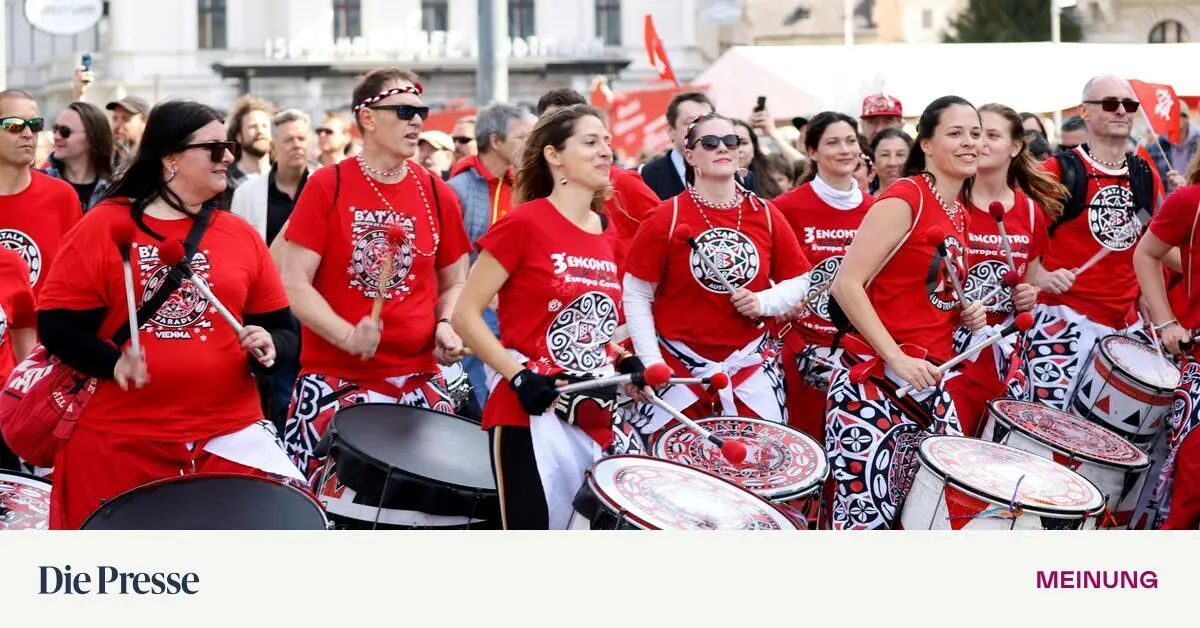
Friday is May 1st and something like the start of the unofficial holiday season: Ascension Day, Pentecost, Corpus Christi – the country has a lot of days off in the next six weeks. In principle, this is not a reason for complaint, at least from the employees’ point of view. When it comes to the number of public holidays, Austria has 13 nationwide days of rest, slightly above the EU average of twelve.
But what’s irritating about it is the proportion of Christian holidays: there are eleven of the 13, two of the eleven – Corpus Christi and the Conception of Mary – are even mainly Catholic. In addition to May 1st, the national holiday, only the national holiday on October 26th is secular in nature. And this in a country in which the proportion of church members is around 60 percent, including members of the Catholic Church (less than half of the population for the first time since 2024) as well as Orthodox and Protestant churches.
Of course, some people probably define themselves as Christian outside of churches, around 68 percent according to the 2021 microcensus. But is that enough to justify 11 out of 13 holidays, or 85 percent?
A holiday is an enormously powerful political measure. It affects almost everyone in the country, it is relatively expensive for the economy – and the occasion always tells a story about the respective society. The Soviet Union had the October Revolution and Hitler celebrated his birthday. Germany celebrates reunification and the USA celebrates its independence. A legal day of rest protects (supposedly) common concerns, allows for commemoration, celebration or both.
In an increasingly diverse society, Austria would do well to question the common celebrations and make more of them. Labor rights on May 1st, neutrality on October 26th – all well and good, but are these enough shared values? Why not celebrate the resolution of the first federal constitution in 1920 on October 1st or the anniversary of the liberation from the Nazi regime in 1945 on April 27th? Or commemorate the uprising against the Austrofascist regime in 1934 on February 12th? All of them are occasions that involve preserving democracy – something that is still not a given today. These are concerns that many people who grew up somewhere else can probably identify with.
“In an increasingly diverse society, Austria would do well to question the common celebrations and make more of them.”
Speaking of multiculturalism: If you want to focus less on Austrian history, March 8th, Women’s Day, would also be a worthy holiday. Or World Children’s Day on June 1st? On these occasions, you could use the shared pause to think about which values you should agree on. After all, there are culturally different approaches to women’s rights and raising children.
Any changes are often argued with the Concordat, the international treaty between Austria and the Holy See that has protected the rights of the Catholic Church since 1934. But not all days that are important for the Catholic Church are fixed here: the concordat does not prescribe Easter and Whit Monday or St. Stephen’s Day on December 26th. An exchange would therefore be legal. Apart from that, history shows that the Pope also lets people talk to him. In the 1950s, Peter and Paul, June 29th, was removed from the Austrian holiday calendar.
Of course, at the end of the day, holidays are, above all, days of community. The family, the circle of friends, the place – at least for the most part – have free time at the same time. Everyone is doing something similar, even if it is “just” staying at home. But this happens against an ultimately political background. The sense of connection it creates makes holidays a powerful tool. Which is why it is time to consider what Austria is using this for.
About the author: Anna Goldenberg is a journalist and author and lives in Vienna. She writes here every 14 days, alternating with the journalist Thomas Weber.