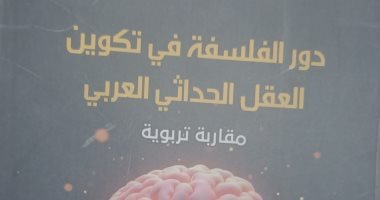
Recently released by Egyptian General Book AuthorityA new book entitled “The Role of Philosophy in Forming the Modern Arab Mind… An Educational Approach” by Dr. Hanan Al-Ghawat, which is an intellectual work that seeks to dismantle the crisis of Arab education from a philosophical perspective, with a focus on the role of teaching philosophy in building a modern critical mind capable of keeping pace with the challenges of the era.
He takes off The book From a central problem related to the education crisis in the Arab world, inspired by the proposal of the Moroccan thinker Muhammad Abed Al-Jabri, who considered that education represents the “chronic problem” that tops the rest of the problems in Arab societies.
The author emphasizes that this crisis is inseparable from a deeper crisis related to the structure of the Arab mind itself, which has been of interest to researchers and educators, in an attempt to monitor deficiencies and suggest ways of reform.
The book focuses on the concept of the “modern mind” as one of the most important outcomes of human thought, with critical thinking representing its basic foundation. The author believes that achieving this goal necessarily passes through the educational system, especially through teaching philosophy, because of its role in developing critical awareness and refining the learner’s personality. However, the reality of Arab education – according to the book – suffers from a severe crisis in the position of philosophy within the curriculum, which calls for a reconsideration of its teaching methods and contents, especially in the secondary stage, which is considered a pivotal stage in forming students’ awareness.
The work raises a set of fundamental questions about the reasons for the failure of the philosophical lesson in the Arab world, including: Does the crisis lie in the social references of the learner? Or in the nature of the educational content? Or in the teaching methods themselves? He also questions the extent to which the current philosophical lesson is able to develop critical thinking, or does it contribute to perpetuating indoctrination and the reproduction of knowledge in a rigid manner.
The book points out that the reforms witnessed in the teaching of philosophy in some Arab countries, including Morocco, did not touch the essence of the problem, as the philosophical lesson was often transformed from a space for creativity and criticism into a mere process of memorization and memorization, which leads to opposite results, such as promoting submission instead of developing intellectual independence.
The book also addresses the historical and political backgrounds that contributed to the formation of a negative view of philosophy in some Arab societies, reviewing the ancient conflict between intellectual currents, which was embodied in the controversy between Abu Hamid al-Ghazali and Ibn Rushd, a conflict whose effects still extend to this day in the form of conservative or rejecting positions on philosophy.
In this context, the book warns against the continued marginalization of philosophy, stressing that building a critical modern mind requires liberating thought from superstition and stagnation, and being open to the tools of rational analysis. It also indicates that Arab societies are still suffering from formal modernity, limited to importing products without adopting a truly rational approach to thinking.
The book concludes that reforming Arab education, and building a human being capable of creativity and independent thinking, will not be achieved except by restoring philosophy within the educational system, as an essential entry point for consolidating the values of modernity and rationality, and enhancing the ability of individuals to understand their reality and interact with it with critical awareness.