
“Two or three days,” President Trump initially responded when asked how long hostilities with Iran would last. After thousands of attacks, Iran continues to send missiles and drones to Israel and its Gulf neighbors.
Not just to American bases. Cities, civilian airports, ports, the oil industry and ships are also targets. And some of it gets past the air defenses. Tuesday the United States closed its embassies in Riyadh and Kuwait City after drone attacks.
Previously arrived in Kuwait six American soldiers killed by drones. In Bahrain, drones caused damage to the headquarters of the Fifth Fleet. US citizens in the region have been advised to leave. “It may take some time before our war goals are achieved,” General Dan Caine, the top US military official, admitted on Monday.
Iran has drones in all shapes and sizes, but a leading role seems to be reserved for the Shahed-136, the kamikaze drone that Iran has supplied in large quantities to Russia for attacks on Ukraine.
The unmanned aircraft has a delta wing with a wingspan of two and a half meters, a piston engine with a pusher propeller and a warhead weighing fifty kilos. With a unit price of several tens of thousands of dollars, it is dirt cheap and can be built quickly in series.
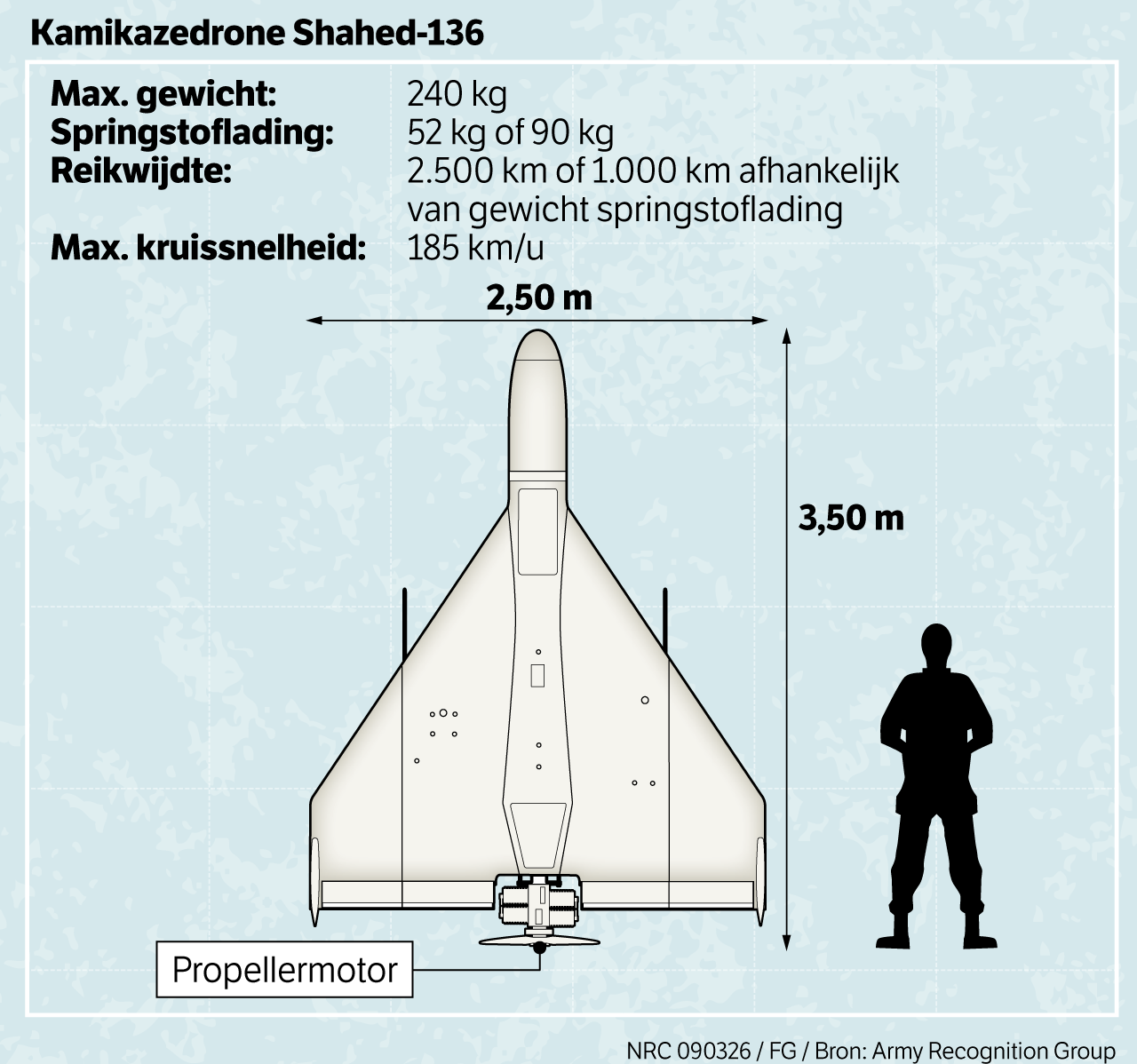
The Shahed-136 is literally none rocket science.
Gulf states have invested billions in high-tech defense against Iranian ballistic missiles. Most radars, including those of the American Patriot and Thaad batteries, are focused on such missiles, which come ‘from above’. Not on a small, slow (less than 200 kilometers per hour) and low flying object, inconspicuous until it is too late. That’s what makes the Shahed-136 such an effective weapon.
Loitering ammunition
“This little plane has no ammunition, it is yourself the ammunition,” it sounded breathless when Israel introduced the Harpy thirty years ago, a small plane – with the same delta wing and a pusher propeller – that could circle for hours above the battlefield and then strike, like the mythological monster birds after which it was named.
Israel had the idea of the loitering ammunition (literally: loitering ammunition) copied from a German unmanned aerial vehicle aircraft from the Cold War. Iran in turn adapted the Israeli idea for a weapon that does not ‘loiter’ but flies directly to its target.
After the large-scale Russian invasion of Ukraine in February 2022, Iran supplied thousands of them to Russia, which attacks cities and the energy grid in Ukraine with them every day.
In the meantime, Russia itself is building variants of the Shahed in enormous numbers under the name Geran-2, -3, -4 and -5; about six thousand monthly. Russia no longer needs Iran for this, experts say. “Iran plays a negligible role in the supply chain,” said John Hardie of the Foundation for Defense of Democracies, a US think tank. against Euronews.
It is therefore unlikely that the Iranian Shahed attacks will come at the expense of Russian capacity. Still, Russia is concerned. That’s because the Shahed family tree has branched out even further: The US is now making its own copy of Shahed, which was destroyed during the recent attacks has been deployed for the first time against Iran itself.
Americans produce improved Shahed
That American drone is called LUCAS, from Low Cost Uncrewed Combat Attack Systemand is basically an improved Shahed. “We got our hands on an Iranian Shahed and recreated it,” an official told the defense website The War Zone last year.
“(Lucas) offers advanced capabilities at a fraction of the cost of traditional long-range systems that can achieve similar effects,” a military spokesman said this week.
The biggest difference: the American Shahed has a flat, square antenna panel on the back that looks exactly like the antenna of Elon Musk’s Starlink satellite communications network. This could also be used with the highly secured and virtually undisturbed Starshield network that Musk built for the US government and which works with similar satellites.
That could enable a new dimension in drone warfare: drones that, immune to disruption, operate in a… self-managing swarm fly like a cloud of starlings, and can be adjusted along the way.
Imagine that Ukraine would have access to such drones via the ‘American route’, they wrote Russian military bloggers. “If we don’t find a solution for this within a year, it will be unpleasant for us.”
Also read
Gulf states shoot down Iranian drones with expensive anti-aircraft defenses, ‘like using a Ferrari against an e-bike’ – but their supplies are rapidly dwindling
:format(webp)/s3/static.nrc.nl/wp-content/uploads/2026/03/03093353/030326BUI_2031971971_1.jpg)
:format(webp)/s3/static.nrc.nl/wp-content/uploads/2026/03/03191539/040326VER_2032014057_Drone.jpg)
A Shahed-136 in the sky over Kermanshah, western Iran, in April 2024, when Iran shot more than a hundred drones towards Israel.
Photo Anonymous/via AFP