Miami/There are people who give the past as much importance as the present, and we consider, at least in the political sphere, that it is the best nutrient to face the challenges of each day, a criterion that, in part, motivated the holding in Miami of a conference on Castro’s subversion in Central America and the Caribbean, in which the speakers, very well versed, presented knowledge that many people have forgotten, or even worse, have never wanted to know.
The conference, organized by several exile institutions and the cooperation of the Patriotic Union of Latin America, represented by its president, retired Guatemalan army captain Óscar Lucero, was held at the Public Library of the city of Hialeah, a venue that never closes its doors to a cultural event.
The moderator of the event was Dr. Daniel Pedreira, an academic with extensive experience in these functions and with a notable ability to conduct activities in which divergent criteria can be detrimental to the quality of the meetings.
Fidel Castro was a subject with a deep imperialist vocation who always considered that Cuba was too small for his talent.
The first presenter was the exiled Nicaraguan writer and journalist Georgina Lupiac, who emphasized the support that Castro’s totalitarianism gave to the insurgents who identified themselves as Sandinistas and how the Castros turned Cuba into a sanctuary for terrorists. The writer explained in great detail the decomposition of her country’s society and economy following the Sandinistas’ takeover of power under the influence of the Castro brothers, a factor that has greatly promoted corruption in her country.
At the end of his appearance, Pedreira called Alexis Ortiz, a Venezuelan journalist, writer and politician, to the stand, who recalled how Castroism supported the Venezuelan insurgency with all types of weapons and training, to later ally with Hugo Chávez and Nicolás Maduro, an association that led the richest country in the hemisphere to the most atrocious misery, eliminating the freedoms it had enjoyed in the 40 years of democracy.
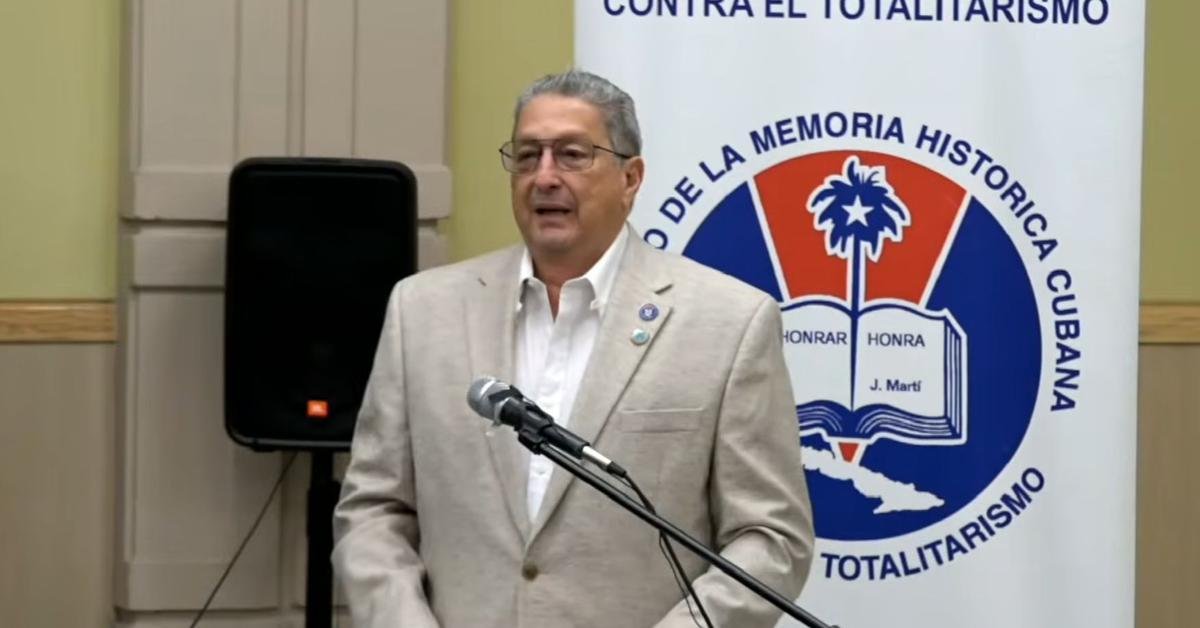
When I was called to the stand, I said that Fidel Castro was a subject with a deep imperialist vocation who always considered that Cuba was too small for his talent, which is why in the same year 1959 he organized four armed expeditions, all unsuccessful, against Panama, Santo Domingo, Nicaragua and Haiti, frustrations that stimulated him to subvert order in the Americas, leaving trails of blood and pain in each and every one of the countries of the hemisphere.
Lucero described with precision and lucidity that the Guatemalan conflict lasted for decades thanks to the support of Castro’s totalitarianism.
The closing of the meeting fell to Óscar Lucero, who deeply thanked the organizers of the activity and the library for having been invited, immediately explaining the work carried out by the Patriotic Union of Latin America, its commitment to freedom and democracy, while, he explained, the concern of the entity he presides over the difficult living conditions faced by numerous soldiers in the hemisphere who at the time firmly fought the insurgent groups that, associated with organized crime, seriously threatened our freedoms. and rights.
Lucero described with precision and lucidity, while showing books of his authorship on the subject, that the Guatemalan conflict extended for decades thanks to the support of Castro’s totalitarianism that since 1960 supported the violence of the insurgents with weapons and explosives, emphasizing that Guatemala is the only country where a US ambassador has been assassinated, 1968, John Gordon Meir together with Colonel John D. Webber, head of the military mission in Guatemala and Lieutenant Commander Ernest A. Munro, naval attaché, adding that these crimes had the consent of the Castro brothers.
The president of the UPH pointed out that in those years while the United States was fighting communism throughout Southeast Asia, the Latin American armed forces faced, with almost no resources, the Castro allied forces against common criminals linked to all types of crime, including drug trafficking.
After the presentations, Dr. Pedreira allowed time for questions and answers that showed the interest of the attendees in the issues discussed and the need to continue addressing similar topics or, at least, expand them, since El Salvador’s experience with the guerrillas, also sponsored by the Castro system, should be aired, taking into account that this conflict, like the rest of those that occurred in Central America and the Caribbean, were particularly bloody.