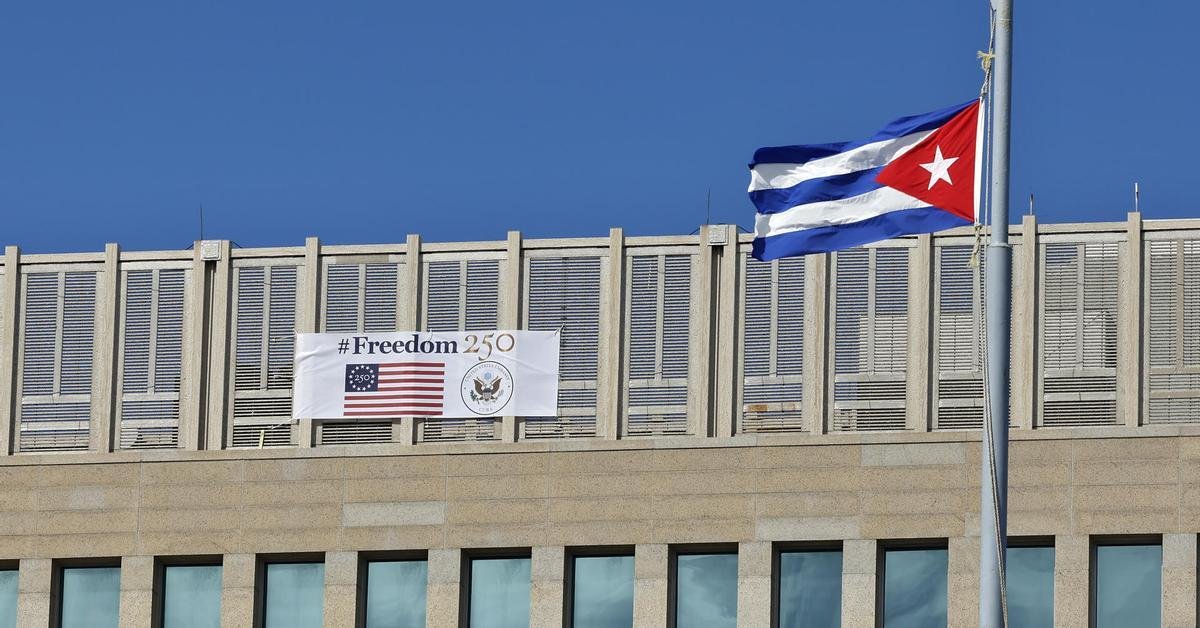
Havana/There are no black flags anymore, like those that flew from the masts of the old Anti-Imperialist Tribune, that can cover a poster like the one that the United States Embassy in Havana hung from its façade this Wednesday. Coinciding with the day of the vote against the embargo at the UNthe diplomatic headquarters has placed a white cloth supported by ropes on which a flag of its country, the Embassy’s shield and the word #Freedom appear next to the number 250, the number of years that the United States celebrated as an independent nation on July 4.
It is a poster similar to those used throughout the northern country during these celebrations, but, on the façade of the Embassy in Cuba and on this precise day, it is interpreted as a political message. The gesture also coincides with the call for a demonstration in the afternoon precisely on the esplanade at its feet, which the diplomatic headquarters itself warned of. on their social networks.
For this reason, the American Embassy interrupted its services at 11 in the morning, and asked its fellow citizens to avoid crowds, maintain a “low profile” and pay “attention to what is happening around you.”
The official press, however, published that there would be a demonstration today, but to commemorate “the physical disappearance of Commander Camilo Cienfuegos.”
The official press, however, published that there would be a demonstration todaybut to commemorate “the physical disappearance of Commander Camilo Cienfuegos.” The central act stated a note from Cubadebateit would be on “the Malecón Habanero”, without specifying the place, and “the population that attends” would travel there through Línea and G streets (also known as Avenida de los Presidentes).
From the Havana schools, meanwhile, they took students out of class to force them to attend “an activity for Camilo.” To do this, they were summoned at 11, when they would be transferred by bus. The family of a 10th grade student in Luyanó tells this newspaper that “there was a mystery”: they were not told where they were being taken and, although the event was scheduled for one in the afternoon, they were kept concentrated on Avenida de los Presidentes for hours.
Hundreds of young people could be seen at the place at noon, some of them waving July 26 banners. The teenager’s mother says: “We still don’t know if they are going to take them to the Grandstand or not. Will they be waiting to see if it is not full to fill in with the boys? For me it is clear that they are going to take them there, but my daughter, the poor thing, doesn’t know.”
The esplanade in front of the US Embassy has been displaced in recent years as the headquarters for pro-government marches – which have been held in other places like La Piragua; near the National Hotel; the Girón Building, on Malecón and F, or 23 and 12, in El Vedado – but it is still the most symbolic area for the regime’s protests.

/ 14ymedio
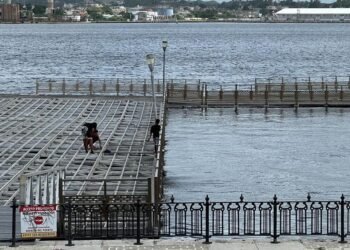
Ordered to be built by Fidel Castro in 2000, as part of the Battle of Ideas to demand the return of the boy Elián González from the United States, the Anti-Imperialist Tribune contained Monte de las Banderas, which was made up of 138 masts, which originally flew black flags with a white star. The regime said that they were a symbol of “Cuba’s fight against terrorism”, but they also served to prevent the illuminated sign with news that was placed by the then so-called US Interests Section in Cuba (Sina), with James Cason as head of mission.
Over the years, the action of the nearby sea and hurricanes contributed to the deterioration of the installation and, in 2021, the rusty masts were replaced by a gigantic concrete Cuban flag.
It is, once again, the site chosen by the regime on a day when the resolution that Cuba presents every year against the US embargo has been approved at the UN, although this time with the worst result: 130 votes in favor, 17 against and 25 abstentions.
The vote at the United Nations was also marked by high bilateral tension that culminated in a act of repudiation led by the Cuban foreign ministerBruno Rodríguez, against the US ambassador to the organization, Mike Waltz, in the middle of the General Assembly session.