By *Azubah Adams
Adapted from a guest lecture delivered at Monroe College, St. Lucia
The tourism industry is undergoing a significant transformation. Around the world, travellers are increasingly seeking experiences that are authentic, meaningful, and deeply connected to the places they visit. This shift in consumer expectations is influencing how destinations develop tourism products and how the hospitality sector delivers value to guests.
At the centre of this transformation lies a growing relationship between agriculture, tourism, and hospitality. While these sectors have traditionally been viewed as separate industries, emerging trends suggest that their integration may play an increasingly important role in shaping the modern guest experience.
The search for authenticity

One of the challenges facing modern tourism is a phenomenon described as “placelessness”. The expansion of mass-market and industrialised food systems has contributed to increasingly uniform dining experiences across destinations. Hotels, restaurants, and tourism districts often offer similar products and services regardless of their geographic location. As a result, many destinations risk losing the distinct cultural and geographic identities that once set them apart.
In response to this standardisation, a growing number of travellers are seeking more authentic experiences. Tourism researchers have described the emergence of the “existential tourist” — a traveller who uses food, culinary traditions, and local experiences as a means of connecting with the culture and identity of a destination. Rather than remaining within conventional tourist environments, these travellers seek opportunities to engage directly with local communities and traditions.
This shift has elevated authenticity from a desirable attribute to a significant market differentiator. Increasingly, travellers are seeking transparency, heritage, and genuine connections to local food systems and cultural traditions. Traditional hospitality models operating in isolation are becoming less capable of satisfying these expectations.
Understanding today’s food traveller
To better understand these changing preferences, tourism researcher Anne-Mette Hjalager identified four broad categories of culinary tourists.
The recreational tourist seeks familiarity and comfort, preferring predictable dining experiences and familiar foods. The diversionary tourist views food primarily as part of leisure and social interaction, placing greater emphasis on atmosphere than culinary depth. The experimental tourist seeks innovation, prestige, and lifestyle-oriented dining experiences that combine local cuisine with sophistication and luxury.
The existential tourist, however, seeks authenticity above all else. These travelers are interested in learning how food is produced, participating in cooking experiences, visiting farmers’ markets, and consuming traditional foods in local settings. Their motivation is not merely consumption but cultural understanding.
Understanding these different consumer profiles is important because they help explain many of the trends currently influencing tourism and hospitality markets worldwide.
The rise of agritourism and experiential travel
The growing popularity of agritourism provides clear evidence of these changing travel preferences.
The global agritourism market reached an estimated US$70.17 billion in 2025 and is expected to grow to approximately US$99.51 billion by 2030, representing a compound annual growth rate of 7.2%.
The primary driver behind this growth is the increasing desire among travellers to escape fast-paced urban lifestyles in favour of authentic, nature-based experiences. The demand for farm stays and on-farm tourism activities reflects a broader shift toward experiences that offer greater personal connection and a closer relationship with food production and rural environments.
Farm stays have become a particularly important component of this movement. Defined as accommodations located on farms or rural properties, they allow visitors to experience agricultural life firsthand while gaining a deeper appreciation for the work involved in food production. According to Eurostat, Farm-based and rural tourism stays reached 826 million nights in 2025, reflecting the growing popularity of these experiences.
These developments are occurring within the broader rise of experiential travel.
The focus of travel has increasingly shifted toward immersive and meaningful experiences rather than traditional sightseeing alone. Travellers are seeking personalised experiences, stronger connections with destinations, and opportunities to engage with local people and cultures. Social media has amplified demand for authentic experiences, while the post-pandemic environment has reinforced the importance of meaningful personal connections.
Millennials have become a particularly influential force within this trend. Research indicates that millennials account for nearly 50% of the global travel market, spend more than US$200 billion annually on travel, and overwhelmingly favour experiences over possessions. Demand among this group remains particularly strong for authentic, wellness-oriented, and adventure-focused tourism experiences.
Culinary tourism as a global driver
Food has become one of the strongest motivators influencing travel decisions.
The global food tourism market was valued at approximately US$967.6 billion in 2025 and is projected to reach US$5.06 trillion by 2035, with an estimated annual growth rate of 18%.
The demand for authentic culinary experiences is a major driver of this growth. Research indicates that 55% of market growth is linked to increasing interest in authentic food experiences and cultural food exploration. Additionally, 62% of travellers consider food experiences when choosing destinations, while 75% of millennials seek authentic local cuisine during their travels. Among Generation Z travelers, 40% report booking trips based on food-related content they encounter online.
These trends demonstrate that culinary tourism is no longer a secondary component of travel. Increasingly, food experiences influence destination selection, travel itineraries, and visitor engagement.
The agri-tourism-hospitality nexus
In response to these evolving market conditions, the lecture introduced the concept of the Agri-Tourism-Hospitality Nexus.
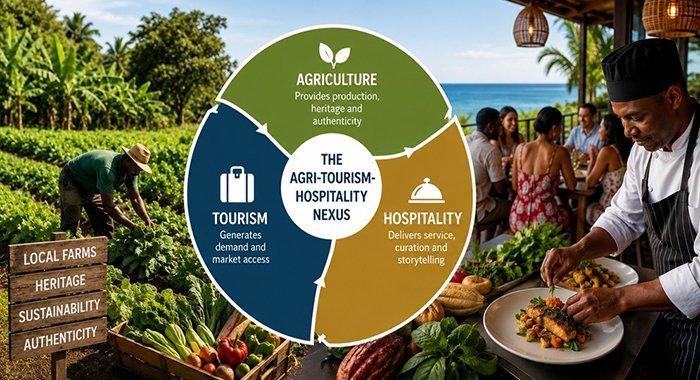
The Nexus is described as an integrated economic and operational framework in which agriculture, hospitality, and tourism function as a unified ecosystem rather than as separate sectors. Within this framework, agriculture contributes production, heritage, and authenticity; hospitality provides service, curation, and storytelling; and tourism generates market demand.
Rather than operating as a traditional linear supply chain, the Nexus functions as a circular value feedback loop in which the outputs of one sector become the inputs of another.
Agriculture provides what the framework describes as “raw authenticity” through landscapes, agricultural products, culinary heritage, and traditional techniques. Hospitality serves as the conduit that translates these assets into accessible and meaningful guest experiences through service, culinary preparation, curation, and storytelling. Tourism provides the scale and market access necessary to bring consumers seeking identity-driven experiences into these environments.
Shaping the guest experience
The Agri-Tourism-Hospitality Nexus fundamentally reshapes the consumer journey through three primary mechanisms: the de-commoditization of food and space, narrative-driven consumption, and multi-sensory place-making.
The first is the de-commoditisation of food and space. By linking meals to specific farms, communities, traditions, and cultural histories, food becomes more than a transactional product. Consumers become participants in a cultural experience rather than simply purchasers of a commodity. Following the framework, this transformation creates nearly irreplicable experiences and supports premium value creation.
The second mechanism is narrative-driven consumption. Modern travellers increasingly consume not only products but also the meanings associated with them. Through storytelling, farm tours, culinary interpretation, and direct engagement with producers, hospitality can transform an ordinary meal into a memorable intellectual and cultural experience.
The third mechanism is multi-sensory place-making. Agricultural environments contribute visual, sensory, and environmental elements that combine with hospitality services to create a strong sense of place. This deeper emotional attachment can contribute to visitor loyalty, destination equity, and positive word-of-mouth promotion.
Conclusion
The agri-tourism-hospitality nexus offers a framework for understanding how changing traveller expectations are reshaping tourism and hospitality.
As demand grows for authentic experiences, experiential travel, culinary tourism, and agritourism, greater integration between agriculture, hospitality, and tourism may provide new opportunities for creating meaningful guest experiences.
When these sectors operate as a connected ecosystem, multiple stakeholders benefit. Farmers gain direct access to premium economic capital, hospitality businesses develop distinctive terroir-driven identities, and travellers receive the authentic experiences they increasingly seek.
In an era where authenticity has become a defining feature of tourism demand, the relationship between agriculture, hospitality, and tourism may prove increasingly important in shaping the future of the guest experience.
*Azubah Adams is a hospitality and tourism development professional with a keen focus on sustainability.
The opinions presented in this content belong to the author and may not necessarily reflect the perspectives or editorial stance of iWitness News. Opinion pieces can be submitted to [email protected].