Switzerland has seen dozens of anti-migration initiatives of direct democracy in recent decades: against “overpopulation” of the Alpine country, against minarets on mosques; for deportation of foreigners convicted of a crime, and for migration quotas. Campaign posters were full of black sheep, evil EU flags and angry brown people.
On Sunday, the Swiss will vote again on such an anti-immigration initiative, introduced by the right-wing radical Swiss People’s Party (SVP). It wants to have it written into the constitution that the Swiss population – almost a third of which consists of people not born in Switzerland – will not exceed ten million by 2050. With a population of 9.5 million, the Swiss authorities would have to intervene with restrictions on asylum applications and options for family reunification. At ten million, the Swiss government must terminate international agreements, such as those on the free movement of people with the EU. At the end of last year, Switzerland had such 9.1 million inhabitants.
In the latest polls, the proponents and opponents are close together, with a lead of only a few percentage points for the no camp. Analysts expect the turnout on Sunday to be decisive. The campaign initially focused mainly on sustainability and the environment, which would come under pressure due to migration. “Protect Switzerland,” proponents’ campaign materials say, beneath a peaceful Alpine landscape with a family with two young white children and a sheep.
:format(webp)/s3/static.nrc.nl/wp-content/uploads/2026/06/10083311/110626BUI_2034353295_zwitserland.jpg)
An election poster for the far-right Swiss People’s Party (SVP) with the text ‘Let’s protect Switzerland’ stands in a vineyard in Bavois, Switzerland on May 1.
Photo Jean-Christophe Bott / ThirdParty via AP
The SVP gradually shifted the emphasis to the pressure on infrastructure, such as housing supply and (public) transport, sees Lukas Golder, co-director of polling agency GMS in Bern. “About three-quarters of the population feels that infrastructure is overloaded,” says Golder. But the question is whether this will also lead to support for the proposal. “They have doubts about the disadvantages associated with the proposal.”
Like other European countries, Switzerland has an aging population, in which sectors such as healthcare and construction have become highly dependent on employees from outside their own national borders. “The elderly in particular are wondering whether they should vote ‘yes’,” says Golder. In other words: who will take care of the Swiss elderly? If migrants are no longer welcome, Swiss people will have to retrain, or robots or temporary workers will have to fill the gap.
Racist undertone
“The SVP has adjusted the message slightly this time to also appeal to center-right voters,” says Rahel Freiburghaus, a political scientist at the University of Lausanne. “With a focus on ‘sustainability’ and by saying that it is becoming ‘too busy’ in the country, they have managed to broaden the frame about immigration.” Unlike previous referendums, a specific (migrant) group is not explicitly addressed, but it is still the same racist undertone that resonates with voter groups, Freiburghaus sees. “The SVP has been the largest party since 1999 and that has led to a normalization of their ideas.”
Freiburghaus also sees a big difference in the focus of the yes and no camps in the campaign. “While the SVP mainly taps into anti-immigration sentiment, its opponents mainly talk about the consequences for the relationship with the EU.” She sees certain ‘growing pains’ of a country with an expanding population, such as crowded trains and pressure on the housing market, which in Switzerland consists mainly of tenants. “But those problems are now being tackled in one way, and that is the most radical way possible.”
While the SVP mainly taps into anti-immigration sentiment, its opponents mainly talk about the consequences for the relationship with the EU
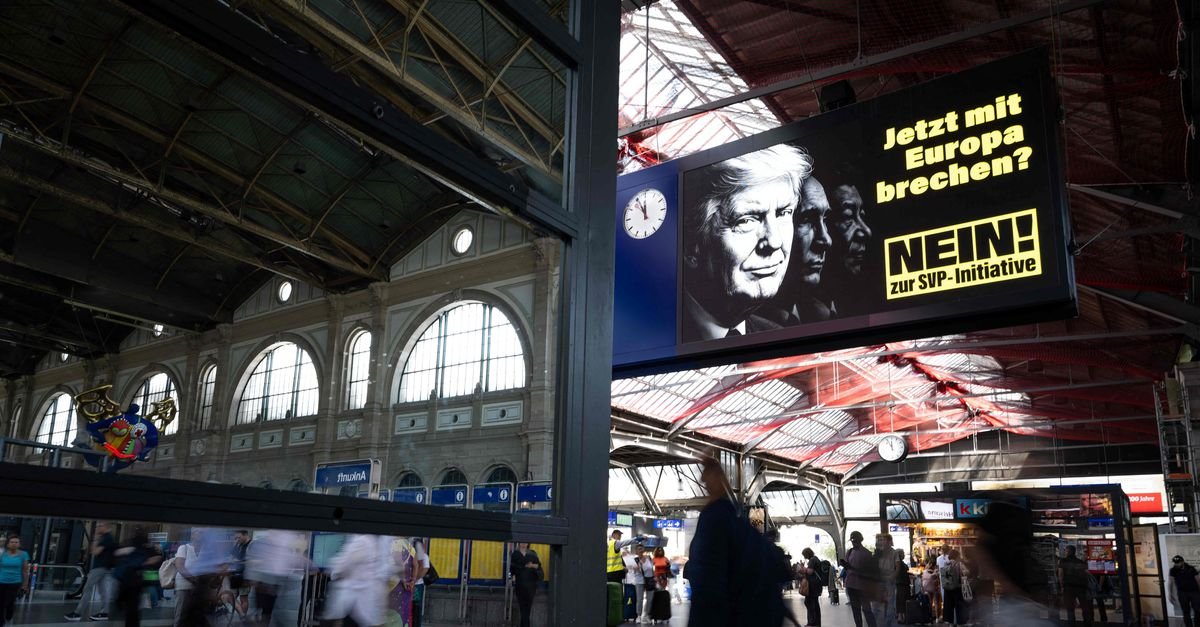
To prevent that, the no camp uses big words. For example, the co-chairman of the social-democratic SP, Cédric Wermuth, spoke of “the most extreme initiative in the history of Switzerland.” US President Donald Trump is seen on election posters a horror in case Switzerland turns away from the EU. EconomySuissean influential employers’ organization in Switzerland, calls it a “chaos initiative” that threatens Switzerland’s security and prosperity and will be “counterproductive.”
The EU is a major driver of Swiss population growth in recent decades. Switzerland is not a member, but does have close ties with the EU. Since 2002, citizens of EU member states have been able to live and work in Switzerland and vice versa. Since then, Switzerland’s population has grown by 23 percent, reaching 9.1 million at the end of last year. The Swiss economy grew accordingly. Earlier this year, the Swiss government signed a bilateral agreement with the EU for closer cooperation, which has yet to be ratified. If there is a yes vote, that process will come under great pressure.
Guillotine clause
The relationship with the EU has previously been under pressure due to an anti-migration mood. In 2014, a narrow majority voted in favor of migration quotas, which went against the free movement of people between Switzerland and the EU. That vote, also initiated by the SVP, unexpectedly achieved a narrow majority. But upon implementation, the Swiss parliament subsequently weakened the plans. This happened under pressure from the EU. No cherry pickingthe message from Brussels was: simply canceling the free movement of people and retaining other privileges was not an option for the EU.
“The SVP has also learned from that,” says political scientist Freiburghaus. “It has now formulated the initiative in such a way that the measures must be implemented.” If the yes camp wins, the consequences will be far-reaching. If the population does indeed reach ten million and the Swiss government puts an end to the free movement of people, a so-called ‘guillotine clause’ would come into effect from the EU: other agreements with the EU will also lapse, including those on free trade, on which the Swiss economy is highly dependent.
On Sunday morning, the Swiss have the opportunity to cast their vote until 12 noon – the vast majority of voters do so digitally. The first results are expected during the afternoon.
Also read
Ten million inhabitants? Then no foreigner will be able to enter Switzerland
:format(webp)/s3/static.nrc.nl/bvhw/wp-content/blogs.dir/114/files/2019/07/gruyter-caroline-de-2019-01-c.png)