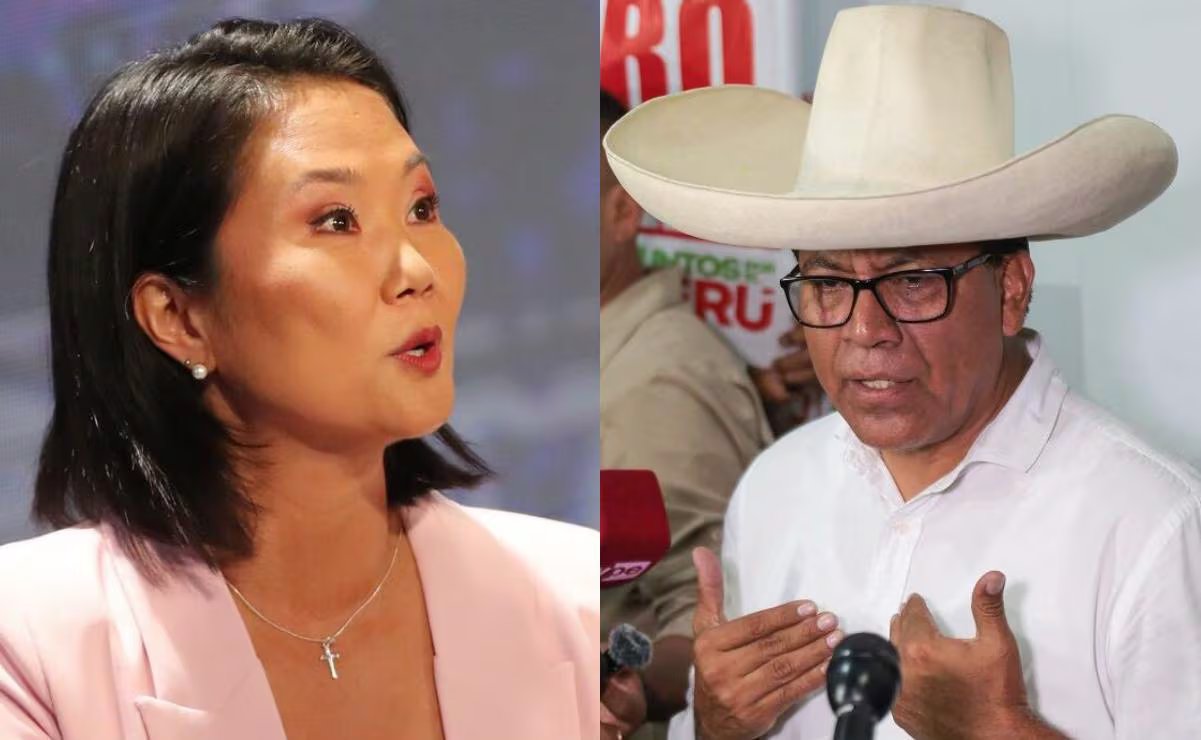
Lime.- The conservative Keiko Fujimori and the progressive Roberto Sanchez They were in a technical tie on Monday in the presidential runoff in Peru when more than 93% of the voting stations were counted.
Fujimori, of the party Popular Forceobtained 50,057% of the votes while Sánchez, from Together for Perureached 49.943% support, according to the preliminary count of the National Office of Electoral Processes (ONPE), the organizer of the elections.
After the closing of the vote on Sunday, the head of the National Election Jury (JNE), Roberto Burneo, estimated that the final result “would be in the next 30 days” and asked citizens and political organizations “to maintain serenity and act with democratic responsibility.” The final count for the first round on April 12 was announced more than a month after the elections.
Read also Elections in Peru, without clear winner; surveys reveal technical tie
The delay in announcing the final results is due to an electoral law that requires that each voting card and each record—which summarizes the votes from each table—must be transported to more than a hundred offices for counting. The identification cards and certificates of those who voted abroad must also arrive in Lima from 63 countries. Added to this is the counting of votes and the resolution of challenges.
Fujimori, daughter of the late former president Alberto Fujimori (1990-2000) and who is participating in a presidential race for the fourth time, asked her followers for patience. “So far there is no winner in this race,” he said the day before in a statement from a hotel in Lima.
Meanwhile, Sánchez went out to a balcony in front of Plaza San Martín, in the center of the Peruvian capital, and thanked the indigenous peoples, the peasants and the vulnerable sectors “who have decided to come to recover the government for the people.”
Read also Peru goes to the second round with opposite poles
The tight partial result is reminiscent of the 2021 presidential second round between Pedro Castillo and Fujimori. The former congresswoman started with a certain advantage, but in the end Castillo won by a small fraction: 50.1% compared to 49.9%. The electoral authorities announced the results 43 days later.
Fujimori seeks to break its streak of defeats by presenting itself as the best option to impose order in a country burdened by growing crime, the greatest concern of Peruvians.
The 51-year-old politician affirms that in her eventual administration there will be “order” for foreign investments and internal security, threatened by the increase in crime. In the last five years, extortions have quintupled and murders have doubled in the country.
Read also Peru at the Latin American crossroads: Keiko Fujomori or Roberto Sánchez
In the only debate prior to the runoff, Fujimori vindicated his father’s government and promised that he will defeat crime just as Alberto Fujimori defeated the violent extremist group Sendero Luminoso.
He stated that in his government there will be “cheaper chicken, gas cylinders at an affordable price, fertilizers at a good price for your harvest, knowing that you will go out to work and return home safely.”
Sanchezformer minister of the imprisoned former president Castillo (2021-2022), promises a government focused on alleviating the poorest and representing remote areas of the Andes and the Amazon.
Read also Iran and Israel promise de-escalation; Trump demands that they stop shooting “immediately”
Popular in the rural sector and the south of the country, he has tried to calm the concern that his candidacy generated among investors by publicly repeating that he will not expropriate any assets of transnational companies that extract minerals or gas from Peru.
During the debate he said that his eventual government will be open to “all flags to generate work and progress,” but highlighted his support for Chinese investments such as the Bioceanic Train, which seeks to connect the strategic port of Chancay, on the Pacific, with the Atlantic coast of Brazil.
Sánchez, 57 years old and who wears a wide-brimmed peasant hat that Castillo gave him, has also distanced himself from a junior partner, the ultranationalist Antauro Humala, who proposes applying the death penalty in corruption cases.
Read also It is “urgent” to strengthen Ukrainian weapons: European leaders
Both candidates entered the runoff with a high level of rejection. More than 70% of the electorate did not vote for either of them in the first round. Fujimori added 17.18% while Sánchez obtained 12.03%.
Those who oppose Fujimori relate her to the authoritarian and corrupt legacy of her father’s government, while questions about Sánchez point to fear of her alliance with Castillo, perceived as chaotic. In Castillo’s brief 16-month administration there were more than 70 ministerial changes.
The credit rating agency Fitch Ratings maintained in an analysis prior to the runoff that regardless of who wins Peru’s governance problems and the composition of the bicameral Congress, in which no party has a majority, “will limit the next government’s ability” to push through key reforms.
L.L.