The website of the ‘Cockroach Janta Party’ (CJP) in India looks unusual. A man in a smart suit wearing a cockroach mask stands behind a lectern with his finger raised. Anyone who wants to become a party member, it reads, must be ‘unemployed’, ‘lazy’, ‘chronically active online’ and ‘capable of professional swearing’ (‘as long as the content is sharp, honest and current.’)
A joke? The style of the “party for the lazy and the unemployed” is clearly satirical, but the message behind it is deadly serious. The website and party must (especially) unite young people in India who want better education, less corruption and more work for the roughly 650 million Indians under 25 (almost half the population). Nearly 10 percent of them have no work. After a high court last month labeled young unemployed people as “cockroaches” (cockroaches), had a young person replied on social media: “What if all the cockroaches unite?”
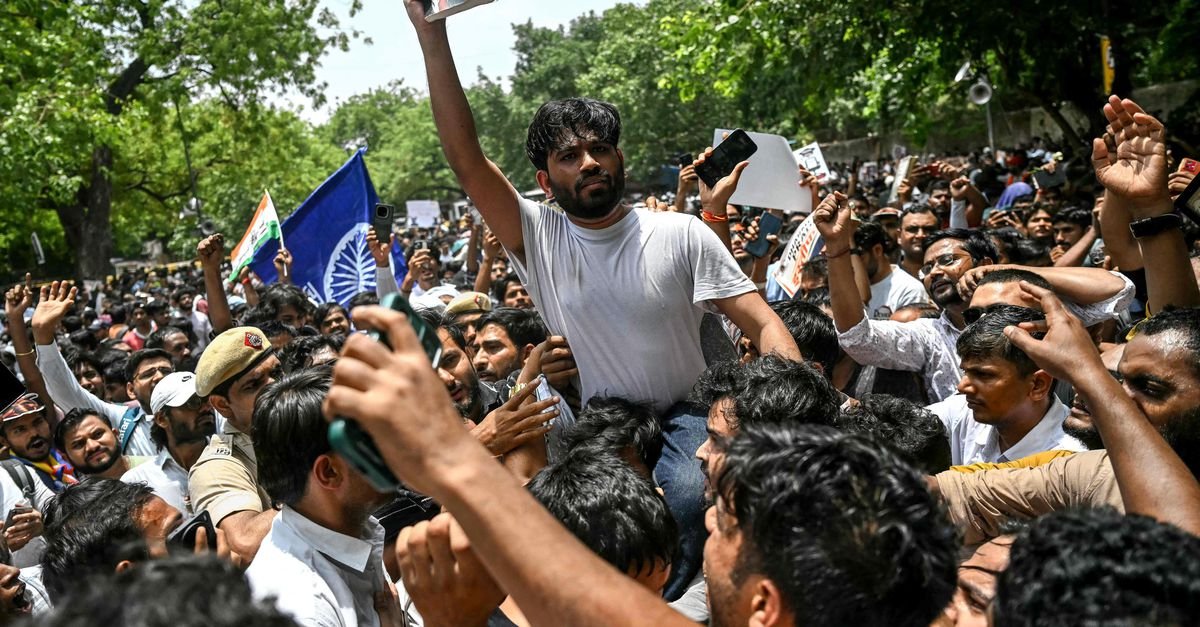
That young person was Abhijeet Dipke (30), until recently a student of journalism in Pune (near Mumbai) and public relations at Boston University in the US. His tweet received enormous resonance and led to the formation of the cockroach party. The CJP now has twenty million followers on social media. They adorn themselves with the hashtag #MainBhiCockroach (“I’m a cockroach too”) and have a own party song. Some of them have appeared in recent weeks on the streets of cities such as Delhi wearing cockroach masks and carrying a broom intended for clean-up operations.
Cronyism
Dipke arrived in India from the US last weekend and now heads an organization that is somewhere between a media phenomenon, a political party and a protest movement. Main demands: the resignation of the Minister of Education who would allow favoritism in the assessment of students, more jobs for young people, more rights for women and the sweeping of the oligarchy in India. For example, powerful CEOs Gautam Adani and Mukesh Ambani should relinquish their media conglomerates.
The fact that many media are now writing about Dipke is not only due to his remarkable communication style and large following, but also to his origins. The activist is the child of parents from the lowest layer of the population (dalit) in a village in Maharashtra, a state in central India. Particularly due to his sense of symbolism, he managed to escape this simple environment and make a career in the capital. In 2020 and 2023, Dipke worked in New Delhi as a communications strategist for the Aam Aadmi Party (the ‘Ordinary Man Party’), which profiles itself with anti-corruption measures. Dipke then received a scholarship to Boston University. He would be helped by leading Aam Aadmi politicians, raising questions among some about his independence as an anti-establishment activist.
:format(webp)/s3/static.nrc.nl/wp-content/uploads/2026/06/08094702/080626BUI_2034279384_2.jpg)
Supporters of the satirical Cockroach Janta Party (CJP) listen to its founder, Abhijeet Dipke (not pictured), during a protest in New Delhi on Saturday.
Photo RAJAT GUPTA / EPA
Within a few weeks, Dipke and his followers managed to broaden their movement. Many elderly people have joined the protests, although there are not many influential administrators or politicians among them. The main opposition party, Rahul Gandhi’s Congress Party, did accept some of the cockroach party’s demands, such as the resignation of the Minister of Education.
At the same time, it must become clear whether Dipke is capable of launching a sustainable political movement. At one first demonstration of the CJP in Delhi last Saturday, only a few hundred people showed up, although that was also due to rumors that the demonstration would be banned and Dipke would be arrested. The party says it has “several tens of thousands” of members who will continue the protests in the coming months, Dipke has announced.
Social undercurrent
In recent weeks it has become clear that Dipke and his party are an expression of powerful social undercurrents that also manifest themselves elsewhere in South Asia. In countries neighboring India with young populations such as Nepal, Sri Lanka and Bangladesh, ‘Gen Z’ protest movements emerged. They managed to force new elections in Nepal and oust a prime minister in Bangladesh.
The movements were often led by unorthodox media personalities such as former rapper Balen Shah in Nepal. Shah crushed his opponents in February’s parliamentary elections and went on to become prime minister of the mountain state. Closer to home, in India itself, film star-politician C. Joseph Vijay won the elections in the state of Tamil Nadu by a landslide last month. Here too, it was a new party (2024) with a lot of support among young people. Vijay also became Prime Minister.
Also read
Young people bring corrupt regimes in South Asia to their knees – but then what?
:format(webp)/s3/static.nrc.nl/wp-content/uploads/2025/09/28103320/data137918611-649178.jpg)