The discovery of more than 80 skullless skeletons at the Neolithic settlement of Vráble in Slovakia may shed light on a funeral custom of the first European farmers. The first results show no signs of brutal executions or a massacre of war. Evidence suggests that these burials, strange as they may seem today, were part of social practices that shaped local and regional relationships.
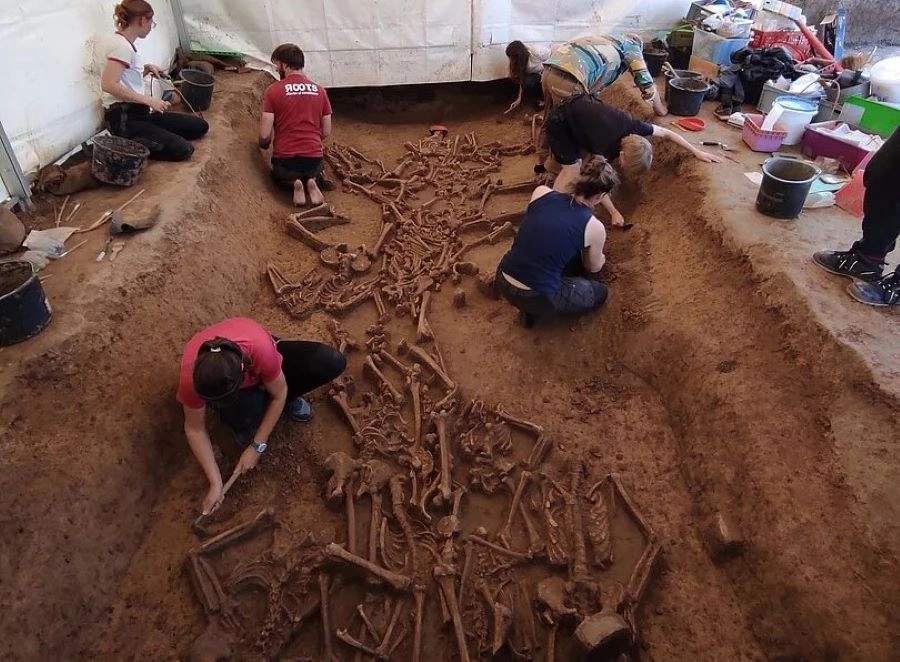
Archaeologists have discovered 78 human skeletons about 7 thousand years old in the Neolithic settlement of Vráble in Slovakia, where 77 of them were without skulls. This opens up new questions about the funeral customs of the first European farmers. Since 2022, archaeologists have been excavating the Neolithic settlement near the present-day town of Vrábles, where they have found dozens of skeletons without skulls. It was initially thought to be an ancient massacre, but new studies show that the explanation may be much more complex.
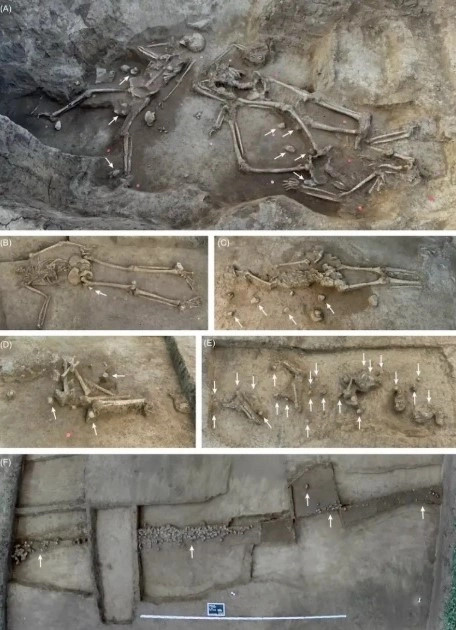
According to a study published in the scientific journal “Proceedings of the Prehistoric Society”, the remains of at least 78 people were found in a ditch that surrounded a large part of the Neolithic settlement. Of these, 77 skeletons were without skulls, while only one child was buried with his head.
Researchers from the University of Kiel and the Slovak Academy of Sciences testify that the first results show no signs of brutal executions or a massacre of war.
According to Professor Martin Furholt, the evidence suggests that these burials, strange as they may seem today, were part of social practices that shaped local and regional relationships, with very little evidence of conflict or crisis.
The Vráble settlement belongs to the Linear Pottery culture, one of the first agricultural communities in Central Europe. Archaeologists have been studying this site since 2012.
The area includes more than 300 house foundations distributed in three settlements, while it is estimated that at its peak about 80 objects were inhabited simultaneously.
The settlement existed between 5250 and 4950 BC. Part of it was surrounded by a moat, which probably served as a boundary or as a defensive area. It was there that human remains were discovered.
Biological anthropologist Katharina Fuchs has explained that the marks on the bones clearly indicate deliberate manipulation of the bodies. According to her, the first analyzes show that it is not a matter of violent beheading, but of careful and skillful removal of the skulls after death.
The meaning of this practice remains unclear. One hypothesis is that the heads were kept separately, a custom also known in other Neolithic contexts, although for Vráble there is still no direct evidence.
Mass graves, ditch burials and body manipulation have also been discovered at other sites of the Linear Pottery culture, especially at the end of its existence. These findings have often been interpreted as a consequence of violence or deep social crises.
However, the authors of the new study propose a different interpretation. According to the researcher Nils Müller-Scheeßel, the placement of the bodies and their parts may have been one of the complex, repeated rituals with special meaning for the community.
He has added that precisely the interruption of these customs can indicate major social changes in that period.
Research continues within the “Neolithic Bodies” project, funded by the German Foundation for Scientific Research. Scientists are analyzing age and gender based on the skeletons, cut marks on the neck vertebrae, possible signs of violence, as well as parentage and family ties through isotopic and DNA analysis.
According to Professor Martin Furholt, the site of Vrábles can help answer some of the most important questions about the Neolithic period: how the communities of that time understood death and the human body, and what role these rites had in the social life of the first European farmers.