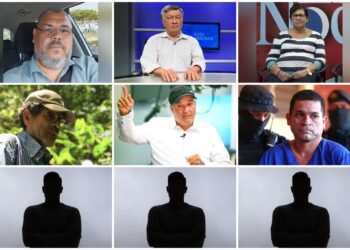
Six relatives of Brooklyn Rivera remain missing since May 31, 2026, when they traveled from Bilwi to Managua to claim the body of the indigenous leader dead in custody of the dictatorship of Daniel Ortega and Rosario Murilo.
Sources close to the Yatama party, founded by Rivera, indicated that the six would have been detained by the dictatorship, after officials from the Institute of Legal Medicine refused to give them the body to be buried in Sandy Bay, Bilwi, as was their wish.
Rivera, 73 years old, died on May 30, 2026 at 8:30 p.m., after more than 970 days of illegal confinement. The dictatorship confirmed his death a day later and kept his body in police custody and ordered his burial in Managua, so it was kidnapped to the grave.
Sources also assure that Rivera’s relatives did not participate in the funeral held in Managua on Murillo’s orders.
Those arrested on May 31, 2026 for claiming the body of the indigenous leader are:
- Alda López Bryan, sister of Brooklyn Rivera.
- Jorge Webster Rojas, friend of Brooklyn Rivera.
- Kurney Valle Bushy, nephew of Brooklyn Rivera.
- Florencia Sarmiento, Brooklyn Rivera’s chef.
- Jorbis Hendy López, nephew of Brooklyn Rivera.
- Glenis Panting Coleman.
Initially, the sources included Waylandin Rivera, son of Brooklyn Rivera, among those detained, but later they corroborated that he was being held in a safe place.
Waylandin Rivera would have been at the Fernando Vélez Paiz hospital at the time of his father’s death, where he heard rumors that he would be arrested if he attended the funeral, which is why he decided to take shelter.
A source linked to the FSLN Secretariat said, after Rivera’s death, that “in the Sandinista government there was fear that mobilizations and riots against the Government could occur in the Northern Caribbean.” That is why they considered that “it was not prudent to authorize funerals in Sandy Bay,” he noted.
Meanwhile, Yatama sources claim that, after the death of the Brooklyn Riveraas it was known in the Miskito communities, an atmosphere of “sadness and a lot of tension” prevails in the Northern Caribbean of Nicaragua.
They add that the police presence on the streets of Bilwi is notorious, due to the de facto police state that prevails throughout the country.
UN expresses “serious” doubts about causes of death
The UN Human Rights Office joined the international condemnations of Rivera’s death and expressed doubts about the circumstances surrounding his death, after suffering forced disappearance and prolonged arbitrary detention.
“We have very serious concerns about the causes of his death, precisely because no one knew his whereabouts until four days before the date of his alleged death,” said the spokesperson for that United Nations office, Marta Hurtado, at a press conference.
“The specific conditions of his detention over the years, including whether he had access to adequate medical care, and the exact sequence of events that led to his death remain unclear,” he added.
Hurtado pointed out that the UN High Commissioner for Human Rights, Volker Türk, has asked the Nicaraguan authorities to carry out an impartial investigation into Rivera’s death, as has also been done by the United Nations Group of Human Rights Experts on Nicaragua.
Brooklyn Rivera was detained by the Nicaraguan regime on September 29, 2023. Since then, he hid his whereabouts and hid his serious state of health until May 27, 2026, when he showed the indigenous leader dying after almost three years of forced disappearance.
Former foreign ministers demand “international investigation”
The demands for justice for the death in custody of Brooklyn Rivera were joined by a group of 24 former foreign ministers from Latin America, who requested an “independent international investigation, with unrestricted access, to clarify the circumstances of the death.”
The former diplomats make a “respectful but firm” call for this case to be treated “with the seriousness and urgency it deserves,” during the next meeting of Latin American foreign ministries to be held in June in Panama.
“The death of an indigenous leader in state custody is not an internal matter: it is a direct challenge to democratic values and hemispheric commitments regarding human rights,” the former foreign ministers emphasize.
The 24 former signing officials are:
- Eladio Loizaga, former foreign minister of Paraguay
- Allan Wagner Tizón, former chancellor of Peru
- Federico González Franco, former Foreign Minister of Paraguay
- Francisco Álvarez de Soto, former chancellor of Panama
- María Emma Mejía former chancellor of Colombia
- Jorge Castañeda, former foreign minister of Mexico
- María Angela Holguín, former chancellor of Colombia
- María Soledad Alvear, former Foreign Minister of Chile
- Mariano Fernández Amunátegui, former chancellor of Chile
- Antonia Urrejola Noguera, former Foreign Minister of Chile
- Heraldo Muñoz Valenzuela, former Foreign Minister of Chile
- Susana Malcorra, former chancellor of Argentina
- Luis Gallegos Chiriboga, former foreign minister of Ecuador
- Juan Gabriel Valdés, former Foreign Minister of Chile
- Carolina Barco Isakson, former chancellor of Colombia
- Ignacio Walker Prieto, former Foreign Minister of Chile
- Martha Lucía Ramírez Blanco, former chancellor of Colombia and former vice president of Colombia
- José Miguel Insulza Salinas, former Foreign Minister of Chile and former Secretary General of the OAS
- Roberto Tovar Faja, former foreign minister of Costa Rica
- Claudia Ruiz Massieu, former foreign minister of Mexico
- José Antonio Moreno Ruffinelli, former Foreign Minister of Paraguay
- Diego García Sayán, former chancellor of Peru
- Samuel Lewis, former foreign minister of Panama
- Isabel de Saint Malo, former chancellor of Panama
Amnesty calls for “independent” investigation
Amnesty International (AI) called for an “independent” investigation into the death of the indigenous leader in state custody, a fact that, it emphasized, “cannot remain silent or impunity.”
“We urgently call on the governments of the region and the international protection mechanisms to demand accountability from the Nicaraguan State and carry out an investigation promptly, and in an effective, exhaustive, independent, impartial and transparent manner that clarifies the circumstances of this potentially unlawful death,” the NGO said in a statement.
“Brooklyn Rivera’s family has the right to the truth,” added AI’s director for the Americas, Ana Piquer, about the death of the Yatama co-founder.
“The Nicaraguan authorities have the obligation to provide Brooklyn Rivera’s family with immediate and unrestricted access to all information related to his detention, the conditions under which he was deprived of his liberty, and the circumstances of his death,” Piquer urged.
“Likewise, they must guarantee the dignified delivery of his remains so that he can receive burial according to his wishes, respecting his identity as an indigenous Miskito leader and the traditions of his people,” he added.
*With information from EFE