Havana/The work week began with total collapse of the energy system (SEN) and likewise ends this Friday. This time, the announcement from the Cuban Electrical Union (UNE) was shorter than the previous one: “4:30 p.m. Total collapse of the National Electrical System,” reported the state in their networks. This is the fourth collapse of the SEN so far this year and the ninth since October 2024.
The comments that immediately filled the publication showed not only the resigned attitude with which Cubans now take the energy crisis, but also that the majority do not even have the electricity to find out. “At what point had they put it in?”, “Oh, why was it working? I didn’t notice it,” “Was it standing?” were some of the expressions.
The situation could be seen coming, two days after the deficit set a record in both megawatts (MW) as in percentage. For a maximum demand of 3,100 megawatts (MW), a shortage of 2,341 MW was recorded at 8:20 pm, “a figure higher than planned due to the non-entry of planned units,” the UNE justified yesterday in its daily report. This meant the absence of more than three quarters of the energy necessary for the country (75.5%).
The impact on Thursday was not as high, but it still indicated that the system was hanging by a thread: 2,237 MW were missing of the 3,200 MW that reached maximum demand, at 9 pm. For the same expected demand, this Friday, a deficit of 1,952 MW was expected. It has not been fulfilled.
For the same expected demand, this Friday, a deficit of 1,952 MW was expected. It has not been fulfilled
No less than 11 of the 16 units that the Island has distributed in different thermoelectric plants are stopped, due to breakdown or maintenance. This includes the most important in the country, CTE Antonio Guiteras, in Matanzas, and the most important in the east, Felton in Holguín and Renté in Santiago de Cuba.
If for ordinary Cubans these numbers have one translation – blackouts –, for the regime they have another: possible protests. It is not trivial, on the eve of the fifth anniversary of July 11, 2021. In recent days, in which the energy crisis worsens, demonstrations have multiplied.
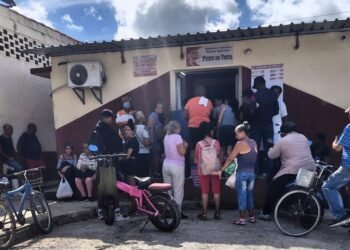
He witnessed one of the most recent 14ymedio, this wednesday and in broad daylight. Dozens of residents of the Havana municipality of Regla, exhausted not only by the lack of electricity but also water, demanded answers at the headquarters of the Government and the municipal Party. Under an intense sun, this newspaper observed women with children, elderly people, men in flip flops, motorbikes, tricycles, a patrol of the Police Operational Guard and several uniformed agents trying to contain the tension.
On Wednesday the capital woke up with the footprints of various other protests. On the corner of Belascoaín and Ánimas, in Centro Habana, ashes, stones, pieces of wood, charred cardboard and remains of burned garbage remained on the asphalt. The images taken by 14ymedio They show a street where the traces of a night of tension remain in the midst of popular fatigue.
Videos of pot-banging, blocked streets and burning garbage have multiplied from various parts of the city. In Central Havana, residents took to the streets after blackouts that, according to reports spread on networks, exceeded 80 hours. Protests were also recorded in the municipality of La Lisa, after more than 40 hours of blackout. In Alamar, in Eastern Havana, groups of residents beat pots and burned garbage in the middle of a public street.