No new proposal from Brussels
Antoniou Košta’s visit to Skopje was part of his diplomatic tour in the countries of the Western Balkans. However, it did not bring a new mechanism to unblock the European integration of North Macedonia.
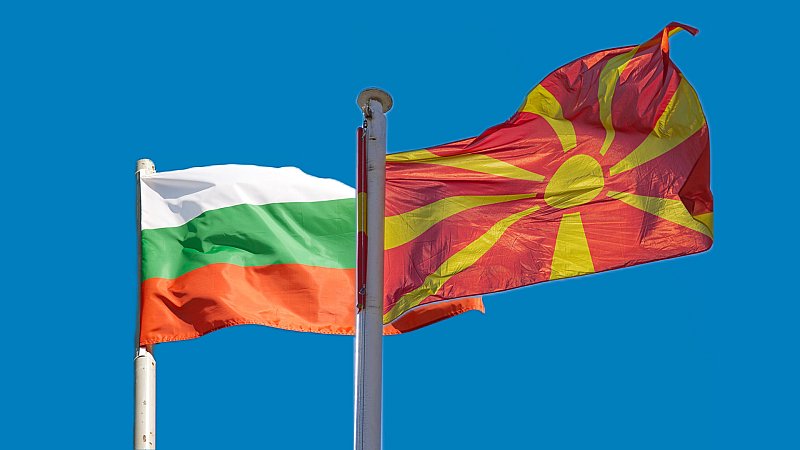
The message was clear: the country must fulfill the commitment already made. This means changes in the constitution, with which the Bulgarians will be registered among the other communities.
“What was agreed upon in 2022 must be fulfilled and nothing more than that,” said Košta.
Thus, Brussels once again confirmed that it does not consider the issue as a new bilateral dispute between Sofia and Skopje. For European institutions, this is already part of North Macedonia’s negotiation framework with the EU.
The Bulgarian position is a European condition
In Skopje, the topic of Bulgarians in the Constitution is often presented as pressure from Bulgaria. After the French proposal from 2022, however, the condition for the entry of Bulgarians is no longer only a Bulgarian position. It is part of the European framework.
This severely limits the possibilities of the government of Hristijan Mickoski to seek renegotiation. For there to be a change, it would have to go not only through Sofia, but also through the entire European Union. So far, there is no sign that such readiness exists.
The new Bulgarian government also has no reason to deviate from the already agreed position. For Sofia, the inclusion of Bulgarians in the constitution is a minimum guarantee that their rights will be recognized at the institutional level.
Skopje demands guarantees
The government of Hristijan Mickoski continues to claim that it cannot proceed with constitutional changes without additional guarantees for the country’s European path.
“There is no price that will make us enter into an adventure without knowing at the same time that this adventure will have a certain end,” Mickoski stated.
This position has an internal political logic. The rulers in Skopje do not want to appear as if they are making concessions under pressure from Bulgaria. The problem is that Brussels does not accept the condition as a concession, but as a commitment already made.
Thus, the Macedonian government finds itself in a difficult situation. It has declared support for EU membership but has refused to take the step the EU says is necessary to start negotiations.
The opposition wants a referendum
The opposition Social Democratic Union of Macedonia is demanding a referendum. According to the party, citizens should choose whether the country should continue with the EU or remain in isolation.
SDSM leader Venko Filipche stated that it has already become clear that there are no additional guarantees and no new conditions. According to him, the only real requirement is constitutional changes.
This puts the rulers under pressure. If they reject a referendum, they will be accused of blocking the European way. If they accept it, they risk that the topic will once again turn into a campaign for identity and confrontation with Bulgaria.
The dispute is increasingly becoming domestic
For years, Skopje presented the blockade as a problem created from outside – first by Greece, then by Bulgaria. Today, this thesis is becoming increasingly difficult to defend.
The reason is that the EU speaks in almost the same terms as Sofia. Brussels does not offer a new runway. He doesn’t talk about new guarantees. It does not question what was agreed in 2022.
So the question gradually shifts. It is no longer just whether Bulgaria will give in, but whether North Macedonia has the political will to fulfill a condition that it itself accepted as part of the European process.
In this sense, the main blockage now looks less foreign policy and increasingly domestic.
The European Parliament reports increase the pressure
Košta’s visit also coincided with the European Parliament’s reports on the candidate countries. For North Macedonia, assessments again point to a lack of sufficient progress and a delay in reforms.
This is an important detail. Even if the constitutional changes are adopted, they will not solve all the country’s problems. They will only open the way to the actual negotiations.
Skopje will then have to show results in areas such as rule of law, fight against corruption, independence of institutions, judicial reform and quality of administration.
Therefore, the European path of North Macedonia is not only blocked by the dispute with Bulgaria. But without resolving this dispute, the country cannot even get to the stage where the reforms can begin to be evaluated in the full negotiation process.
The Bulgarian question does not disappear from the agenda
For Bulgaria, the topic has several dimensions. The first is the protection of the rights of people with Bulgarian identity in North Macedonia. The second is the fulfillment of international commitments. The third is the guarantee that hate speech and discrimination will not remain outside the European control mechanism.
Sofia insists that the inclusion of Bulgarians in the constitution is not a maximalist request, but a minimal institutional step. From the Bulgarian point of view, this is a test of whether Skopje is ready to recognize the Bulgarian community as part of its society.
That is why Bulgaria is unlikely to accept an attempt to dilute, postpone or replace the condition with more general political declarations.
Comparison with other candidates becomes uncomfortable for Skopje
The position of North Macedonia becomes even more difficult against the background of the other candidates for membership.
Montenegro continues to make progress in the negotiation process. Ukraine and Moldova are also moving forward despite the war against Ukraine and the difficult geopolitical environment.
This contrast puts Skopje in an awkward position. A country that has been part of the enlargement process for years remains blocked before the actual start of negotiations. At the same time, other candidates managed to use the political moment and move on to the next stages.
The more time passes, the harder it will be for the Mickoski government to explain why North Macedonia is not making progress.
Time is working against North Macedonia
The biggest risk for Skopje is no longer just the diplomatic deadlock. The risk is that citizens will gradually begin to perceive the European perspective as an empty promise.
This could increase Euroscepticism, increase political polarization and give more space to forces that do not see the country’s future in the EU.
At the same time, young people are increasingly looking for a European future outside their own country – through education, work and emigration. Thus, the blockade is no longer just a foreign policy problem. It is becoming a social and demographic problem.
The output remains the same
After the visit of Antonio Costa, the picture looks clearer, but not easier for Skopje.
No new offer. There is no new formula. There is no signal that Bulgaria or the European Union are ready to change what was agreed in 2022.
For Brussels, the next step is known – inclusion of Bulgarians in the constitution. For Sofia, this is a condition that has already become part of the European process. For the rulers in Skopje, it remains a political risk.
That’s where the blockage is. North Macedonia claims it wants to move towards the EU, but refuses to take the step without which this path cannot begin. For now, the cost of this delay is mostly paid by the country itself.