“This is not just about football, it’s about building something from scratch,” Eriati Reebo, the Kiribati football president, explains. “A legacy, a story, that the world will always remember.”
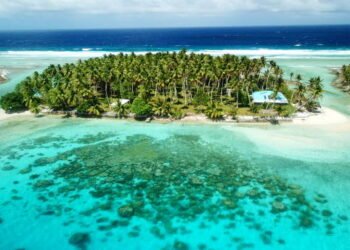
Kiribati, a group of Pacific islands south of Hawaii with 138,000 inhabitants, is seeking entry into World Cup qualifying for the 2030 tournament. Becoming a recognised international football team would help to bring attention to the only nation on earth that sits within all four hemispheres, and one that is rapidly disappearing from the map. It could be the first, but certainly not the last, country to be engulfed by sea water, leaving it uninhabitable. And before that happens, it wants to professionalise the football setup and become a full member of the Oceania Football Confederation. This would both create a route to competing with bigger nations and help to keep the Kiribati spirit alive.
“Football is our passion and, despite our small territory, we dream big,” Reebo says. “In Kiribati you’re born knowing how to play football, that’s why we are working through our effort to be part of football and to be qualified for the World Cup. This may be our last chance.
“Kiribati is a very tiny island and it’s not really known by people, and if we can be part of the World Cup it will give Kiribati a new audience that it has never had before. Football unites people and we want to be part of that, and being part of the World Cup will be life‑changing for Kiribati.”
Reebo travelled to April’s Fifa congress in Canada to discuss the nation’s case for being part of the OFC, where they would face teams such as New Zealand, who will be at the World Cup this summer. Rubbing shoulders with Fifa’s president, Gianni Infantino, and other leading football figures shows the significant progress made. “When I was young we did not even know who the president of Fifa was, so attending congress is a fantastic milestone for Kiribati,” Reebo says.
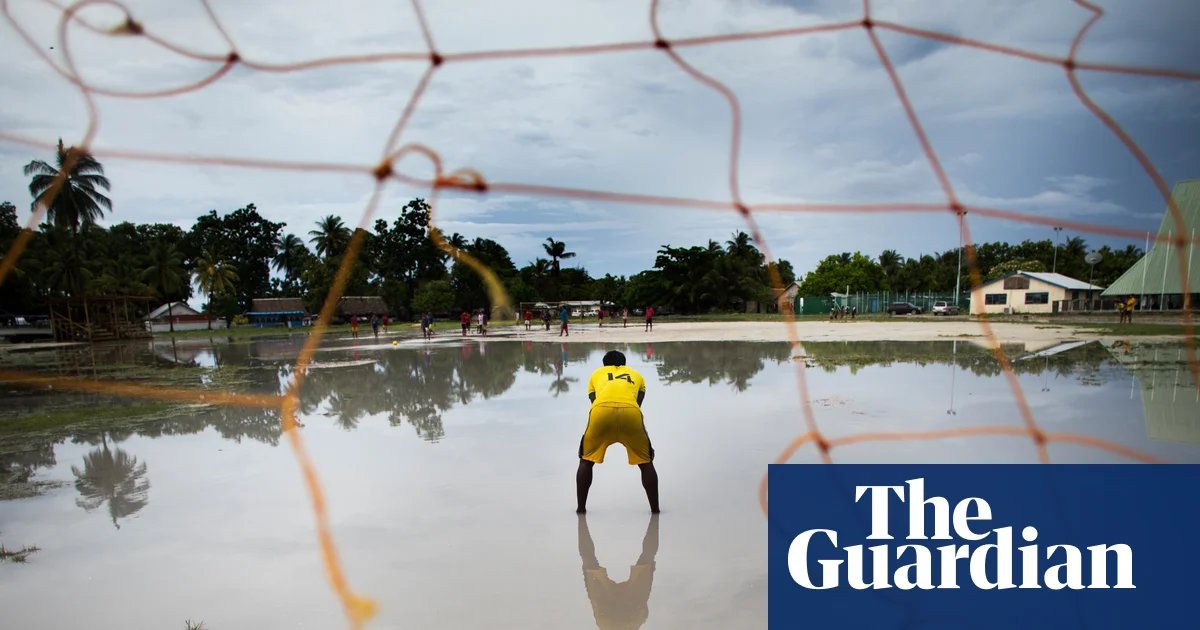
Joining Fifa, and the OFC, would bring funding, which would help to improve resources and facilities in Kiribati. It is, however, a vicious cycle, because if the current infrastructure – sand pitches and beach football – does not meet OFC criteria, Kiribati will not pass the test to become a full member.
Independence from the UK was gained in 1979 for the 33 atolls that make up Kiribati, but rising sea levels means planning for a different future than was imagined then. Government policies to encourage citizens to migrate abroad to find a new life are already in place, while Kiribati has bought land from Fiji as part of a plan to move climate refugees, such is the precarious position of the country.
Football’s popularity in Kiribati cannot be doubted. It is always the biggest draw at the Te Runga Games, a multisport event held every four years that brings together 23 teams from across the atolls. “It is incredible to witness,” Reebo says. Such is the event’s importance to locals that in 2023 Kiribati opted against attending the more prestigious Pacific Games, which were taking place at the same time in Samoa. Participants arrive in the capital, Tarawa, on small planes or by boat to represent teams such as Abaiang and Makin. It is a bucket-list event for many football supporters, because the crowds are so passionate and allowed to watch inches from the pitch.
The Premier League and La Liga are popular in Kiribati but it is not a given that foreign matches are available to view. Plans were under way to show the World Cup live on television in the country, with Reebo working alongside Fifa to reach an agreement. All being well, he will be keeping a close eye on his favourite players, Lamine Yamal and Neymar, in the coming weeks.
Kiribati is not the only nation whose very existence is threatened by rising sea levels; the Marshall Islands and Tuvalu are examples of others. The Marshall Islands’ football federation, set up in 2020, produced a “disappearing shirt” to raise awareness.
“Talking about climate change is much more prevalent and widespread because it’s a fundamental issue of survival,” says Mirey Atallah, chief of the adaptation and resilience branch, climate change division of the UN Environment Programme. “It’s not a luxury issue, it’s not a choice issue, it’s not a matter of whether it’s going to happen, it’s a certainty. The question is when.”
Plans are afoot to bring Kiribati’s best 24 players to Tarawa to be coached full time. “If Pep Guardiola wants to come, he’d be very welcome,” Reebo says hopefully. While the most polluting World Cup in history prepares to kick off, Kiribati is in a battle for survival.
This is an extract from our newsletter, The Hotspot. To subscribe just visit this page and follow the instructions.