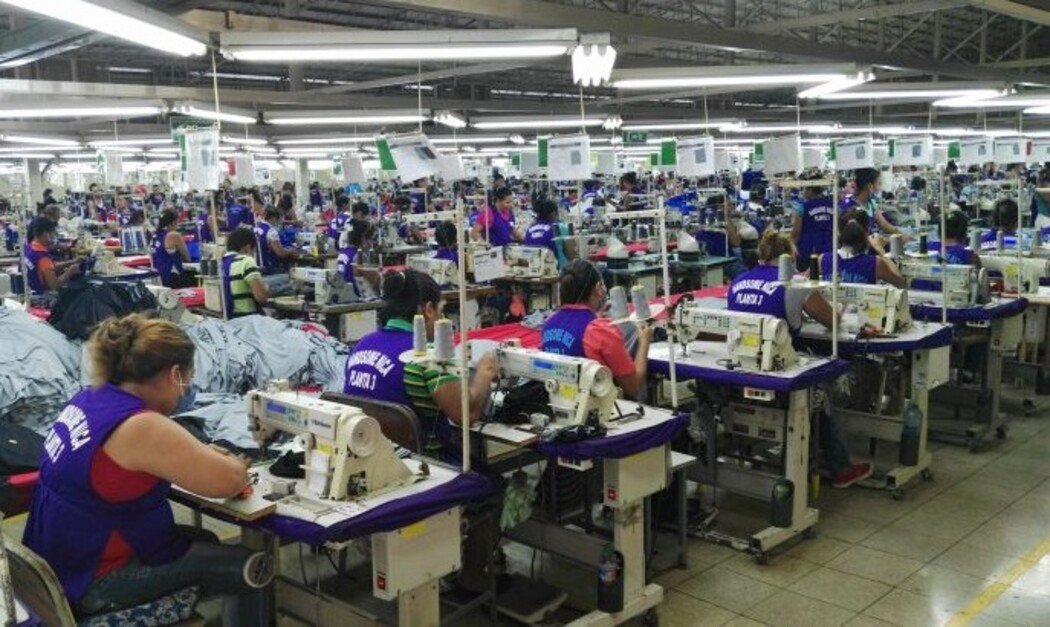
The regime of Daniel Ortega and Rosario Murillo ordered on March 7, 2026 to reform Law 917 or Law of Export Free Zonesin force since 2015, so that companies that already operate in that tax regime obtain similar benefits—or better—than those that companies that operate based on Law 1264 will receive. Special Economic Zones Law of the Belt and Road, effective December 19, 2025.
In the last months of 2025, the regime accelerated an offensive to attract new investments from other markets. Especially from its Chinese partner, to whom it has given more than it receives. Their reason is to try to replace the American partner with the Asian one, even though they know that this process does not occur by decree, because it has its own dynamics.
A data published in the Annual Report 2025prepared by the Central Bank, adds an extra layer of urgency: in 2025, the manufacturing industry reported a loss of 6.9% of contributors reported to the Nicaraguan Social Security Institute (INSS). That represents 11,954 fewer people working in that sector.
The Special Economic Zones (EEZ), They offer ten extendable years of tax exemptionwhile the Free Export Zones (ZFE) offer 15 years of exemption, but only once. The changes ordered will make that 15-year period extendable indefinitely.
Free Zone taxes
The proposed law It goes further, because it mandates that the exemption also includes the payment of taxes levied on the capital gains obtained by the operating companies and their partners, for their operations in the Free Zone Regime in Nicaragua. This means that these investors will not even pay taxes on the dividends they generate as shareholders of those companies.
At this time, the current Law exempts 100% of the payment of Income Tax (IR) on economic activities and the Tax on dividends obtained in the Free Zone Regime. This 100% covers the first ten years of operation, and is reduced to 60% from the eleventh year, although it leaves open the option of requesting 100% for ten more years. The bill allows the request for the ten-year extension to be permanent, meaning that, in practice, these companies would never pay taxes.
Finally, it is ordered that the rest of the tax benefits be in force indefinitely, to ensure that companies that operate in the country remain, and are thinking about the convenience of looking for other jurisdictions that do not have to pay 18% tariffs to enter the United States. All in order to avoid compliance with the commitments made by the country when signing the Free Trade Agreement with the United States, Central America and the Dominican Republic.