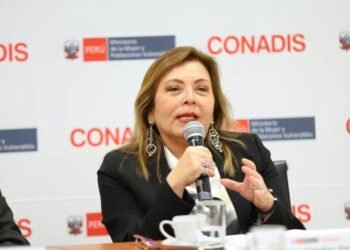

Innovating in health does not only mean developing a new medicine. For María Julia Caffaro, general manager of Roche Farma Perualso means reviewing processes that delay diagnosis and treatment, strengthening capabilities and ensuring that care reaches where the patient is. In conversation with The Commerce during the Roche Press Daycarried out in Costa Rica, the executive maintains that Peru has made progress in the regulation and evaluation of health technologies, but still has the challenge of converting successful experiences into policies that reach more patients.
Within the framework of World Day to Fight Breast Cancer, which is commemorated every October 19Caffaro focuses on a gap that goes beyond detecting the disease in time: An early diagnosis loses much of its value if the patient has to wait too long to start treatment. For the executive, Peru’s challenge is to reduce the entire journey, from screening and suspicion to confirmation of the diagnosis and timely access to therapy.
—In health we usually associate innovation with new medications or treatments. How much can be innovated also from processes and management?
At Roche we understand that innovating in health does not only mean bringing a medicine or a technology. If one wants to start seeing better health results and a more efficient system, innovating involves strengthening capabilities, optimizing processes that we already have established, generating more access routes for everyone, innovating in management and making it more efficient. That’s truly what allows us to get the results at scale that we’re looking for.
—You presented experiences in Arequipa and Junín that managed to reduce cancer care times. If we know that they work, what prevents us from taking these models to a national scale?
I presented two models of priority care and navigation for cancer patients, in Arequipa and Junín, but they are two among many other pilots that are already implemented in Peru, they are working and they are showing results. There is a very significant reduction in the times in which patients navigate within the system, from suspected diagnosis to diagnosis and treatment.
Shortening these times means improving results. If a patient navigates the system better, reaches a certain diagnosis sooner and the possibility of treatment sooner, this has a correlation with health outcomes and the efficiency of the system.
What do we need to scale it and for it to not be isolated experiences?
From my perspective, there is a lack institutionalize oncology navigation. We need to give greater visibility to how these process optimizations, which are relatively simple interventions, can produce meaningful results for the patient and for the system.
In Peru we have a great opportunity because we have a regulatory framework for cancer and for the organization of cancer care. The next step is to institutionalize this management practice so that it is not just a few patients who benefit, but rather every Peruvian who needs it. In cancer, time counts. There is a very significant difference between starting treatment at an advanced stage and doing it at an early stage. We are talking about opportunities for healing and mortality.
—In breast cancer, where is Peru’s greatest debt today: in early diagnosis or in timely access to treatment?
I think it would be a mistake to think which one we should prioritize. We need to improve screening goals, get women to carry out their controls, so that if they suspect they can quickly access a certain diagnosis and then they can navigate from that diagnosis to treatment in a timely manner.
We also need them to have access to treatment standards in accordance with clinical practice guidelines. We have to act on each of those points. It is not worth having an early diagnosis if that woman with breast cancer is going to have an unacceptable delay in accessing treatment later. We lose the value we add with early diagnosis if we delay treatment.
—During the meeting it was mentioned that four out of every ten people estimated to be living with hemophilia in Latin America would still not be diagnosed. What is the situation in Peru?
It is an alarming figure for Latin America. We do not have official data on patients with hemophilia in Peru. There are some records and it is estimated that there are around 1,200 to 1,300 patients diagnosedbut we know that there is a gap between diagnosed patients and people who could be living with hemophilia.
Furthermore, we have a very unequal territorial distribution of doctors. Only about 10% are in remote or rural areas. So, when we talk about rare and orphan diseases, which have low prevalence and are often almost invisible, the question is how do we find those patients.
The first point is to strengthen the knowledge and suspicion capacity of first-level health personnel. If a patient arrives with bleeding, a hematoma or some hemorrhagic manifestation and the professional does not suspect that it could be hemophilia, we will not move towards the diagnosis. Then we need diagnostic capacity to perform the corresponding tests. These gaps are repeated in other rare and orphan diseases. There is a huge opportunity to find those people, bring them into the health system and give them real access to diagnosis and treatment.
—You talk about “opportunities” even when you describe quite big problems of the Peruvian system. Because?
I am a doctor by profession and I am very optimistic. When I arrived in Peru I found a country where there are strong inequalities in health: territorial gaps, fragmentation of the system and opportunities for articulation. But we can see it as a problem and lower our arms or see it from the opportunity to work jointly between the different sectors: public, private, pharmaceutical industry, civil society and the Ministry of Health.
What moves me from my position at Roche Farma Perú is to find solutions that allow us to improve people’s lives.
—When an innovative treatment already exists internationally, what path must it take to effectively reach a Peruvian patient? Where are the main barriers?
There are different points on that journey. First is regulatory approval: our agency evaluates the efficacy and safety profile of a new technology and grants approval. Then we have the health technology evaluation process, governed in Peru by a multi-criteria manual, which re-evaluates effectiveness and safety, but also incorporates the social and economic value of that technology. Today it is very important to be able to measure cost-effectiveness when we incorporate a new technology into the health system.
If that evaluation is positive, we need financing. And there two questions appear: how do we finance the new and, from what we already have, what is generating value and what we can defund to make room for innovation. There is no place for everything. Budgets are finite and health priorities are many.
Then we need to make sure that that technology is available in the institutions and, finally, that the patient can reach it. That’s why we talk so much about decentralization. It is not how the patient arrives, but how we reach the patient.
In Peru we have made progress: regulatory times have improved, there are rapid evaluation mechanisms for certain situations and we have a multi-criteria manual for the evaluation of health technologies. But you always have to continue optimizing, especially the times required by each process. Innovation will have value if it reaches the patient. If each of those processes is slow and generates delays, that innovation does not produce the value we expect in outcomes for the patient and efficiency for the health system.
—If you had to point out the priorities for Peru to achieve better health results in the next five years, what would they be?
I would tell you three. The first is continue strengthening the first level of carebecause there are the screenings, the prevention campaigns and the promotion of healthy habits, and it is the first point of contact to generate a diagnostic suspicion and move towards the diagnosis.
The second is strengthen networksimprove the articulation between the levels and the reference and counter-reference processes. We are talking about optimizing the times from suspicion to diagnostic confirmation and access to treatment. We also need to look at what digital technologies, including interoperability, can help us make those networks more efficient.
And the third is work with clear indicators and measure results. When we can generate data from our interventions, measure it, analyze it and make it visible, we will be able to make better decisions about where to invest, what processes to improve and what avoidable costs to remove from the system. If I think about what can lead us to better results and more efficient systems five years from now, I would say: prevention and early diagnosis, referral and counter-referral networks, and data to make better decisions.