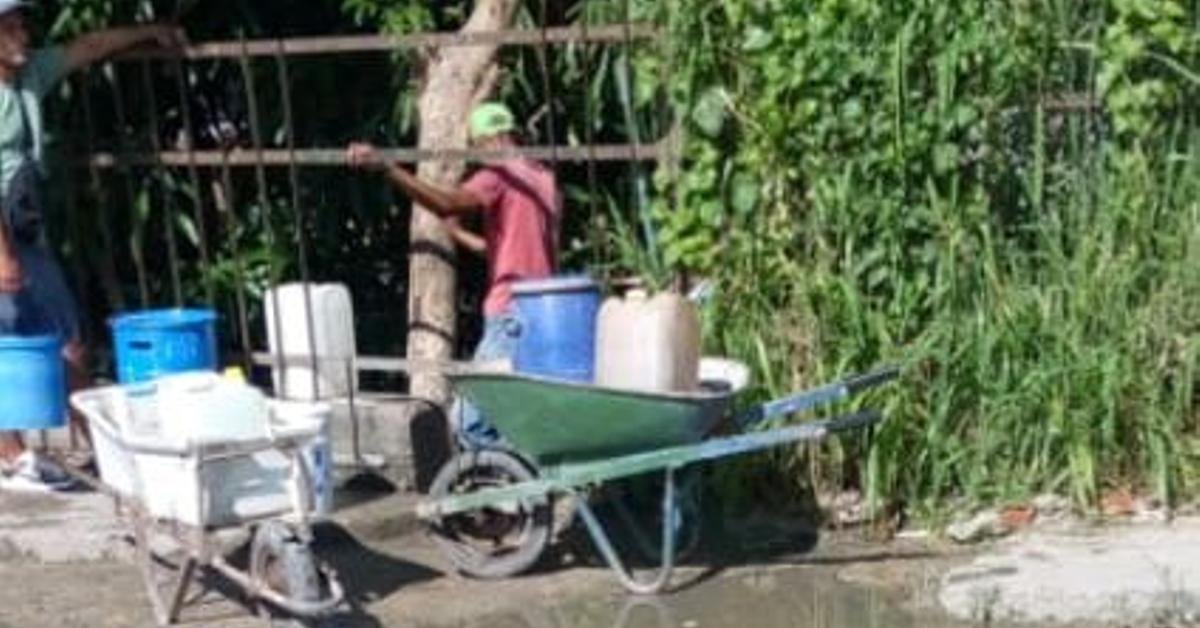
Havana/For more than three months, hundreds of families in the Alturas del Mirador neighborhood, in the Havana municipality of San Miguel del Padrón, have not had a drinking water supply. The prolonged absence of service has forced residents to rely on the Diezmero River, one of the most polluted river courses in the capital.
The neighbors fill their buckets in the stinking riverbed, while, a few meters away, a huge garbage dump occupies the entrance to the neighborhood. The combination of accumulated waste and a shortage of drinking water has raised fears of disease in an area where residents report feeling abandoned by the authorities.
“Women, children and the elderly consume well water that is not suitable for human consumption and, sometimes, even water from the Diezmero River,” he denounces 14ymedio José Lugo, neighbor of the neighborhood. “That’s without taking into account a landfill that is located in front of the town’s winery,” he adds.
“Women, children and the elderly consume well water that is not suitable for human consumption and, sometimes, even water from the Diezmero River”
The water crisis has become one of the main triggers of social unrest in Havana. In Guanabacoa, residents report that they have not had service for six days. “We don’t even have water to drink, and the government does nothing but make excuses,” denounces a local resident. “First they said that yesterday at 10 am he was coming in, then that today at 6. It’s already 9:15, and still nothing,” he lamented this Thursday.
In the middle of the downpour that fell yesterday in the capital, people went out with their buckets to collect the water that fell in streams from the terraces. “I opened the tank in my house to let some of the rain in,” said another woman. And he concluded: “Right now we live off of nature, like centuries ago. Sun for the panel, rain for drinking and bathing. We will have to send pigeons to communicate.”

/ 14ymedio
In recent weeks, neighbors of Regla They staged several protests in front of the municipal government headquarters to demand the restoration of service after several days without water and electricity. The demonstrations, accompanied by banging pots and blocking streets, are part of a growing wave of protests linked to the deterioration of basic services in the capital.
In Alturas del Mirador, however, residents assure that the situation has not received official attention for months.
“People here are tired of going to the headquarters of the Communist Party and Popular Power, but everything has been in vain,” says Lucrecia, a nurse at a Havana hospital. “Officials say they are going to come to review the problem, but they have never arrived.”
“The people here are tired of going to the headquarters of the Communist Party and Popular Power, but everything has been in vain”
For the health company, “this part of the cast has been forgotten and abandoned to its fate, no one listens to us.” The woman also takes care of a mother who is bedridden due to neurological problems, a circumstance that turns the lack of water into a daily drama.
“Every day is an ordeal, tremendous wear and tear and a danger to my health. Sometimes I have had to go to work without even being able to bathe. How is a nurse going to approach a patient when she herself is dirty and without proper hygiene?” she asks.
According to José Lugo, the problem does not seem to be due only to the scarcity of available water but also to failures in the management of the distribution system.
“This distribution is at a natural height of the land and depends on an impeller that is in the Baraguá Estate. From there they pump the water here, but we have to close some conduits and open others so that it reaches all areas. It is the human factor and the lack of interest that has us like this,” he says.
“Sometimes I have had to go to work without even being able to bathe. How can a nurse approach a patient when she herself is dirty and without proper hygiene?”
The neighbor claims to have called the Communist Party, the municipal government and even the director of the Aqueduct for weeks. “I have cried out for an official to come here to talk to the population, but that has never happened,” he laments.
Meanwhile, the neighborhood’s wells have been running out.
“People are drinking water from very depressed wells, yellowish in color, which is no longer suitable for human consumption, but it is what it is,” explains Lugo. “Other neighbors are taking water directly from the Diezmero River, which is very polluted.”
The potential health crisis is worsened by the general deterioration of public services. Lugo denounces that the medical offices in the area practically do not function and that the enormous garbage dump located in front of the warehouse and the butcher shop turns the environment into a permanent source of contamination.
“Cazuelas are played here almost every night, but since this neighborhood is so remote, it often doesn’t appear on the news”
Moving is not easy either. “The bakery works because the bread comes from somewhere else, but public transportation practically does not exist and many streets are clogged with garbage,” he says.
The rains of the last few days did not bring relief either. “Yesterday, when it rained a lot, the surroundings of the river looked like a party. People were carrying buckets and tanks, but that water is contaminated,” says Lugo.
The water shortage is also added to the blackouts, which in that area barely leave “one or two hours of power” a day. Added to this is the lack of telephone coverage. “The Etecsa tower broke and people have to walk to the Calzada to be able to communicate,” he explains.
In the midst of this panorama, unrest continues to grow. “This generates a depressive state in people. Here they play pots and pans almost every night, but since this neighborhood is so remote, it often doesn’t appear in the news,” says Lugo. “There is little time left until an epidemic with fatal consequences breaks out.”