No matter how much fuel is consumed by the equipment needed for road construction, the more significant – both financial and symbolic – blow to the road construction industry is caused by the increase in the price of bitumen, an oil product.
As it has been since time immemorial, the road construction season in Latvia opens with a meeting of Latvian and foreign road construction and management officials and businessmen organized by the national road construction contractor “Latvijas Valsts ceļi” (LVC). This year’s meeting is organized on April 22 and 23 in Jurmala. The content of this form has become alarming news that the end of the industry in Latvia will soon be here. You don’t have to look back further than until the “Independent” publication of April 11, 2025, in which the LVC conference organized a little earlier than this year was referred to with the words, “that already next year there will be a lack of money to guarantee safe movement on Latvian roadsHowever, the same article also contains a reminder as a consolation that not for the first time, but for the second time, the road construction industry is on the brink of trouble, because “almost as it is now, it has already happened twice in the foreseeable past, or in the last ten years”.
Another overwhelming power approached Latvia
In the course of the past year, it seemed that the mood of last spring had been too anxious. Of course, no one promised the industry 607 million euros, how much, after LVC according to calculations, it should be every year so that there is no doubt about the quality and sustainability of Latvia’s road network, but 184 million euros in total from the Latvian state budget and EU aid funds were planned for the industry. This is a little more than in 2025 in terms of nominal value and a little less in terms of purchasing power, if its fall is expressed according to official statistical percentages, but it is still comforting that the danger of the apparent collapse of the road network has been pushed further. But then February 28 of this year came, and the tales of last spring’s perils took on a prophetic tone. Namely, US President Donald Trump ordered to start a war in the oil and gas fields of the Middle East, almost completely blocking the flow of these resources from this region and causing a worldwide oil shortage, which drives the prices not only of fuel, but of all oil-derived products to unpredictable heights.
No matter how much fuel is consumed by the machinery needed for road construction, the more significant – both financial and symbolic – blow to the road construction industry is caused by the increase in the price of bitumen, an oil product, and ultimately the question of whether this product will be available at all. So, the road construction season should begin and it is impossible to imagine the current road construction without asphalting, even if we have to make some changes in the conditions of asphalt shortage.
Atis Shvinka proposes “intelligent and intermodal mobility”
A striking difference between last year’s and the current LVC conference was the Minister of Transport Ata Shvinkas participating with a speech from the rostrum in Jūrmala, not from a screen online with the Ministry of Transport, even if a recording of the speech was broadcast from there. Regarding last year’s content, it had to be noted that the address “consisted of such vague good wishes for the industry and the participants of the conference, which would be more appropriate for the President and Prime Minister, when senior officials congratulate gatherings of doctors or foresters, linguists or veterans with practically the same words”.
This time at the conference, the minister was a lively person with a speech adapted to the situation. In the picture, A. Švinka together with the host of the event, the chairman of the board of LVC Mārtiņas Lazdovski.

A. Švinka began with the assurance that “I am part of you”, “we will fight together” in the conditions of the oil and oil products crisis. The concreteness of the struggle is that the Ministry of Transport has submitted to the government draft regulations on the indexation of road construction project execution prices according to the increase in the price of oil products, but the draft was not approved at last week’s government meeting. A. Švinka expressed confidence that the regulations will be adopted at the next government meeting on April 28, but on the evening of April 27 it looked like it would not happen. In the agenda of the government meeting published last night, it was determined that A. Švinka would come up with regulations on how to “develop and expand sustainable, climate-resistant, intellectual and intermodal mobility”. Thus, the Ministry of Transport has created a new word “intellectual”, but the financing of road construction is not mentioned.
Both M. Lazdovskis and the chairman of the board of the industry company “Latvijas Ceļu būveņijs”, former Prime Minister Andris Bērziņš expressed to “Neatkarīga” that in the clash between the request of the Ministry of Transport to allocate money and the decision of the Ministry of Finance not to allocate money, a decision to compensate for the increase in the price of some construction works at the expense of not carrying out other construction works will emerge.
Variants for the selection procedure for postponement of construction works
One of the options for sorting out the construction works to be carried out this year and the planned but not completed construction works would be to be guided by whether a contract has already been concluded for the construction works. It sounds understandable why to use such a criterion, but it is equally likely that it will not remain the only criterion. Perhaps the bridge will have to be saved with construction works planned but not yet ordered today or a week from now, so that it does not collapse under the riders; perhaps there will be other sections of the road, along which many people have to move or goods have to be moved, in order for a company to operate, without which a municipality is in danger of going bankrupt.
A. Bērziņš added that now the municipalities, led by Riga, have applied to use a large part of the capacities of road construction companies, which were developed when Latvia was allowed to divert much more money from EU aid funds to road construction than now. But now the local governments have faced the same situation as the state. So with the need to pay more than the agreed prices for the ordered or planned construction works. The construction season, which hasn’t really started yet, threatens to end sooner than all municipalities will be able to figure out what they can or can’t (shouldn’t) afford financially.
Plan “A” written, plans “B”, “C” and others are allowed
M. Lazdovskis and likewise the Minister of Transport did not include 2-3 figures in their introductory speeches, the naming of which has meant the climax of the LVC conference: for so and so millions of euros we will repair so and so kilometers of road in so and so stages. There is, of course, a plan “A”, but without excluding the fact that at the end of the season we will be much further than plans “B” or “C”: maybe there will be “P”, maybe there will be “Z”.
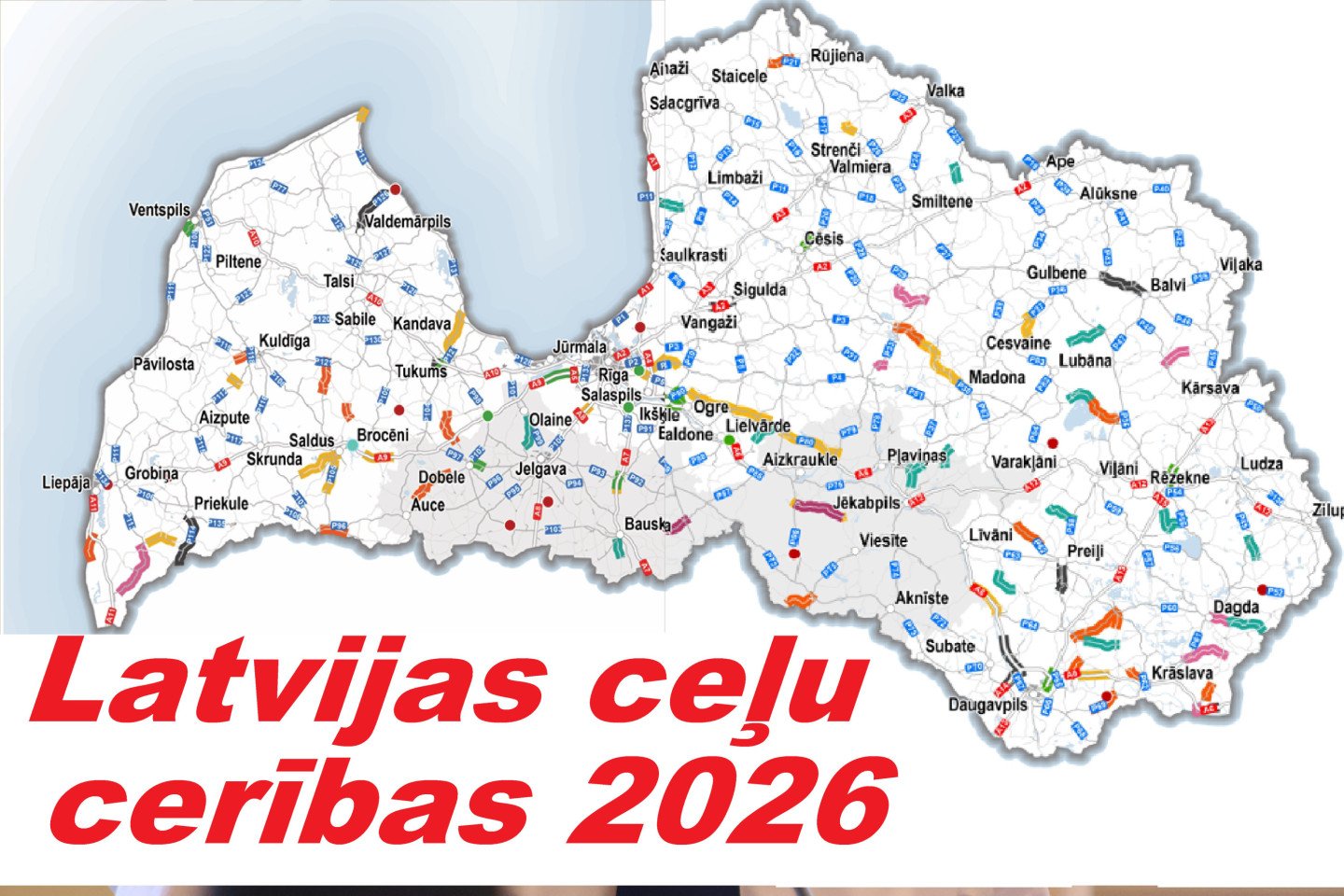
M. Lazdovskis invited to get acquainted with the plan “A” in the March edition of the LVC internet publication “Autoceļu Avīze”. In the place of honor of the publication, a map of Latvia with road sections, where works ordered by LVC are planned this summer, and an explanation of this map by M. Lazdovskis in the format of an interview. The map prepared by LVC was placed at the head of this “Independent” publication.
In the interview, M. Lazdovskis stated that even at the beginning of March, the current construction season seemed very similar to the previous one. However, the war in the Middle East already reached Latvia in the middle of March as a significant increase in the prices of not only fuel, but also bitumen. We have to take into account what happened in 2022, when the war in Ukraine resumed. In the words of M. Lazdovski, “the situation is unexpected and it is not clear how long it will last. There is also a deep uncertainty about the consequences that we can expect, the situation changes from week to week. This is a big challenge for our industry, even despite the fact that, by nature, entrepreneurs have created to work in conditions of uncertainty.” “However, the conditions that are developing now are something quite unstable. The solution could be an emergency indexation of existing contracts, if an appropriate government mandate is received. The industry calculates that the increase in costs could be about 15%. It should be taken into account that, if no additional funding is provided for such indexation, it is likely to be necessary to review this year’s plans and postpone repairs at certain stages.”
Road reconstruction stages worth mentioning
For the time being, work is being started with the hope of accumulating such momentum that at least something will be done by the end of the season. The largest amount of work in terms of sections and number of kilometers is directed to the country’s local roads. Out of a total of 80 objects, 50 will be on local roads and will cover 350 kilometers. This is half of the total amount of construction work, in total we plan to work on 657 kilometers of national highways. There are several reasons for this trend. First of all, the state budget cannot pay for large and expensive reconstruction projects. Secondly, the EU money available for roads is promised for local and regional highways and traffic safety affected by the administrative territorial reform.
National highways in this list are represented by sections of the Riga-Daugavpils highway (A6).
If we are talking about asphalting, which became a symbol of the road construction industry in Latvia in the middle of the last century, then this year the access road to the Sēlija landfill, or the local road Daudzeva-Viesīte-Apserde (V956) (1.18-17.19 km) and the regional road Bauska-Aizkraukle (P87) in the section from Ozolaine to Bārbele, must be converted from a gravel road into an asphalt road. (17.41-28.06 km). Almost 65 kilometers of local gravel roads will be poured with a pitch layer without reinforcing the lower layers.
Various tricks will be used to get by with resurfacing where realignment would be needed. This is about the section of the road Cēsis-Vecpiebalga-Madona (P30) from the intersection with the road Gaiziņkalns-Lubeja-Gulbēre-Liezere (V851) to Madona (km 61.13-83.91). Motorists and journalists, to whom motorists and other activists tend to complain about the poor quality of road repairs, must be prepared that after such repairs the road will not be perfectly smooth and cracks may appear sooner, but the road is thus protected from further collapse and driving comfort becomes better.