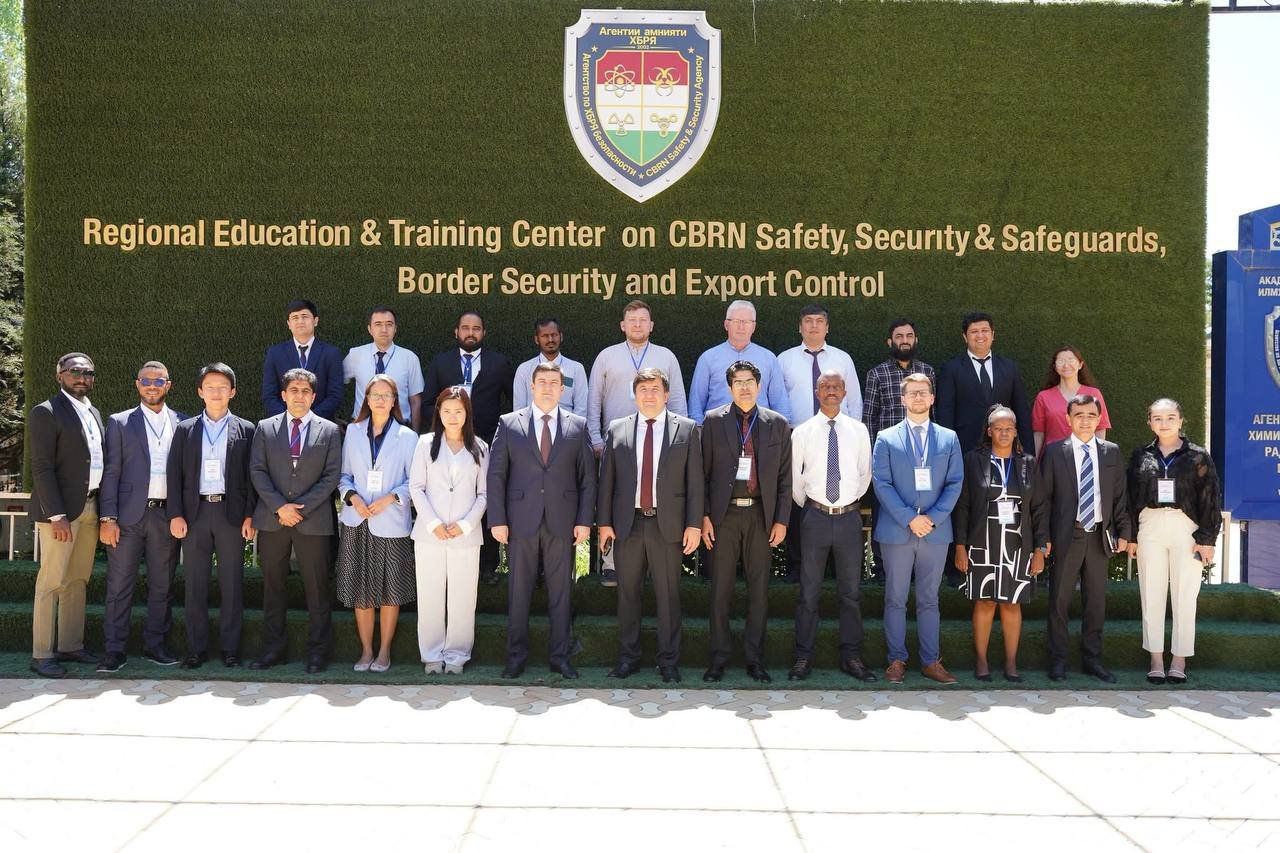
In the city of Dushanbe, at the Agency for Chemical, Biological, Radiation and Nuclear Safety, an international training course of the International Atomic Energy Agency for instructors on the topic “Creation and operation of the National Nuclear Safety Support Center” began.
The event is held from June 22 to 26, 2026 and is aimed at strengthening national and regional potential in the field of nuclear safety, developing a specialist training system, improving scientific and technical support and introducing advanced international experience into the activities of specialized structures.

The opening ceremony was attended by the President of the National Academy of Sciences of Tajikistan, academician Kobiljon Khushvakhtzoda, Director of the Agency for Chemical, Biological, Radiation and Nuclear Safety Ilkhom Mirsaidzoda, representatives of the International Atomic Energy Agency, international experts and participants of the training course.
The holding of this event in Dushanbe is an important evidence of the consistent strengthening of cooperation between the Republic of Tajikistan and the IAEA and recognition of the growing role of the country in the regional nuclear safety architecture.
Of particular importance in this process is the functioning of the Regional Center for CBRN Security, Protection and Guarantees, which was directly opened by the President of the Republic of Tajikistan Emomali Rahmon, and the Chairman of the Majlisi Milli Majlisi Oli, Chairman of the city of Dushanbe Rustam Emomali.

Today, this center acts as a modern regional platform for conducting international training courses, practical training of specialists, exchange of expert experience and strengthening cooperation with international organizations, including the IAEA. Its activities contribute to enhancing the role of Tajikistan as an active participant in international initiatives in the field of nuclear and radiation safety, physical protection, non-proliferation and human resources development.
The main goal of the training course is to train instructors and specialists capable of facilitating the creation, development and sustainable operation of National Nuclear Safety Support Centers. Such centers are considered in international practice as the most important element of the national nuclear safety regime, combining training, technical support, scientific and methodological support, human resource development and coordination between interested departments.

During the study week, participants review the maintenance of the national nuclear safety regime, the key functions of the National Nuclear Safety Support Center, institutional design, resource assessment, gap analysis, coordination mechanisms, strategic planning, laboratory development, equipment procurement, sustainability, program self-evaluation, and performance indicators.
Particular emphasis is placed on practical exercises, case studies, group discussions and the exchange of international experiences.
The course presents the approaches and practices of specialized institutions and experts from different countries, which allows participants to compare national models, identify effective solutions and adapt best practices to the conditions of their countries.

A significant part of the program is devoted to the development of human resources, technical support and scientific support – three key areas on which the sustainability of the national nuclear safety regime depends.
This approach is especially important in the context of modern challenges, when safety requires not only equipment and a regulatory framework, but also ongoing training, competent instructors, effective interdepartmental coordination and a developed safety culture.