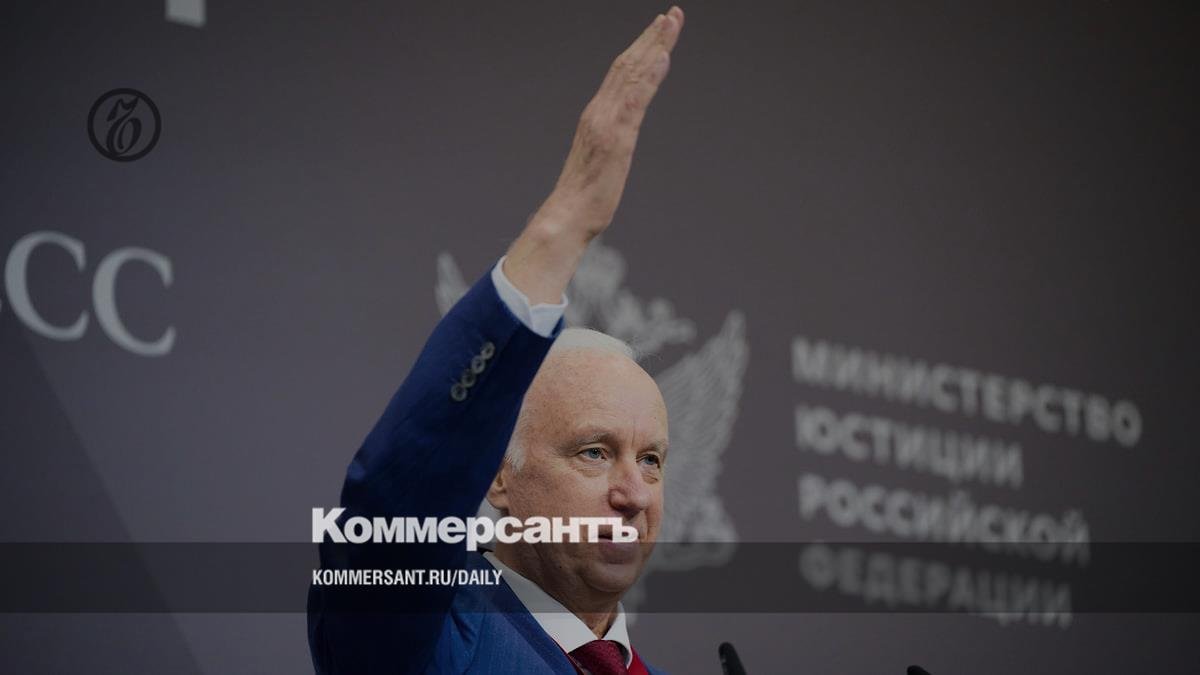
Participants at this week’s St. Petersburg International Legal Forum (SPBILF) openly admitted that they prepared abstracts for speeches using artificial intelligence (AI), but only to find out what neural networks think about themselves. They discussed how to regulate new technologies and worried that in the future they would be self-aware. But not everyone was worried about the future: the head of the Investigative Committee of Russia (ICR), Alexander Bastrykin, talked about the past and assured the forum guests (periodically in poetic form) that only a return to the ideals of the USSR would help build a strong state.
The main topic of the SPBILF in 2026 was AI. On June 25, the Chairman of the Constitutional Court, Valery Zorkin, already spoke out about his threats, warning that the fifth industrial revolution is coming, during which humanity will “finally lose control over artificial superintelligence” and will become an “appendage of platforms.” Deputy Head of the Ministry of Justice Oleg Sviridenko was worried that AI could start doing in Russia “everything that foreign agents did.”
The next day, discussions on this topic continued, both during the sessions and on the sidelines of the forum. Representative of the Ministry of Digital Development Ekaterina Larina said that “AI is already becoming aware of its subjectivity.” “We see how artificial agents act independently, take some actions, guided, among other things, by the instinct of self-preservation,” she noted. Along with the upcoming emergence of self-awareness in AI, Ms. Larina was also concerned about the inability of neural networks to admit their mistakes. “AI will never say, ‘I don’t know,’” she complained, adding that this is why it can so convincingly produce false information and spread deepfakes.
“We are entering an era when seeing does not mean believing,” she concluded and admitted that ChatGPT even helped her formulate the theses of her speech.
During the session on healthcare, Deputy Head of the Ministry of Health Oleg Sagalay also admitted that he turned to the neural network when preparing his speech, noting that the AI itself “does not really want to take responsibility for making clinical decisions.” The Ministry of Internal Affairs also spoke on this topic. Deputy head of the department’s investigation department, Danil Filippov, said that the ministry supports the idea of adding the use of AI to the list of aggravating circumstances when committing crimes.
Earlier, representatives of the Investigative Committee also expressed this idea at the forum. However, the head of the Investigative Committee, Alexander Bastrykin, did not pay attention to the topic of AI in his lecture, which became one of the most notable events on the final day of the SPBILF.
In his opinion, lifting the moratorium on the death penalty, which is not supported by legislators, would help solve many problems in the development of society. “Why did China begin to develop so rapidly? Because the party supports honest business. And corrupt officials are shot there!” – he remarked.
In addition, China is helped, according to Mr. Bastrykin, by a formulated state ideology in which the market economy is combined with the theory of socialism. For this reason, the head of the Investigative Committee proposed introducing the possibility of state ideology into the Russian Constitution and holding a referendum for this purpose.
Mr. Bastrykin is not satisfied with the ideological guidelines that are now being broadcast in schools to the younger generation – “Talking about important things,” he said, “is of no use, and chatter will not defeat crime.” Instead, he proposed conducting “courage lessons” in schools and lowering the age of criminal responsibility to 12 years. The head of the ICR also proposed to restore the “Octobers, Pioneers and Komsomol”, because nothing has been heard about the current “Movement of the First”. To be convincing, he even sang lines from the song “And the battle continues again”: “And Lenin is so young, / And young October is ahead,” and then indulged in memories of the Soviet Union in poetic form. Alexander Bastrykin recited a poem of his own composition (see takeaway), in which he admitted that he wanted to return back to the USSR.
Legal forum
I want to go back to the Union in which I was born,
Having shaken off the heavy burden of deception, free yourself from dreams.
From all freedoms and mortgages, from rising prices, inflation,
From the verbiage of long rivers, the deception of installations.
From the Central Bank with a key rate that is constantly growing,
It’s like a mean fight with a mongrel that is always growling.
I want to return to the old world, where there is brotherhood of all peoples,
And it is not wealth that is the idol, nor the scale of income.
But there is always confidence that the future is ours
It always depends on work, and tomorrow will be more beautiful.
And only common honest work, and equality, and brotherhood
They will bring happiness to the people and our state.
By the power of goodness he will return to us faith in justice,
And again the winds of October will return intransigence.
To the one who loves to oppress, deceive and rob,
Not to stand at the machine in the workshop, but to fool the workers.
And the newly awakened people will return to the highest power,
And once again it will decorate the sky not as a sign of profit of passion,
And the stars of the coat of arms of the country that united us,
We were all born into it, and this is our strength.
At the end of the SPBILF, the topic of AI was returned to again – director Nikita Mikhalkov did this at his own lecture. Moreover, at that moment he was thinking about traditional values. “Moral ideals should be invested in a citizen when he is two, three, four years old,” said Mr. Mikhalkov. “If from the age of five he sits on a gadget from morning to night and plays shooting games, then at the age of fifteen you can no longer tell him about moral values - it’s pointless. One hope lies in artificial intelligence. But it doesn’t exist on its own; someone controls it.” The director also saw problems with instilling correct values in young people in approaches to labeling books. “On the one hand, we declare certain writers to be foreign agents, and on the other hand, their books lie on the shelf. And at the same time, on “The Three Little Pigs” by Mikhalkov (poet Sergei Mikhalkov.— “Kommersant”) it is written that you need to be careful with drugs, because there are “nif-nif”, “naf-naf” and “nuf-nuf” – they are probably snorting something there. Well, this cannot be taken to the point of absurdity,” he concluded.