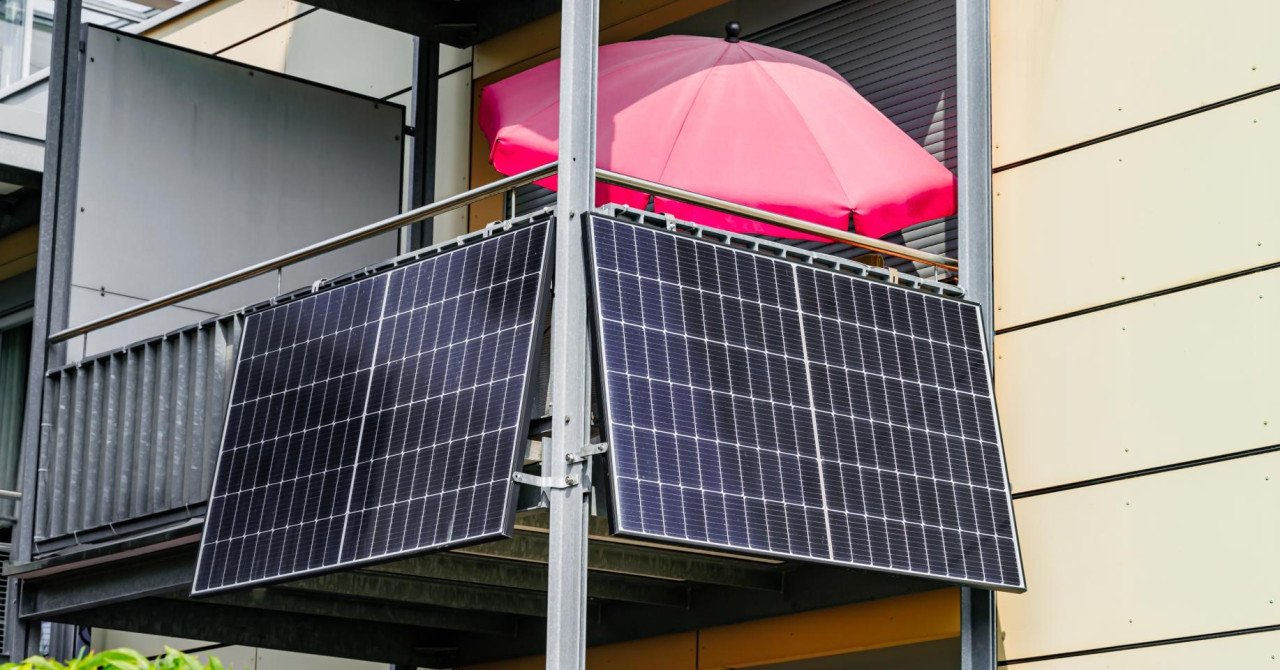
It sounds almost unbelievable: plug the solar panel into a regular socket and start producing your own electricity. This is exactly how the so-called plug-in solar systems work, a technology that in recent years has turned from a niche product into one of the fastest growing segments of the European renewable energy market.
It is important to emphasize that the socket is not a source of electricity, but only serves as a connection through which the energy produced on the panels reaches the devices in the household. The produced energy is immediately consumed in the household, which reduces the amount of electricity that needs to be taken from the grid.
So far, such systems have achieved the greatest success in Germany, where the number of registered installations has already exceeded one million, but interest has been growing in recent years in France, Italy, the Netherlands, Poland and other European countries. According to expert estimates, between four and five million plug-in solar systems are in use across Europe today, including those that have never been officially registered.
These are small photovoltaic systems that usually consist of one or two panels and a microinverter. Unlike classic solar power plants, which require more serious operations and larger investments, these systems can be placed on a balcony, terrace, facade, in the garden or on the roof, and the users can mostly install them themselves.
He decided to check how such a system looks in practice Christopher Mims from Wall Street Journal. After his state of Maryland allowed the use of such devices, he installed one in his own home and documented the entire process.
As he described, he installed it in less than an hour. After connecting the panel to the microinverter and plugging it into an outdoor outlet, the system began generating electricity for his household.
According to the words Moncef Krarti, professor of architectural engineering at the University of Colorado Boulder, plug-in solar “is already widespread in Europe,” and Germany is the best example of the development of that market. There, balcony panels are a common sight on residential buildings today.
One of the most common questions is how much benefit such systems can bring to the household.
According to the first major European report on plug-in solar published by the organization SolarPower Europesuch systems can cover between five and 25 percent of a household’s annual electricity needs. How much it will cover depends on the size of the system, the position of the panels, the amount of sunlight and consumption habits. In the same report, it is stated that the return on investment is usually between two and six years.
You would never guess that these elegant panels generate electricity: They are almost invisible
Krarti warns that plug-in solar should not be seen as a substitute for a large home power plant.
“The point of plug-in solar is not to reduce household consumption to zero,” he told the Wall Street Journal.
In other words, the goal is not to completely eliminate the electricity bill, but to reduce the part of consumption that can be covered during the day by the energy produced by your own panels.
In Germany, the power of individual systems is generally limited to 800 watts. This is not enough to fully power the household, but it is enough to reduce part of the daily electricity consumption.
One of the main reasons for their popularity is the fact that they are not just for homeowners.
While classic solar power plants generally require their own roof, plug-in systems can also be used by tenants of multi-apartment buildings. The panel can be placed on the fence of the balcony or terrace, and in case of moving, it is relatively easy to dismantle it and take it with you.
This accessibility is one of the reasons why the market has grown so quickly.
According to data from SolarPower Europe, more than 780,000 such systems were registered in Germany at the end of 2024. In the meantime, the number of registrations has exceeded one million, and experts believe that the real number is even higher because some users have never registered their systems.
Leah Le Penuizic from SolarPower Europe warns that further market growth must be accompanied by clear regulations.
“Europe needs clear product standards and consistent installation rules to ensure safety, network compatibility and consumer confidence,” she said when launching the report.
According to writing Euronews, precisely the simplification of the rules is one of the reasons why Germany has become the European leader. The German manufacturer Meyer Burger told this media that it was the citizens who were the main initiators of the changes.
“Customers started this boom and successfully asked politicians to simplify the bureaucracy,” the company said.
Unlike Germany and some other European countries, plug-in solar systems have not yet taken off in Croatia to a significant extent. Although such kits can be bought on the domestic market, the interest of citizens is limited for now.
A possible reason is the regulatory framework. While some European countries have simplified the rules for balcony power plants in recent years, HEP states that in Croatia, the rules that apply to solar power plants connected to the distribution network also apply to plug-in solar systems.
“If it will be connected to the distribution network, it is possible to set up a photovoltaic power plant in Croatia by observing all the rules and regulations that define the installation of solar power plants and respecting the procedure for obtaining the necessary documentation for the connection of such buildings, which also applies to plug-in solar systems,” answered us from HEP.
They add that without the necessary documentation, only systems that are not connected to the network can be used.