Loading Text-to-Speech…
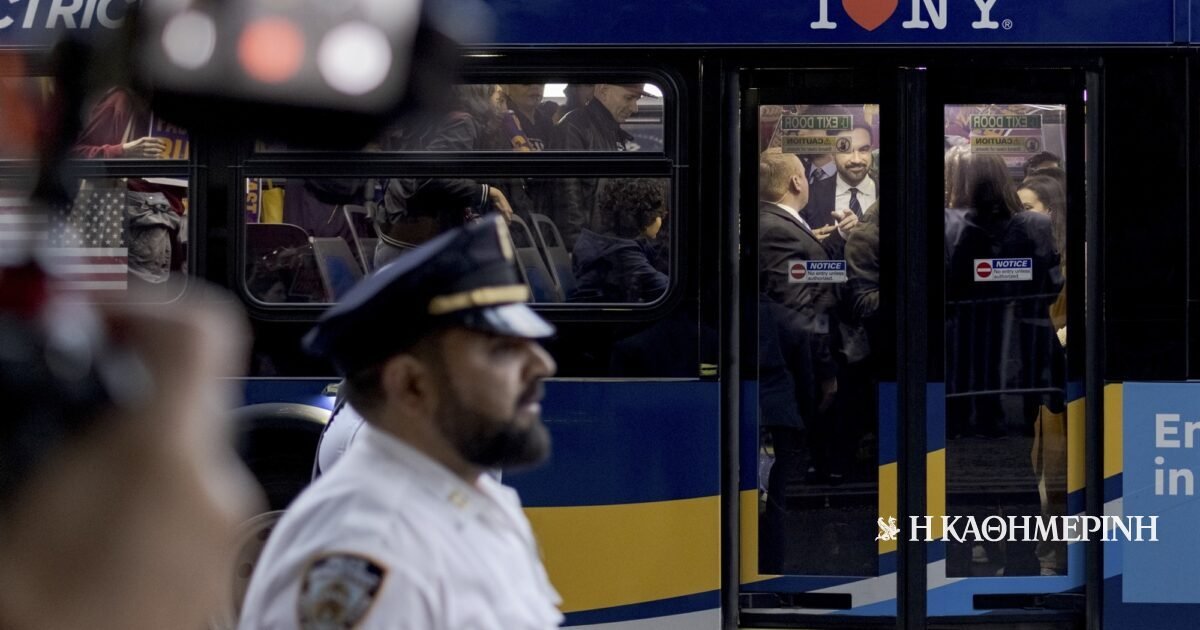
On the campaign trail, he promised free public transportation – specifically city buses – and affordable housing, through a rent freeze for rent-controlled apartments. Raising the minimum wage. Public supermarkets to reduce food prices. Taxation of the super rich.
With these promises and with the cost of living at the center of his rhetoric, Mr Zoran Mamdani was elected mayor of New York last November. But he also accomplished something else. It was held up as a model of electoral success that transcends the borders of the American metropolis.
Now that Greece is entering its own election season, the two parties that appear to be vying for the position of main opposition appear to be inspired by Mamdani’s agenda.
Competition
PASOK promises free travel on public transport in Athens and Thessaloniki for all young people up to 24 years old. ELAS promises free public transportation in Athens and Thessaloniki for everyone, except tourists.
ELAS proposes the creation of a non-profit social management body that will purchase the red loans of vulnerable citizens, arrange loans based on real income, and protect the first home. PASOK wants to develop or renovate housing for long-term leases at affordable rents, providing incentives to private individuals to allocate closed properties to social programs.

His party Alexis Tsipras wants the institutionalization of a minimum guaranteed amount of electricity, stable and affordable prices for households and businesses, while that of Nikos Androulakis suggests moving to cheaper “blue” tariffs and an indirect wholesale cap. Are they copying Mamdani? Do they copy each other? Or are they simply responding to the most basic request of citizens?
For class reasons
The program’s focus on affordability, that is, on “financial accessibility”, was a very conscious choice, the lawyer and coordinator of the PASOK program team tells “K”. Lefteris Karchimakis. “Who do we want to represent? The hundreds of thousands of workers, the struggling small and medium-sized businesses and the new generation that is leaving abroad.” comments.
Even before New York – “We had made this choice”, to make the cost of living the center of the program, “before the Mamdani phenomenon”, the coordinator of the PASOK program team, Lefteris Karchimakis, tells “K”.
With this in mind they diagnosed two main problems – the cost of living and the production model. “I wish we were Mamdani,” he says, first jokingly, then seriously: “We had made that choice,” to make the cost of living the center of the program, “before the Mamdani phenomenon.” But, he points out, the fact that there are a number of politicians in different countries who are campaigning on the basis of material needs – “and how we’re going to have life rather than survival”, he says – indicates that class opposition has returned.
“There is a misunderstanding”, the lawyer and executive of ELAS tells “K” Dionysis Teboneras“because Mamdani tried it in New York, many people think we are copying him, it’s not like that at all.” ELAS, he declares, has a class orientation. “We don’t have Mamdani logic in our program – affordability is a small part of our intervention, the interventions are structural in nature, in a completely different orientation.”
Nevertheless, speaking about the main points of the program he mentions among others: state intervention in the fight against punctuality, redistribution of wealth through strengthening the poor and middle incomes, free MMMs for the “common people who use them”. And then “innovation in research, in industry, in the primary sector, conflict with the cartels”.
According to Mr. Karchimakis, ELAS has more or less copied the program of PASOK. “These are things we announced, they are obviously reading. And this reveals that there was no programmatic and political vacuum”, he says.
Avoid copying – “Because Mamdani tried it in New York, many think that we are copying him, it is not like that at all – affordability is a small part of our intervention”, emphasizes ELAS executive Dionysis Teboneras.
According to Mr. Tebonera, the programs do not have that many similarities. “PASOK talks about social housing, we said something completely different, we proposed the non-profit loan management organization.” The comparison is inappropriate according to him. “We are talking about a 20-day party and a 50-year-old party that has a two-year program,” he underlines and adds: “Without criminalizing some common propositions, overall the logic is different – they focus more on the management of the free economy, we more on the Keynesian model.”
And as far as the Mamdani phenomenon is concerned, he believes that in any case there cannot be a complete “transfer” of policies, one cannot compare a city, even if it is New York, with a country. “However, this does not mean that certain principles are not becoming relevant again – because inequality is increasing again. It’s a matter of social protection.”
New recipe
The current picture is a change from the classic left-wing prescription, says Professor of Political Science, holder of the Gladstone Chair at the University of Oxford, Stathis Kalyvas. The “prescription” is not rights and entitlement – ”that was a parenthesis that has been closed,” he notes, “because as we understood it did damage to the Left.”
The basic recipe, he emphasizes, was taxation and redistribution. “What seems to be happening now is a policy of perks, a policy of specific sub-perks like free tickets, which departs very much from that tradition.”
And yet, according to the associate professor of Sociology at the Greek Academy of Sciences Panagi Panagiotopoulosthere is no question of a return to social democracy. “There may be demands that are relevant again, but there is no serious sign anywhere that Social Democracy can meet them.” In the past, he notes, “everyone could say ‘we’ll give it to you’.” But they didn’t explain where they would get the resources because they were borrowing. Now does the question really make sense, where will this money come from?”
Anyway, the assistant professor of Political Science at EKPA Bright Rori states that the common theme based on accuracy and cost of living has logical appeal. “It is an objective problem, the number one issue that concerns the citizens, and therefore it will logically be the central issue of the pre-election period.”
“After the crisis in Greece, new inequalities were formed, issues of housing, living, low wages are objective complaints that people have,” he explains, concluding: “Now how appropriate the proposals will be and the dose of populism with which they will be presented, depends on the character of the party and the leader, but the cost of living will be the No. 1 issue of the election campaign.”