Change font size:
By Ferit Hoxha
Anyone who knows even a little about Albania is aware that the cornerstone of Albanian foreign policy in the post-communist period has been a clear orientation toward the Euro-Atlantic world, as a guarantee of democracy, security, and the country’s development, and as an expression of our aspiration for freedom, progress, and Western belonging.
This policy has been characterized by consistency and broad national consensus, focusing on NATO membership, advancement toward the European Union, and a highly constructive role in regional cooperation. This approach has aimed to position Albania as a source of stability, a reliable partner, and an actor contributing to peace, cooperation, and regional integration.
I say with satisfaction and pride that in all these elements, part of a single strategic vision, Albania has succeeded, and they continue to remain at the center of our external projection.
While our foreign policy has been characterized by predictability, stability, and coherence, for the first time in these decades, this approach is facing a new international reality dominated by unpredictability.
In today’s developments, the only certainty is uncertainty. The global order we have known has faded and is shrinking, while the one that is emerging still lacks clear contours. Some, more boldly, say the world is spinning aimlessly. In such conditions, foreign policy cannot remain static. It must be flexible and dynamic.
For Albania, at the center of this vision naturally stands the process of accession to the European Union. It is significant that, even after decades of waiting, many promises, skepticism, delays, and numerous challenges, Albanians have never lost faith in this path. On the contrary, support for the EU has remained stable and strong.
This is because, in essence, the EU accession process has been the only path, but also because it has not been seen merely as a political objective, but as a profound transformation. Not only as a destination, but as a concrete path of modernization and progress; not as another organization with certain rules, but as a way of thinking and living.
Where do we stand today? If I were to use an expression from my childhood, in our relations with the European Union, we have crossed the rainbow. At that time, this expression symbolized the impossible. Today, it symbolizes what is achievable, because we are no longer in the phase of hope, but of action; no longer waiting, but engaging in cooperation and concrete co-investment; no longer searching for formulas to keep enthusiasm alive, but directly negotiating our future in the EU.
We have moved from aspiration to a tangible process, from vision to measurable reality. This historic moment requires continuous institutional commitment, but also collective responsibility to realize it with seriousness, credibility, and concrete results, as great opportunities bring greater responsibilities.
This is my duty, this is my commitment!
This brings me to another field where Albania has consistently invested and built: regional cooperation. We have sought and found common interests at the bilateral level with each country, but we have also worked with the conviction that, without good neighborly relations and constructive cooperation at both bilateral and multilateral levels around us, it would be more difficult to successfully build our European narrative and perspective. While we do not choose our neighbors, we can choose the quality of the relationships we build with them.
And precisely for this reason, we have viewed regional cooperation as an accelerator of integration. Albania has advanced concrete initiatives by thinking and acting creatively. We do not regret any effort and will not stop, because only genuine cooperation makes the Balkans truly Western and our countries worthy of the European Union.
Building and maintaining good and constructive relations with neighbors is not merely a diplomatic principle, but a pragmatic approach aimed at reducing tensions and increasing trust. This is what we have done with all countries without exception, promoting cooperation and increasing regional interdependence.
Our relations with Kosovo constitute a very special, stable, and unchanging dimension of our foreign policy. Our objective is the further strengthening of our close relations and strategic cooperation in all fields, as well as active support for consolidating its statehood and increasing its international subjectivity.
Albania will continue to be fully committed, and I would like it to be understood by everyone, everywhere, both those who recognize and those who do not, including in the region, that it is in the direct interest of the entire population, including all minorities in Kosovo, for their country to become a member of the Council of Europe, where minority rights are addressed in a detailed, structured, and continuous manner.
In the same spirit, Kosovo’s membership in UNESCO would serve the better protection of cultural and spiritual heritage across its entire territory, whether Albanian, Serbian, or of other communities.
The same applies to UN agencies, funds, and programs. To those who still do not recognize Kosovo, although this is regrettable, I ask at least that they do not hinder its membership in international organizations, because it is in the interest of its citizens, including minorities.
There are still five EU member states that do not recognize its independence, although all of them, in one form or another, have shown flexibility in finding practical solutions in specific aspects: they have supported freedom of movement, support Kosovo’s Euro-Atlantic advancement, and the normalization process with Serbia, but remain unconvinced to move further toward formal recognition.
After 18 years of independence, reality has convincingly shown that our region, Albanians and Serbs in Kosovo, live better and with greater prospects in this new reality than during the previous period of conflict and administration under Serbian dominance. This fact should serve as a basis for a more pragmatic and future-oriented approach, where stability, coexistence, and European integration prevail over the political divisions of the past.
Our support for Albanians in the region remains an important pillar of our engagement. This approach is aimed at strengthening stability, coexistence, and the European integration of the entire region, in line with the principles of good neighborly relations and European values. This applies to Albanians in North Macedonia and their essential role in the country’s overall architecture, as well as to those in Montenegro and in the Presheva Valley. Soon, we will open a general consulate in Bujanoc, precisely to be closer and to do more in strengthening the Albanian community there.
I would like to highlight the serious engagement we have established with Greece to resolve the issues that remain pending in the near future, in a spirit of trust and goodwill. Both sides agree to make the most of the most positive atmosphere in bilateral relations we have experienced in some time.
I grew up, both personally and professionally, in a world where the West was perceived as a whole. For us, the young Albanians of that time, and later in my formation as a diplomat, the United States, France, Germany, and Italy were countries separated by geography, but united by everything we aspired to become and achieve: democracy, freedom, the rule of law, security, and the model of an open and developed society.
They represented not only a geopolitical orientation, but a system of values and a standard of development that guided our strategic choices and inspired Albania’s path toward the Euro-Atlantic family.
This sense and connection has been so strong, also supported by specific elements of bilateral relations and the continuous investment in regional security by all Western actors, that we still find it difficult to understand that among strategic partners there may be different approaches to essential issues, uncertainties, or even differences that could lead to divisions.
Such a reality requires us to be more attentive, to preserve and strengthen everything we have achieved, and to act with pragmatism, always guided by our national interest.
For Albania, membership in the European Union and the preservation and strengthening of the Euro-Atlantic partnership are two sides of the same coin, defining the Western world as a space of values and security.
Because in this space, democracy stands against dictatorship; peace and development against conflict and poverty; and free society triumphs over deprivation and oppression.
Multilateral relations constitute an essential pillar of contemporary diplomacy, as they create the necessary space to address challenges that no state can face alone. “Global problems require global solutions,” as Kofi Annan rightly said, and for this, global platforms are needed. As is often said, no country is large enough to succeed alone, and none is small enough not to make a difference.
For small countries like Albania, multilateralism remains an important instrument to be heard and to influence the international arena, as well as for visibility and protection. If I were to mention just one example, it would be our presence in the Security Council.
In this context, the rules-based international order is a fundamental principle that guarantees predictability, stability, and equality among states. For Albania, supporting this order is not merely a political choice, but a direct strategic interest, as it ensures a safer and fairer environment for development and Euro-Atlantic integration.
In a world characterized by profound technological transformations and geo-economic reconfiguration, foreign policy can no longer remain merely an instrument of representation, but must become a driver of economic development. Albania, in this context, has articulated a new vision for economic diplomacy, placing it at the center of foreign policy and as a pillar of its development model.
Economic diplomacy aims to systematically link foreign policy with national development through the promotion of investments and exports, as well as the promotion of culture, image, and tourism. My goal is that, from an appealing slogan, economic diplomacy becomes a concrete plan of action, using our diplomatic network also as a service platform for business, enabling foreign policy to serve as a real catalyst for the country’s economic transformation and as an instrument of European integration.
Within this vision, we aim to increasingly involve the Albanian diaspora in a structured and active manner. What we call “Albania beyond” we seek to turn into a partner in national development, and this is an important dimension of my mission.
The National Diaspora Strategy 2026–2030, still in the consolidated draft phase, aims to place the diaspora at the center of this vision, as a genuine development actor contributing directly to the economy, diplomacy, innovation, and the strengthening of Albania’s international profile.
From remittances to investments, from the transfer of knowledge and experience to the building of global professional networks, the potential of the diaspora represents an irreplaceable national asset, which we aim to structure and transform into a sustainable force for the country’s development. We also aim to make it a strong, increasingly networked voice for Albania 2030.
Finally, but no less importantly, I would like to briefly address the Foreign Service and public service. Often, our diplomatic representations come to public attention only in moments of crisis or tension, when swift action is required under urgent conditions. In reality, they are engaged in daily work, mostly quietly, as dictated by the nature of this profession.
We are advancing further in simplifying and modernizing services, mainly through the full digitalization of procedures, as well as expanding visa-free travel for our citizens. The Albanian passport, as an important indicator of the country’s credibility and international image, has strengthened year after year. Today, Albanian citizens can travel visa-free to 123 countries worldwide, while negotiations continue with around 20 others to further expand this space.
We have expanded our diplomatic presence, which is also reflected in the growing presence of other countries in Albania. The opening of new embassies in Azerbaijan, Indonesia, India, and Kenya, as well as the consulate in Bujanoc, is fully in line with this objective. We also have other plans, as we will continue to cultivate important partnerships with the Gulf countries, Azerbaijan, and Israel.
Today’s Albania is more ambitious, more demanding, and in many ways unlike that of a decade ago.
Just as it served for the first time as a non-permanent member of the United Nations Security Council, and as it successfully hosted the fifth summit of the European Political Community in Tirana, Albania is preparing to host the NATO Summit next year, a major event that will further strengthen our country’s profile and weight within the Alliance, and demonstrate our capacities as a reliable partner and contributor to Euro-Atlantic security.
Likewise, on June 12, we will host the Meeting of Southeast European Ministers for Ukraine, another demonstration of our sustained commitment to key issues of security and stability on the continent.
I mentioned these examples to illustrate the level of ambition we have set for our foreign policy and the way we aim to engage with the world. In short, we are building a foreign policy for future generations.
__________________
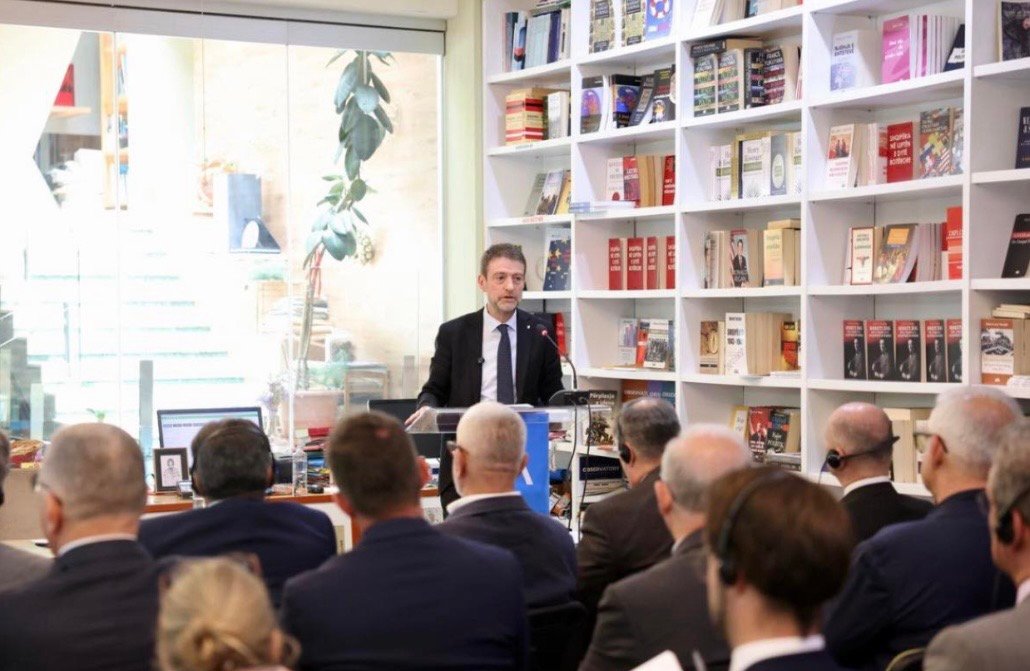
This is the speech delivered by Ferit Hoxha the Minister for Europe and Foreign Affairs at the Foreign Policy Forum of the Albanian Institute for International Studies on April 29, 2026.