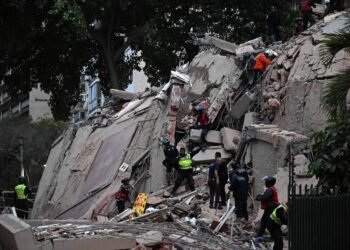
The biggest earthquake to achieve Caracas in more than a century found the capital of Venezuela with precarious infrastructure, partly the result of an economic crisis that has hit the country for more than a decade.
This Friday morning (26), around 36 hours after earthquakes of magnitude 7.2 and 7.5the authorities of the regime commanded by the interim leader, Delcy Rodríguezhad confirmed 920 dead. The tendency, however, is for the number to grow — the Geological Survey of United States calculates, based on a previously established technical scale, that there is a 42% chance that the total number of deaths will be between 10 thousand and 100 thousand.
The agency cites the precariousness of the affected area. “In general, the population of this region lives in structures vulnerable to seismic tremors, although there are resistant buildings. The predominant types of vulnerable construction are unreinforced brick masonry and adobe blocks”, states the service.
The situation is partly due to the economic situation of the population. According to Encovi (National Survey of Living Conditions, its acronym in Spanish), carried out by the Andrés Bello Catholic University, 55% of Venezuelans were in a situation of multidimensional poverty, which is calculated based on indices such as income, employment, housing and services, in May 2025.
Research on the urban distribution of Caracas is scarce, but in 2016, when the economic crisis was still beginning, a regime social program estimated that around 60% of the population lived in slums in the capital.
In recent years, several studies have demonstrated how the fragility of buildings could be dangerous during the occurrence of an earthquake. One of them, published in 2014 in the Revista da Faculdade de Engenharia da UCV (Central University of Venezuela), calculates the risks in Guarenas and Guatire — at that time, the main areas of expansion in the metropolitan region of Caracas.
According to the study, the death toll from a moderate to large magnitude earthquake that occurred at 2 am and hit both locations could kill almost 20,000 people. The authors state in the article that only 40% of the population of the municipalities studied lived in formal buildings. All informal constructions and more than half of the formal ones were highly vulnerable in an earthquake situation.
“Caracas is a city of ancient structures”, says Valentina Páez Hernández, master in earthquake engineering from UCV, to Sheet. She calculates that around 80% of the buildings predate the main standard for earthquake-resistant construction, drawn up in 1982. She stresses, however, that the situation was exceptional — the tremor was the strongest recorded in the country since 1900.
The text is a milestone as it was the first prepared with a more robust scientific basis, with the help of the Venezuelan Foundation for Seismological Research, in the aftermath of the 1967 earthquake. That year’s earthquake was of magnitude 6.3 and killed more than 200 people.
In addition to the precariousness of buildings, Venezuela is in a fragile situation in relation to basic services infrastructure in general.
This Thursday, the electricity grid was working in most of the country, but parts of Caracas and other affected cities, such as Catia la Mar and La Guaira, are without electricity — a situation that This is not news to Venezuelans.
Most of the country, including the capital, suffers blackouts daily. According to Encovi, only 10% of the population said they would never suffer power cuts in May 2025, the period in which the last survey was carried out. Of the remainder, 39% said they were without electricity for several hours a day — a number that reached a low of 8% in 2016, but which has since only grown until reaching its worst level in eleven years, in 2025.
Regarding piped water, the situation is also worrying. The percentage of people who have access to the service has reached 78%, a figure that was 85% in 2016. The frequency with which it works, however, is irregular: only 19% say they have running water daily and continuously, and 11% say they only have it once a week.
The scenario of lack of energy and water should affect the use of equipment and communication, hampering searches in the 48 hours following the event, essential to rescue survivors from the rubble.