Dubai will construct 31 new pedestrian bridges and tunnels across key roads over the next five years as part of efforts to improve road safety, encourage walking and cycling, and make journeys to public transport stations easier, the Roads and Transport Authority (RTA) announced on Monday.
The ambitious plan, covering 2026 to 2030, comes as pedestrian fatalities in the emirate have fallen by 98 per cent over the past 18 years, while the number of walking trips has climbed to more than 326 million annually.
Stay up to date with the latest news. Follow KT on WhatsApp Channels.
Mattar Al Tayer, Director General and Chairman of the Board of Executive Directors of the RTA, said the new bridges would strengthen an integrated network linking residential communities with business, tourism, and transport hubs across Dubai.
“Existing and planned pedestrian bridges form an integrated pathway network linking residential communities across Dubai with key destinations and encouraging residents to use sustainable soft mobility modes for first and last-mile journeys,” Al Tayer said.

The new crossings will be built at strategic locations, including Sheikh Zayed Road, King Salman bin Abdulaziz Al Saud Street, Al Ittihad Road, and Omar bin Al Khattab Street. Their locations were selected following detailed studies that examined population density, land use, proximity to major attractions, and public transport links.
The expansion reflects the rapid growth of Dubai’s pedestrian infrastructure. The number of pedestrian bridges and tunnels has increased from just 26 in 2006 to 178 by the end of 2025, a rise of 585 per cent. By 2030, another 31 crossings will be added to the network.
According to the RTA, the infrastructure has played a major role in improving safety. Pedestrian fatalities dropped from 9.5 deaths per 100,000 residents in 2007 to just 0.22 in 2025.
The authority also reported strong growth in active mobility. Pedestrian trips increased from 307 million in 2023 to 326 million in 2025, while cycling trips jumped 23 per cent, rising from 46.6 million in 2024 to 57.3 million in 2025. Resident satisfaction with Dubai’s pedestrian infrastructure currently stands at 88 per cent.
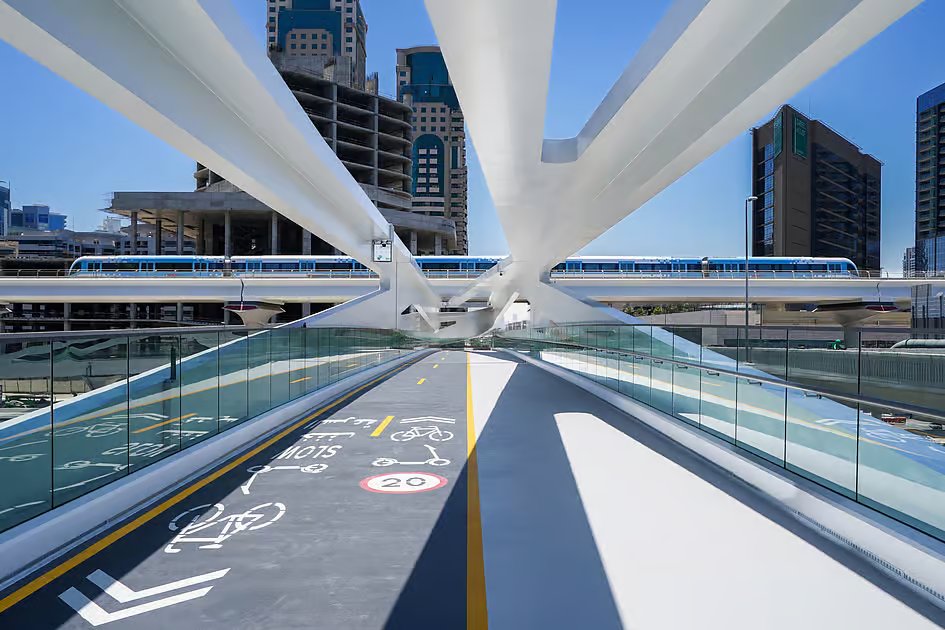
The RTA recently completed three pedestrian and cycling bridges, including two landmark structures on Sheikh Zayed Road and Al Khail Road. Designed with dedicated lanes for cyclists, e-scooters, and pedestrians, the bridges connect communities in Al Sufouh, Dubai Internet City, Barsha Heights, Al Barsha, and Dubai Hills.
The Sheikh Zayed Road bridge spans 528 metres. It features an architectural design inspired by themes of connectivity and continuity, while the Al Khail Road crossing spans 501 metres and incorporates elements that reflect sunlight and movement.
A third bridge in Al Quoz Creative Zone on Al Manara Street was built to improve connectivity within the district and to nearby attractions.
Meanwhile, three additional pedestrian bridges are currently under construction. Among them are two of the largest pedestrian and cycling bridges in Dubai.
One bridge at the Tunis Street–Al Nahda intersection on Sheikh Mohammed bin Zayed Road will connect Muhaisnah 1 with Al Twar and provide access towards Al Mamzar Beach. Another, spanning 730 metres across Dubai-Al Ain Road, will link Liwan in Wadi Al Safa 4 with Nad Hessa in Dubai Silicon Oasis.
A third bridge on Al Sukook Street is being developed as part of the Al Mustaqbal Street Development Project and is expected to be completed in the first quarter of 2027.
The RTA said the projects form part of Dubai’s Traffic Safety Strategy, which aims to achieve zero fatalities and reinforce the emirate’s position among the world’s safest cities for road users.