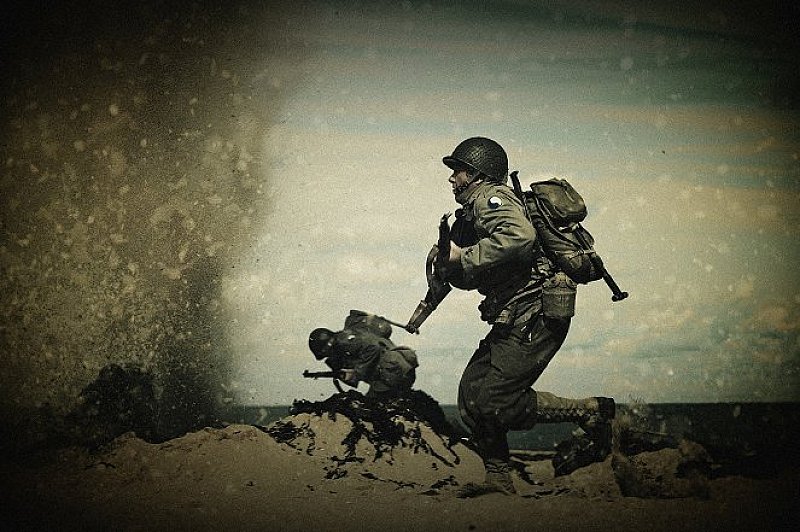
Scale of Operation: Involved nearly 160,000 troops, 7,000 ships, and 11,000 aircraft. By the end of August, the Allied forces fighting Hitler reached 2 million people.
The operation takes place in five main sectors along the Normandy coast:
– USA: “Utah” and “Omaha”
– Great Britain: “Gold” and “Sword”
– Canada: “Juno”
Historical Significance:
The Allied success led to the liberation of Western Europe and marked a turning point in the course of the war.
Decades later, however, British Prime Minister Winston Churchill’s expression that “Dictatorship’s war on freedom has no day off” – continues to be in effect.
***
This is the largest naval landing in history. Over 150,000 men were attacking a heavily defended bank on the west coast where Hitler had amassed a vast amount of troops and equipment. To capture the coast, the Allies used 7,000 boats and ships. It is the largest fleet in history used for such an operation.
In the sky, over 12,000 Allied planes meet the German planes.
In terms of logistics – planning, engineering and tactical execution – it is one of the most stunning achievements in military history.
What is the reality?
Hitler’s dream of a 1,000-year Reich was under dire threat in the early summer of 1944. Not from the west, where the Allies were preparing their invasion, or from the south, where Allied troops were making their way into Italy, but from the east.
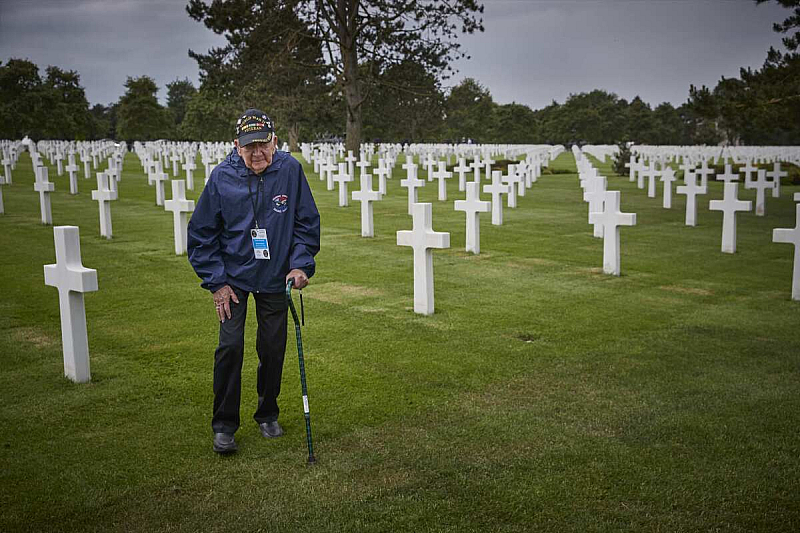
Let us not forget D-Day and those who died in the name of today…
The titanic battle between Germany and Russia from 1941 to 1944 was perhaps the most horrific and destructive conflict in history. Genocide and the whole range of war crimes have become the norm. Millions of men were killed or wounded as Stalin and Hitler waged a war of total annihilation.
In June 1944, the Soviets already had the upper hand. The front line that once ran through the outskirts of Moscow now shifted to Poland and the Baltic states. The advice seems overwhelming. Perhaps Stalin could have finished off Hitler without D-Day and the Allied advance from the west.
Maybe. But what is certain is that D-Day and the liberation of Western Europe that followed ensured Hitler’s downfall and provided security for much of Europe. Any hope that Germany could direct its entire war machine against the Red Army was dashed by the Western Allies with the Normandy landings.
Nearly 1,000,000 German soldiers, whom Hitler intended to transfer against Stalin, were forced to fight on the Second Front.
Diversion of German armies and divisions
In the fighting after D-Day, as the Germans desperately tried to stop the Allied invasion, they deployed the largest concentration of armored divisions anywhere in the world. If there was no Western Front, we can be sure that the battles in the East would have been even more bloody and success uncertain.
And another very important thing: if Stalin had ultimately won and defeated Hitler alone, Soviet forces, not the British, Canadians and Americans, would have “liberated” Western Europe. Holland, Belgium, Denmark, Italy, France, and other countries would have found themselves in the camp of Moscow, and one despot would have succeeded another despot.
The puppet communist governments that were installed in Eastern Europe would have their equivalents from Oslo to Rome. The world would be completely different and no better.
Importance of landing
D-Day hastened the destruction of Hitler’s empire and halted the genocide and crime it spawned. The landing ensured that liberal democracy would be restored in much of Europe. This, in turn, allowed countries such as West Germany, France, and Italy to contribute to the unprecedented economic boom that contributed to the advances in living standards that became a hallmark of the second half of the twentieth century.
D-Day, and the battles that followed, not only changed the course of World War II, but also world history.
Daniel Robert Snow
(British-Canadian popular historian and television presenter, founder of History Hit – the global History media network.)