Change font size:
The prime minister casts the widening unrest as a “hybrid war,” citing antisemitic narratives, claims about resettling Palestinians and AI-manipulated content.
Tirana Times, June 6, 2026 — Prime Minister Edi Rama has accused Iran of standing behind the growing protests in Tirana against the proposed Zvërnec tourism project, shifting the government’s response from an environmental and political dispute to a national security narrative.
Speaking on June 5 from Tivat, Montenegro, where he attended the EU–Western Balkans summit, Rama said the protests were not really about the environment but part of a “hybrid war.” “Behind the protest are the Iranians, who have been involved in attacks against Albania on other occasions as well,” he told reporters in Montenegro.
Later the same day in Vlora, he expanded the accusation, saying that anti-project propaganda had taken an antisemitic character, including claims that Palestinians from Gaza would be brought to Albania and that such narratives had circulated even in some mosques. According to Rama, images and videos generated or manipulated through artificial intelligence have been used to distort the project and inflame public opinion.
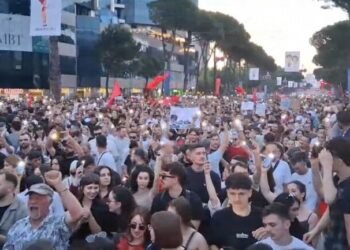
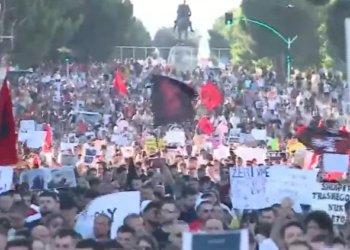
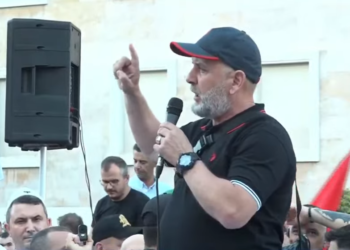
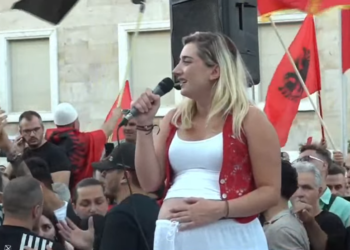
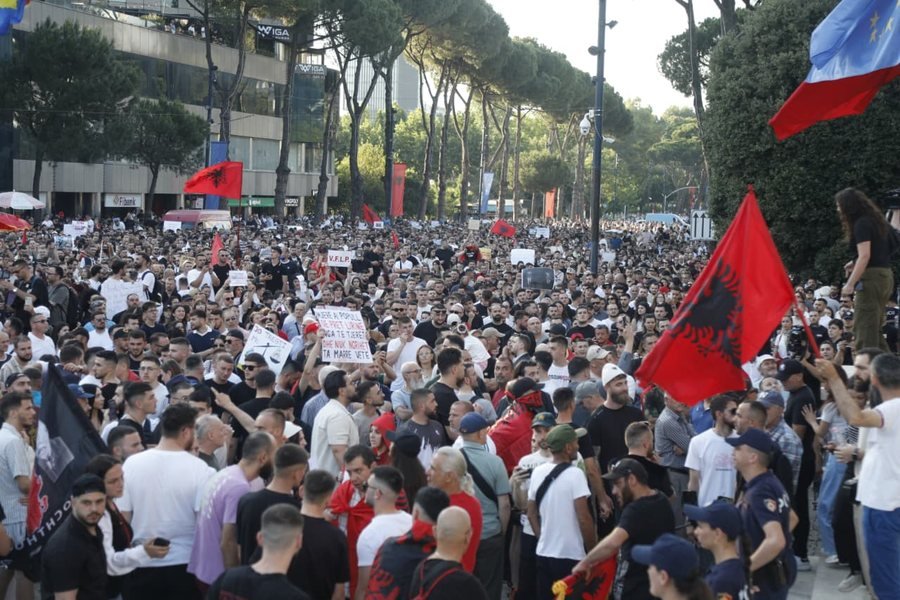
But Rama’s latest claim has entered a far more volatile domestic setting. By its sixth day, the Tirana protest had expanded beyond opposition to a resort project linked to Jared Kushner and the Trump family. Protesters have begun calling for the resignation of the government, the repeal of the strategic investor framework, the cancellation of changes to protected areas legislation and the reversal of other laws they say weaken public control over natural and cultural heritage. The movement, described by activists as the “Flamingo Revolution,” has drawn large numbers of young people and is not formally led by opposition parties.
The original trigger was local and visual: barbed-wire fences, private security forces and images of a protester being dragged away from the Zvërnec area. But the reaction quickly became national. For many Albanians, the episode touched older memories of exclusion, state arrogance and closed decision-making. It also revived current concerns over how public land, protected areas and strategic investments are managed in a country where corruption, political polarization and the influence of narrow economic interests remain persistent issues.
The government says the Zvërnec project is part of Albania’s effort to compete in high-end Mediterranean tourism and attract large foreign investment. Critics argue that the project symbolizes a governing model in which major decisions are taken with limited transparency, laws are changed to accommodate powerful investors, and local communities are asked to accept outcomes they had little role in shaping.
The protests have spread beyond Tirana to Vlora, Durrës and Elbasan, while diaspora demonstrations have been reported or announced in cities including Berlin, Munich, London, Stockholm, Brussels, Milan, Florence, Bologna, New York and Toronto. In Vlora, the protest remains closely tied to the fate of Zvërnec, Narta and the protected Pishë-Poro–Nartë landscape. In Elbasan, it has taken a more openly political tone, with calls for the government to step down.
That is what makes the moment politically important. The Zvërnec project may have been the spark, but the fire is being fed by deeper dissatisfaction with Albania’s post-communist transition. More than three decades after the fall of one of Europe’s most isolated communist regimes, many citizens still see the state as weak, captured or unresponsive. Albania has also experienced one of the most dramatic population losses in modern Europe through emigration. In the modern history of states, there are few, if any, comparable cases of a country losing nearly half of its population in peacetime. This is not simply migration; it amounts to a large-scale abandonment of the country.
What makes this reality even more alarming is the social and educational profile of the population that remains. According to Albania’s Institute of Statistics, 50 percent of men and 44 percent of women have only low or basic eight-year education. These figures point not only to demographic decline, but also to a profound weakening of the country’s human capital. The result is a society caught between mass emigration, low trust in institutions and a shrinking base of skilled citizens able to drive economic, social and democratic renewal.
For the government, framing the protests as part of a foreign-backed hybrid operation may help shift attention from the substance of the domestic grievances. For the protesters, however, Rama’s accusation risks being seen as another attempt to delegitimize a movement that has grown out of local anger but now reflects a wider crisis of trust. Whether or not foreign disinformation has played a role, the political force of the protests lies in the fact that they have connected the fate of a protected landscape with a larger question: who controls Albania’s future, and why so many Albanians no longer believe that future can be built at home.