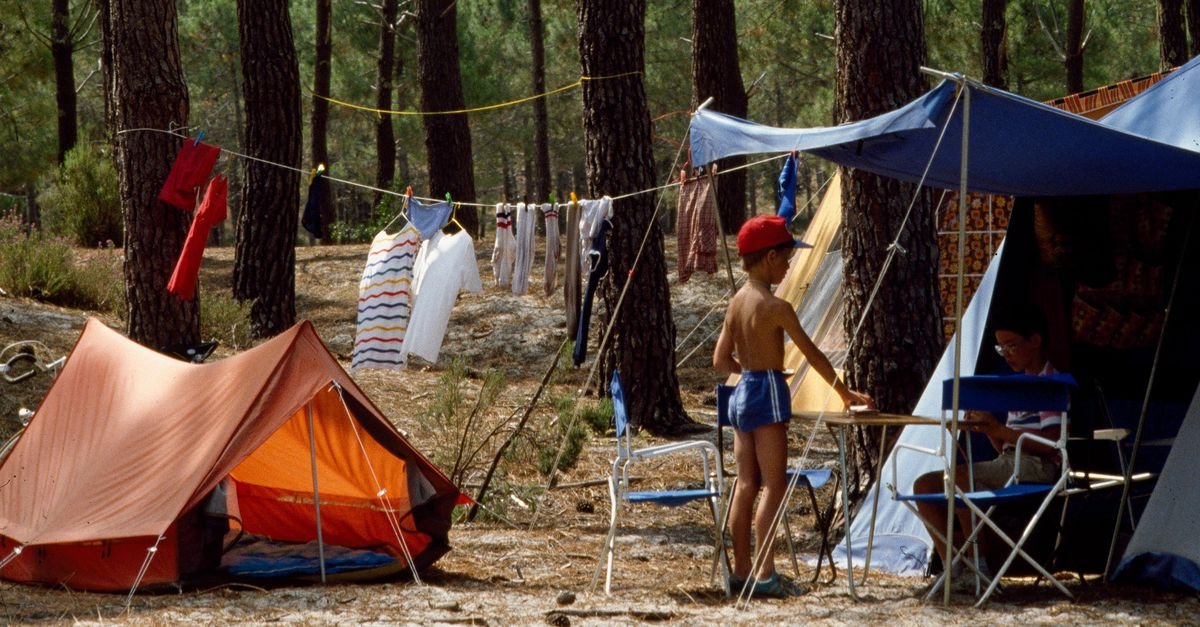
They were often small, second-hand Beetles or Dafs that were stuck in traffic jams at the border during the summer months. Fully loaded, sometimes large packs of luggage on the roof. They were anything but safe. The cars had been bought especially for a holiday and should not cost too much. There was often anything and everything wrong with it. But still they were on their way to the Côte d’Azur, on their way to adventure, the glamor of the French coast, and of course the beautiful weather.
While the Dutch moved south en masse in the 1970s, they have traveled the other way again. The current Dutch summer has increasingly resembled the French summer of yesteryear. In De Bilt, which is fairly representative of the Netherlands, the average temperature for a 24-hour period between 2010 and 2019 – measured from 00:00 to 24:00 – was 17.6 degrees. This is consistent, according to research by NRCwith temperatures in large parts of central France in the 1970s.
used for the analysis NRC data from Copernicus, the EU’s Earth observation programme. This divides the continent of Europe into boxes of about 30 by 30 kilometers. For each box, the Copernicus program calculates, among other things, the average temperature and the amount of precipitation in 24 hours. These data are available for the period from 1950 to last year.
NRC calculated the average temperature and precipitation for the summer months between 2010 and 2019 for the area around De Bilt. These were compared with all boxes throughout Europe in the 1970s: in which areas was the weather most similar to that in De Bilt in recent years? How did summer weather change due to climate change?
:strip_icc()/s3/static.nrc.nl/bvhw/files/2022/07/web-2307zatcamping.jpg|//images.nrc.nl/0Os2TRCHk3b8WAyW8woMhdhWp00=/1920x/smart/filters:no_upscale():strip_icc()/s3/static.nrc.nl/bvhw/files/2022/07/web-2307zatcamping.jpg|//images.nrc.nl/3V9uFyv5mWOoIpF99RIPeXJDT2M=/5760x/smart/filters:no_upscale():strip_icc()/s3/static.nrc.nl/bvhw/files/2022/07/web-2307zatcamping.jpg)
Endless camping summers in La douce France in the 1970s.
Photo Richard Phelps/Getty Images
This week was an example of that change. Anyone who had to go outside in the Netherlands, especially on Tuesday, sought the shade, from bathers who lowered themselves into the water next to the Scheveningen pier, to the painter who took a parasol into the aerial platform. In De Bilt temperatures were measured above 35 degrees; Since measurements began in 1901, this has only happened nine times. The chance of such warm days increases due to climate change, says KNMI climate researcher Peter Siegmund. This is not just a consequence of direct warming caused by greenhouse gases, he says. “In the summer there is also an increase in the amount of solar radiation in the Netherlands, because it is cloudy less often. The temperature also increases.”
Cooling off in the fountain
Now it is not the case that the seventies did not have warm summers. Who it digital archive searches from the Netherlands Institute for Sound and Vision, you quickly find images of full beaches, of campsites where tents and caravans were located in a “hut by mutje” according to the Polygoon news, of “city youth” who sought cooling in ponds and fountains. Sometimes it was so hot that “even the elderly did not hesitate” to dive into the fountain. “One thing is certain,” said the Polygoon news, “the summer of 1975 will go down in history as one of the warmest since climatological observations began in De Bilt.”
But the weather wasn’t always that good. Dutch people may have become accustomed to warm summers, but climate researcher Siegmund – himself a student in the 1970s – says he mainly remembers “rained-out youth holidays”. “We always went on holiday in the Netherlands, to Zeeland or Bergen aan Zee. Always rain.”
At 16.3 degrees, the average daily temperature in the Netherlands in the 1970s was indeed 1.3 degrees Celsius lower than in the 1910s. But it has actually started to rain more in the summer months: from a daily average of 1.9 millimeters back then to 2.7 millimeters in the 1910s.
In any case: you cannot simply say that the Dutch summers are ‘so’ wetter now, says Siegmund of the KNMI. Yes, on average more millimeters fall. But: it does not necessarily rain more often, the intensity of the showers has mainly increased. “That’s because it has become warmer. Warm air can hold more water vapor.” Result: more downpours, fewer drizzly days.
Travel south
The summer temperature in the Netherlands has risen by more than one degree in those fifty years. You could also say: the heat has traveled five hundred kilometers north. And that didn’t just happen in the Netherlands. Temperatures have moved north across Europe. In central France – which in the 1970s resembled today’s Netherlands – summers are now roughly as warm as in northern Spain in the 1970s, which in turn has reached the temperatures of southern Spain.
This is more complicated when it rains. Changes can also be seen there, but they are not all in one direction. There is more rain, especially around the North Sea – from Brittany to Norway, and also in the Netherlands. It has become drier further inland, while it remains just as wet around mountain ranges. Not surprising, says Peter Siegmund of the KNMI. “The wind hits air containing water vapor against the mountains, pushing it upwards. Higher in the air, the water vapor cools, and then it starts to rain.”
The KNMI expects that the Netherlands will become even warmer in the coming decades: in thirty years the country will resemble the France of today. Summers are slowly becoming drier – it rains a little more, but the heat causes even more moisture to evaporate. “As the soil becomes drier, it absorbs more heat. If a heat wave occurs, this means even higher temperatures than with less dried-out soil,” says Siegmund. This also happened in France, where it is warming up faster than in the wetter Netherlands. In 2050, the climate in the Netherlands all year round – not just in the summer – will be like that of today’s Bordeaux.
Video: Polygoon-Profilti/Netherlands Institute for Sound and Vision