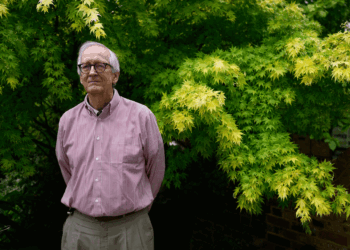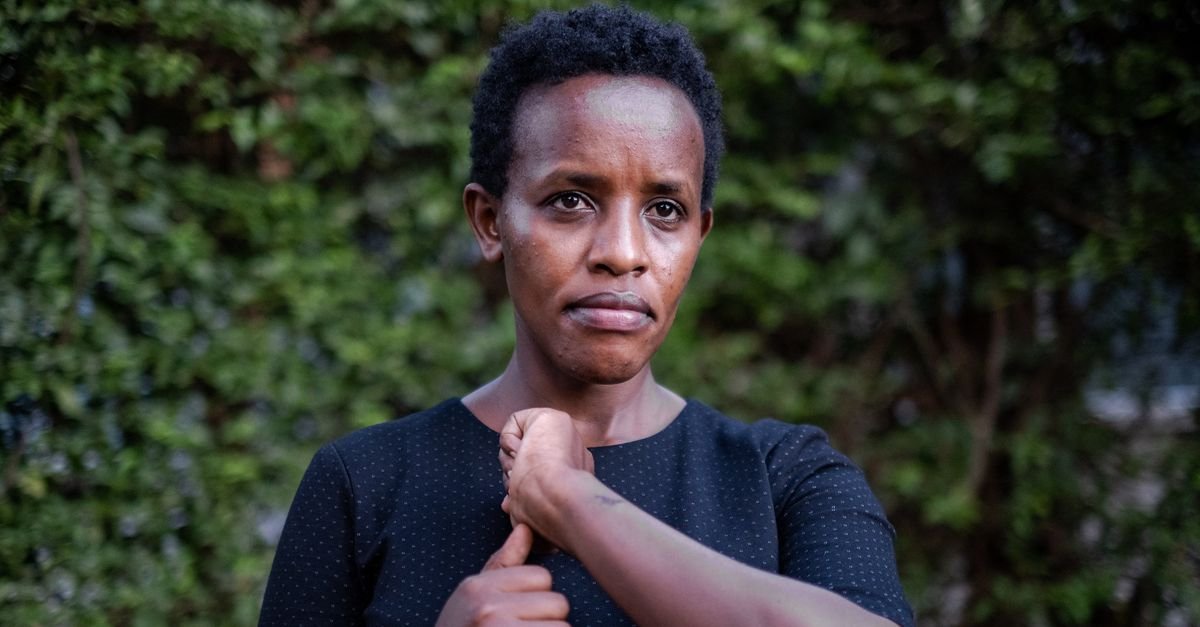
She is sitting and talking calmly in the garden of activist friend Nico Schoonderwoerd, where she is staying. But Agather Atuhaire (38), in a white T-shirt with a large stylized microphone on it, still feels “stressed”. The border guard at Schiphol probably did not think that a black woman from Uganda could have so many stamps in her passport, she says scornfully about what she calls a “racist” action by the military police. The night before she missed her plane home because of it.
“At Schiphol they said they wanted to check whether my passport was not forged. They didn’t ask me anything, spoke Dutch to each other, and made me wait twenty minutes. Even though they knew that I had little transfer time because my flight from Oslo was delayed. After I missed my flight and they had booked a new flight for the next day, one of those border guards, a young, arrogant guy, told me that I should sleep at the airport or take a hotel myself. At that moment I got a shooting pain in my chest. I sank to the ground, froze, couldn’t breathe, started crying, couldn’t speak. It felt like Tanzania all over againit must have been post-traumatic stress disorder. When this subsided, I called Nico.” Her involuntary stay in the Netherlands at the beginning of this month offers the opportunity for an interview about courage and the human rights situation in her region.
The lawyer and journalist Atuhaire, who heads the human rights organization Agora in Uganda, was in neighboring Tanzania a year ago to attend the trial of Tundu Lissu, the leader of Chadema, the country’s largest opposition party. He had been jailed for “treason”, an inflated accusation to prevent him from participating in the October 29 elections. Atuhaire wanted to show her solidarity and draw attention to Lissu’s plight. She had arranged to meet Boniface Mwangi, a well-known Kenyan activist and presidential candidate for the 2027 elections, who had come with the same goal.
Weeks on crutches
On May 19, shortly after arrival, both were taken from their hotel by the police, after which they were held for three days in an unknown location. There they were abused – they were hit hard on the soles of their feet – and raped with an object in the anus, as they describe in their complaint against Tanzania that they filed with the East African Court of Justice. Then they were dumped just across the border – Atuhaire in Uganda and Mwangi, who was still on crutches weeks laterin Kenya.
My fame won’t protect me. I learned that from Alexei Navalny
The secret services of the three neighboring countries work together to intimidate each other’s activistsMwangi and Atuhaire noted. The activists in the three neighboring countries also have a lot of contact with each other. She also had contact with Mwange about Schiphol. “Boniface called me and said: why didn’t they google your name at Schiphol? Then they would have known immediately who they were dealing with.” The military police had then seen that Atuhaire had received the Human Rights Defenders Award from the EU in 2023 and a year later the International Women of Courage Award from the American Department of State.
Does that fame help her work in Uganda, where critics of the regime can count on a lot of repression? Does it make her feel protected? She shakes her head. “I read the memoirs of (Russian activist) Alexei Navalny,” she says about it, published after his death Patriot: A Memoir. “He also thought he was too famous to be murdered. Yet it happened. That book was an eye-opener. A year after I read it I was kidnapped in Tanzania.”
:format(webp)/s3/static.nrc.nl/wp-content/uploads/2026/06/12103844/140626BUI_2034415181_2.jpg)
After her release, Agather Atuhaire showed her injuries to colleagues at a hospital in Kampala.
Photo AFP
Although the EU gave her an award, there was “no condemnation” from Brussels of what happened to her and Mwangi, she says. “Human rights violations are in any case much less condemned internationally. Look at Gaza. The dictators see that and know that they can go about their business undisturbed.”
The US finally responded: on May 22 they announced “personal sanctions.” against Faustine Jackson Mafwele, the police commander held responsible for the torture and rape of Atuhaire and Mwangi, and who ” thugsthe gangsters, came and tortured us. Mafwele is very unhappy about the sanctions, I hear from my Tanzanian friends, he says that the regime has thrown him ‘under the bus’, used him as a scapegoat. Of course he also carried out orders.”
Her organization Agora is nevertheless also affected by American policy. Agora received support from USAID, which allowed her to hire paid workers. Since President Trump dismantled the American development agency, its work has increasingly relied on volunteers. Despite this, Agora continues to make revelations about corruption in Uganda, one of the reasons she received the EU prize. The organization also published in April an extensive report about the violence in the run-up to and aftermath of the unfair trial elections from January 15 in Uganda.
Also read
The elections in Uganda still revolve around one question: will Museveni’s controversial son become president?
:format(webp)/s3/static.nrc.nl/wp-content/uploads/2026/01/13093943/130126BUI_2029757741_1.jpg)
House of opposition politician stormed
In particular, politicians and supporters of the largest opposition party, NUP, led by Robert Kyagulanyi Ssentamu, better known as Bobi Wine, were targeted by extrajudicial killings, arrests and kidnappings. These are carried out by soldiers or secret police, who travel in vans without license plates, called “drones”.
On election day, the army stormed the house of Bobi Wine, who managed to escape. He went into hiding for a long time and then moved to the US because he fears for his life. Muhoozi Kainerugaba, the son of President Yoweri Museveni and head of the Ugandan army, tweeted at the time that Wine was wanted, “dead or alive.” He also threatened to “castrate” Wine – in messages on X that have since been deleted.
Many of the incidents described in Agora’s report took place on election day and the days after, Atuhaire says. “The authorities were afraid that people would protest against the results. There were about a thousand arbitrary arrests. If you stood together with five friends, you could be arrested.” The report gives 374 names of people who this happened to, and against whom accusations such as “disturbing public order” or “calling for violence” followed.
More serious are the 21 incidents in the report that resulted in fatalities. On election day, Atuhaire describes one of the examples, soldiers stormed the home of Muwanga Kivumbi, vice-chairman of the NUP and candidate for parliament. His house in Butambala, eighty kilometers south of Kampala, was full of his supporters who wanted to wait for the results.
“The soldiers opened fire on those present, who ran to Kivumbi’s garage and closed the door. But the soldiers shot right through it. According to some witnesses, twelve people were killed, others say fifteen. Because we only want to present facts based on interviews with family members, we only mention the names of seven fatalities. But there were certainly more.” Police said they only shot “in self-defense” and blamed Kivumbi for the violence. “He is still in custody on charges of terrorism.”
It is important that political prisoners like him are released, says Atuahaire. “That is one of our biggest priorities. Yet you can at least say that it is known where they are staying. This does not apply to the missing. At least eighteen NUP members who disappeared around the previous elections, in 2021, are still missing.” She shows small portraits of them on her phones, distributed via social media. “We continue to draw attention to their fate.”
Fellow activists lived in uncertainty about Atuhaire’s own fate for three days last year. She reminisces about the five Tanzanian ones thugs who took her to the Ugandan border after her captivity and torture. “The woman in the group wanted me not to tell anything about what had happened to me. ‘What happened in Tanzania stays in Tanzania,’ she said. ‘Do you really think you have the right to silence me about everything that happened to my body?’ I replied. ‘If that’s what you want, you have to kill me.’ Fortunately, it stayed at that.” After a short pause: “I will never remain silent about human rights violations.”